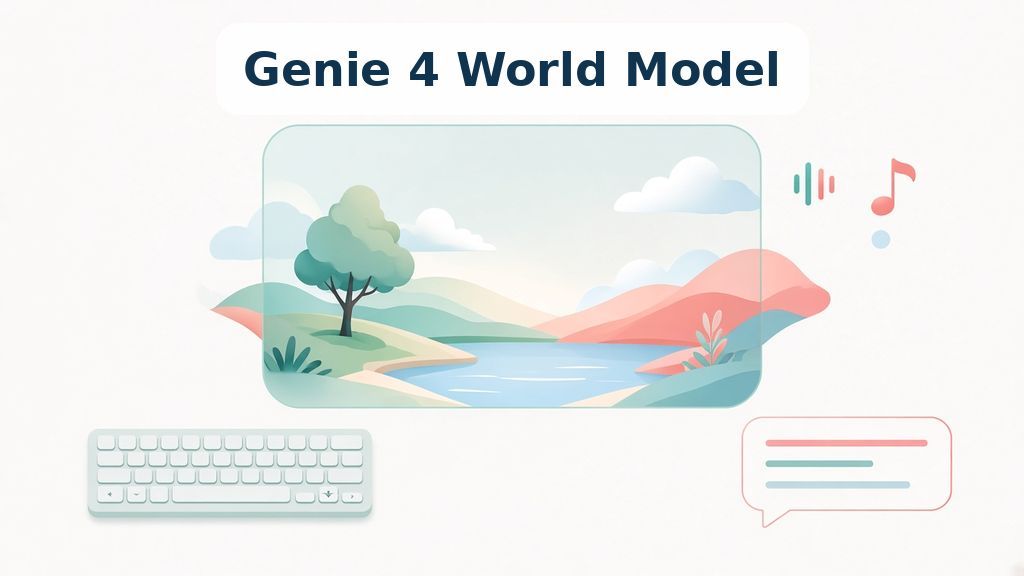
Video games let players walk through worlds that artists built by hand. Each tree, sound, and character takes hours of work. Now Google DeepMind says an AI model can build such worlds on the fly. On October 27, 2026, the company announced the Genie 4 world model. According to Google, users can steer a scene with keyboard keys and typed prompts. For example, they can change the weather, move the camera, or add a new person. In addition, the model creates matching sound, music, and dialogue as the world unfolds. Raia Hadsell, Diego Rivas and Hang Qi wrote the Google DeepMind announcement. Google also summarized it on its company blog. So far, no journal has published a peer-reviewed paper on Genie 4. As a result, every result in this article is company-reported. Even so, the release shows where interactive AI may head next.
A world model is an AI system that predicts how an environment changes. Think of it as a simulator that learns from data rather than from hand-written rules. Google DeepMind calls world simulation a crucial step toward general intelligence. That is the company’s view. It also links Genie 4 to safe training spaces for robots and AI agents. Robots learn slowly and expensively when mistakes happen in the real world. In contrast, a simulated world lets a machine fail many times without breaking anything. Peer-reviewed work backs this idea. A fusion controller trained in simulation then ran on real hardware (Degrave et al., 2022). For instance, ENTECH has covered a quadruped robot learning to walk inside AI simulations first. Even so, building such worlds in real time remains hard. At the same time, the model must stay stable and believable.
Lessons From Earlier World Models
Earlier peer-reviewed work on world models (Hafner et al., 2025) described DreamerV3. That system learned a world model and then practiced inside its own predictions. As a result, one fixed configuration of settings handled over 150 different control tasks. It also became the first algorithm to collect diamonds in Minecraft without human data. Simulation also helps physical robots. A drone trained mostly in simulation won races against world champions (Kaufmann et al., 2023). Genie 4 pursues a fundamentally different objective, though. Rather than training one agent, it generates detailed, steerable environments for exploration. In other words, it emphasizes realistic visuals and sound, not only control. As a benefit, that richness could make simulations feel closer to real life. By contrast, richer worlds are harder to keep consistent over time. Google’s own limits section, covered below, admits this tension quite openly.
How the Genie 4 World Model Works
Google describes Genie 4 as natively multimodal. In plain terms, one model produces video and audio together, rather than adding sound later. The model builds on Google’s Gemini family of AI models, according to the announcement. In particular, Gemini Omni anchors the scenes in real-world appearance and behavior. Other Gemini models supply the reasoning that keeps a simulation coherent. During use, a person moves with standard keyboard controls and steers events with text prompts. Gemini then adapts each prompt to fit the surrounding scene, Google says. Between inputs, Gemini also watches the scene and keeps it moving forward. Users can also set an event in motion and let Genie 4 simulate what follows. That includes how the world responds, how it sounds and how people react. The idea resembles a digital twin. However, Genie 4 invents scenes instead of copying real factories.
Gemini as a Guide Inside the Loop
For complex, multi-step events, Google adds a planner to the loop. Here, Gemini 3.8 Flash acts as a guiding agent while Genie 4 renders frames. To begin with, Gemini breaks a goal into a sequence of steps. Next, it reviews incoming frames to track progress and confirm each step. If the user steps in, Gemini then changes its plan on the spot. This setup echoes the planner-and-checker design behind BrainBody-LLM for robots. Google also pairs Gemini 4 Argon with Genie 4. In one demo, Argon splits a task into steps for a simulated Apptronik Apollo humanoid. The robot then plays checkers inside the generated world. Google feeds these steps to Genie 4 as text captions while it renders. In this way, the simulation adapts as it moves toward the task goal. Google calls this a path toward simulating many robot scenarios.
Fig. 1: How Gemini Guides a Genie 4 World
What Google Reports for the Genie 4 World Model
According to the announcement, Genie 4 advances four main abilities. These are real-time steering, physics and human motion, sound, and complex events. First, Google says the model simulates physics scenarios such as aerodynamics and collisions. Demos include a falling maple seed and a watermelon on a stone plinth. Next, the company highlights digital people who move and react to their surroundings. Google calls this its most dramatic leap. Yet it offers no supporting measurements. Neither page gives frame rates, image resolution, session length or accuracy scores. In the same way, no outside group has tested the model or published a benchmark. Because of this, readers should treat the demonstration videos as carefully curated examples. They show what the system can do at its best, not typical performance. Company phrases such as “unprecedented realism” stay claims until independent studies check them.
Sound and Speech in a Genie 4 World Model
Audio marks a clear first, according to Google. The company calls Genie 4 its first real-time world model that generates audio natively. Every world carries the ambient sound of its setting. For example, users may hear wind in trees or waves crashing on a beach. Beyond that, characters can hold interactive dialogue that changes as events unfold. They talk and react to user inputs in real time, Google says. Sound adds a lot to how real a scene feels. However, it also adds another layer that must stay in sync with the picture. Google itself lists real-time audio accuracy as an open research problem. Testers in creative industries are already experimenting with the tool, the company reports. For instance, filmmakers use it as a draft mode to rehearse camera angles and dialogue. Meanwhile, game developers test visual styles before writing engine code.
Limits Google Lists for Genie 4
Google describes Genie 4 as an early, experimental model. According to the company, it keeps scenes coherent over short sessions. Over longer runs, however, visual details and object permanence can drift. Object permanence means an object stays identical when the viewer looks away and returns. Drift increases after numerous complicated prompt edits or extensive camera movement through environments, Google notes. In addition, the company lists several areas still under research. These include complex physical interactions, legible text and spatial accuracy. Real-time audio accuracy and long-term consistency also remain unresolved research problems today. Because of these limits, Genie 4 cannot yet reliably replace real-world testing. A robot trained in a drifting simulation could learn inaccurate physical lessons. For that reason, Google is releasing the model slowly and gathering feedback first. Independent testing will show how serious these limits are in practice.
Business Uses and Rollout Plans
Google says Genie 4 has reached a limited group of trusted testers. Later, Google AI Ultra subscribers will get it in Project Genie, says the Google blog. Early-access partners in the Gemini API and Google AI Studio will follow. Neither page gives a date or any pricing. For business, the testers point to several possible markets. Studios could pre-visualize scenes, while game teams could prototype ideas in seconds. Photojournalists are exploring how one archival photo could become an explorable scene. Enterprise partners are also testing it for quick scenario generation, Google says. Looking further ahead, Google sees promise in hybrid world models. These would join the logic of code and language models with pixel-level simulation. In that plan, Gemini maps the structure while Genie renders what the world looks like. Whether this produces lasting products depends on quality, safety and independent testing.
Careers Linked to Genie 4 World Models
Systems like this need many kinds of skilled professionals working together. Machine learning engineers design and train the models that generate each frame. At the same time, robotics engineers use simulations to test robot plans before real trials. Game developers and technical artists shape the worlds and their visual styles. In turn, audio engineers help judge whether sound matches the action on screen. AI safety specialists test models for harmful output and plan careful releases. For teens, useful school subjects include computer science, mathematics and physics. Probability and linear algebra underpin machine learning. In addition, physics helps people judge whether a simulated collision looks right. College majors such as computer science, robotics and digital media all fit this field. Students can also build simple games or physics simulations at home today. As well as that, small Python projects teach AI basics.
Safety, Watermarks and Next Steps
Realistic synthetic video raises serious concerns about public trust. Google says Genie 4 follows strict safety guardrails that match its other models. Before the preview, the company ran internal safety evaluations against harmful or malicious content. Every video and audio clip from Genie 4 will also carry SynthID, Google reports. SynthID is an invisible digital watermark that helps identify AI-generated content. A peer-reviewed study tested SynthID on AI-written text (Dathathri et al., 2024). It covered nearly 20 million Gemini responses. Even so, it did not cover video or audio. So Genie 4’s watermark claims still await outside checks. After that, Google plans to collect tester feedback before a broader release. Labels also matter for AI developers. Training models on unlabeled AI output can cause lasting defects (Shumailov et al., 2024). Until then, the public can judge Genie 4 mainly through the company’s own posts.
Fig. 2: Key Takeaways From the Genie 4 Preview
Conclusion: A Preview That Needs Testing
Google DeepMind’s Genie 4 world model points to a new kind of interactive simulation. According to the company, users steer live worlds with keys and text. Meanwhile, the model adds native sound, music, and dialogue. Gemini models plan multi-step events and check each step, Google says. Taken together, these features could help robot training, film planning and game design. At the same time, every result so far comes from Google’s own announcement. No peer-reviewed paper, benchmark or independent test exists yet. Google also admits drift over time, weak text rendering, and unsolved complex physics. For now, Genie 4 remains a research preview for trusted testers. As a result, the fairest view is cautious interest rather than firm conclusions. Students who study AI and its evaluation will be ready for this field. In short, the next chapter belongs to careful, independent measurement.
References
Dathathri, S., See, A., Ghaisas, S., Huang, P.-S., McAdam, R., Welbl, J., Bachani, V., Kaskasoli, A., Stanforth, R., Matejovicova, T., Hayes, J., Vyas, N., Al Merey, M., Brown-Cohen, J., Bunel, R., Balle, B., Cemgil, T., Ahmed, Z., Stacpoole, K., . . . Kohli, P. (2024). Scalable watermarking for identifying large language model outputs. Nature, 634(8035), 818–823. https://doi.org/10.1038/s41586-024-08025-4
Degrave, J., Felici, F., Buchli, J., Neunert, M., Tracey, B., Carpanese, F., Ewalds, T., Hafner, R., Abdolmaleki, A., de las Casas, D., Donner, C., Fritz, L., Galperti, C., Huber, A., Keeling, J., Tsimpoukelli, M., Kay, J., Merle, A., Moret, J.-M., . . . Riedmiller, M. (2022). Magnetic control of tokamak plasmas through deep reinforcement learning. Nature, 602(7897), 414–419. https://doi.org/10.1038/s41586-021-04301-9
Hafner, D., Pasukonis, J., Ba, J., & Lillicrap, T. (2025). Mastering diverse control tasks through world models. Nature, 640(8059), 647–653. https://doi.org/10.1038/s41586-025-08744-2
Kaufmann, E., Bauersfeld, L., Loquercio, A., Müller, M., Koltun, V., & Scaramuzza, D. (2023). Champion-level drone racing using deep reinforcement learning. Nature, 620(7976), 982–987. https://doi.org/10.1038/s41586-023-06419-4
Shumailov, I., Shumaylov, Z., Zhao, Y., Papernot, N., Anderson, R., & Gal, Y. (2024). AI models collapse when trained on recursively generated data. Nature, 631(8022), 755–759. https://doi.org/10.1038/s41586-024-07566-y
Editorial note
World models are moving from research labs into tools that studios, robot makers and AI developers may soon use. We are running this story because Genie 4 joins live video, sound and text control in one system, and because Google links it to robot and agent training. That makes it a useful window into where AI jobs are heading: machine learning, simulation, game design, audio and safety testing. We are treating it with more caution than our usual journal stories. The only sources are Google's own announcement pages, so every claim must be clearly attributed to Google DeepMind. Takeaway: students who learn both how AI models work and how to test them will be ready for this field.
Reviewer's comment
I checked the brief against both Google pages, and its facts match them: the October 27, 2026 date, keyboard and text steering, native audio, Gemini Omni and Gemini 3.8 Flash roles, the Apollo checkers demo, the trusted-tester rollout, and SynthID. The company curates the demo videos. The statement that simulation is "a crucial step toward AGI" is a company view, not a finding. The article should give the stated limits equal weight: drift in object permanence over time, and unsolved complex physics. Avoid any cost or access-price claims; neither page gives prices. Verdict: accurate, publishable with clear attribution and caveats.
Charudatta Pathak was a student at St. Aloysius High School in Bhusawal, established in 1874, making it one of India's oldest convent institutions. He earned his bachelor's degree in mechanical engineering from SSVPS College of Engineering, Dhule in 1995, demonstrating exceptional academic achievement. Thereafter, he launched his career as a CNC programmer in a toolroom. He has utilized FANUC, Deckel, Maho, and Mikron controllers to operate 2-axis and 3-axis machines for the fabrication of jigs, fixtures, dies, and molds. He commenced his career as an academic in 1996, when he assumed the role of lecturer at SSVPS College of Engineering, Dhule. Additionally, he earned his post-graduate degree in CAD/CAM from L. D. College of Engineering, Ahmedabad, in 2000, and then acquired a Ph.D. from COEP in 2011 while concurrently engaged in teaching. Until 2023, he occupied many academic roles, including lecturer, assistant professor, professor, dean, principal, director, and vice chancellor at both public and private universities throughout India. From 2008 to 2010, he served as the project lead in the CAE department of a European multinational firm. During his 28-year professional tenure, he identified a need for dependable books targeted at students in grades 8 to 12, particularly for nascent career planning. He founded ENTECH Digital Magazine, a free monthly publication available on entechonline.com and magzter.com. Teens with a strong interest in Science, Technology, Engineering, and Mathematics (STEM) who aspire to pursue careers in these fields may find ENTECH Digital Magazine beneficial.