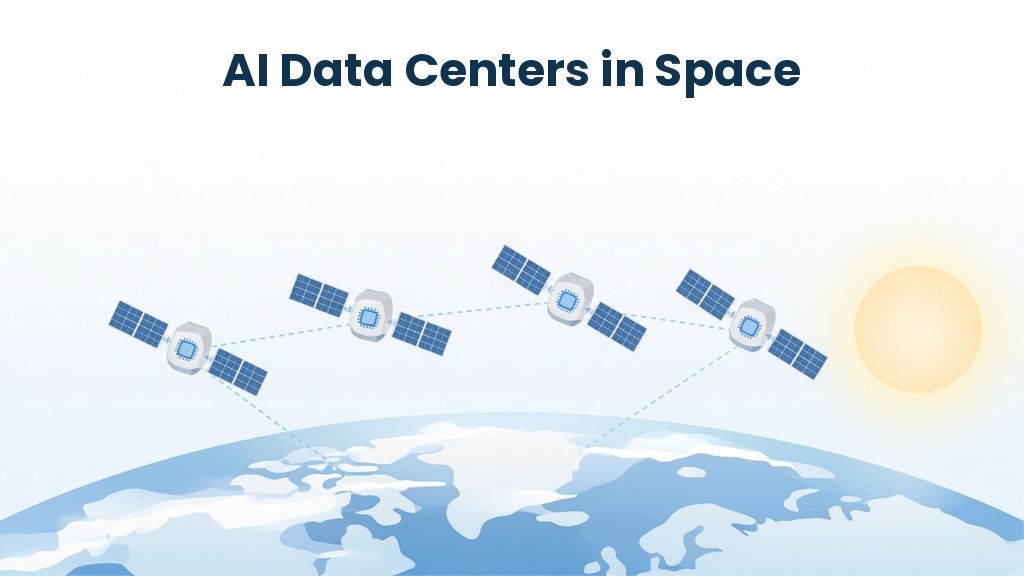
Every time you ask a chatbot for homework help, a distant computer does the work. In fact, those computers occupy enormous facilities called data centers. They also consume enormous amounts of electricity, and AI keeps asking for more. Consequently, engineers keep searching for abundant, cleaner energy sources. Now, a Google team has studied an ambitious alternative. They designed AI data centers in space that run on nearly continuous sunlight.
Blaise Agüera y Arcas, Travis Beals and Jessica Bloom helped lead the work. James Manyika and five other Google LLC researchers joined them. The team published its design study in the journal Joule in 2026. Readers can find it through DOI 10.1016/j.joule.2026.102678. Google calls the effort Project Suncatcher. In addition, a prototype satellite reached orbit on October 1, 2026. By late October, its AI chip had already written a short poem in space. In short, the idea has moved from paper sketches to a real test.
Challenges and Motivation Behind AI Data Centers in Space
AI models need enormous computing power, and that power needs energy. In fact, Google has made artificial intelligence dramatically more efficient. For example, energy use per Gemini query fell 33 times in one year. Even so, total demand for AI computing keeps climbing fast. On Earth, data centers compete for land, power lines and cooling. For instance, engineers already develop energy-efficient cooling methods for these facilities. Meanwhile, the Sun offers a nearly limitless supply of energy. According to the paper, it emits 3.86 × 10²⁶ watts. That is over 100 trillion times humanity’s total electricity production. As a result, the authors explored placing AI chips directly in sunlight. Accordingly, they examined whether orbital solar power could supplement terrestrial computing. The paper calls this long-term project a research “moonshot.” In other words, success is uncertain, but the payoff could be very large. For this reason, the team mapped every major hurdle first.
The Energy Case for AI Data Centers in Space
Terrestrial solar panels face clouds, nighttime and seasonal variation. In certain orbits, however, panels see nearly continuous sunshine. According to the study, they can collect up to eight times more energy each year. That comparison uses a panel at Earth’s mid-latitudes. To get this benefit, the team picked a special path called a dawn-dusk orbit. In this orbit, satellites ride the boundary between day and night. As a result, they stay in sunlight almost all the time. They would also need fewer heavy batteries. Consequently, each satellite could generate electricity almost continuously throughout the year.
Transmitting solar power back to Earth has always proven difficult. Instead, Suncatcher moves the computing up to the power source. Only the computed answers travel back to Earth as digital data. On the other hand, space brings its own problems, such as radiation and heat. In addition, satellites must talk to each other at enormous speeds. The Joule paper tackles each of these challenges in turn.
Science Explained: How a Satellite Data Center Works
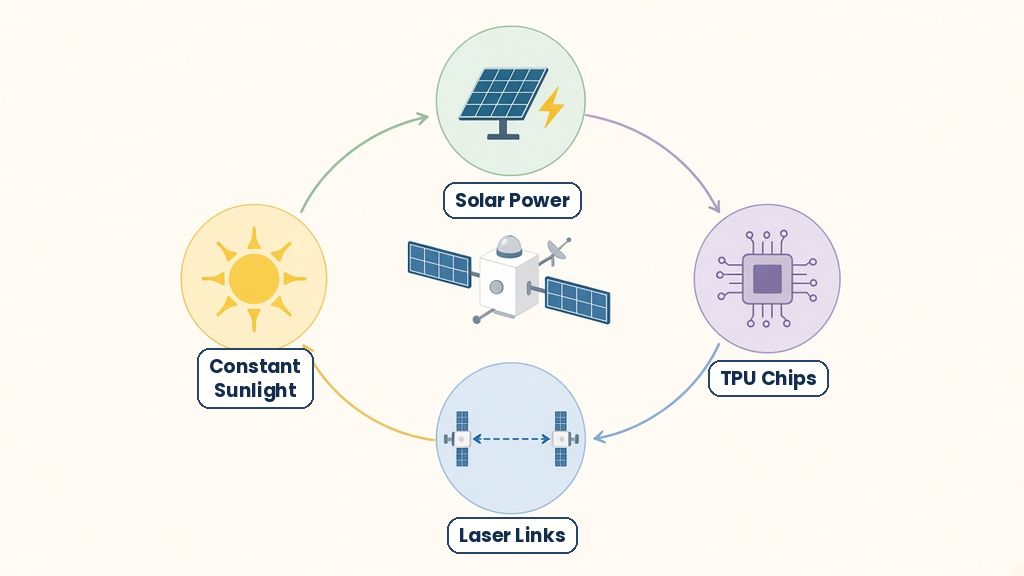
Picture a conventional data center divided into many small orbiting pieces. Each satellite carries solar panels, computer chips and a radiator for cooling. The chips are Google’s Tensor Processing Units, or TPUs. A TPU is a chip built specifically to run machine learning math. Google has also designed other custom chips for data centers, such as Axion. In the design, dozens of satellites fly in a compact formation called a cluster. Together, the cluster acts like one large computer. To make that work, satellites must share data almost instantly. For that reason, they talk using laser beams instead of radio waves. Engineers call these free-space optical links. Meanwhile, a heat pipe and radiator system carries waste heat away. In particular, the chip memory must stay below about 90 °C. Altogether, the design combines power, chips, cooling and fast communication links. The diagram below shows how these pieces fit together.
Fig. 1: How a Satellite Data Center Works
Laser Links Between Close-Flying Satellites
Inside a data center, chips share data through cables at very high speeds. In space, lasers must perform that function across empty distance. According to the paper, each link needs roughly 10 terabits per second. In other words, one terabit equals a trillion bits, or ones and zeros. By comparison, today’s commercial satellite links reach about 1 to 100 gigabits per second.
To close that gap, the team used a multiplexing trick from fiber networks. It sends many colors of light through one beam at once. In a bench test, the team reached 800 gigabits per second one way. That equals 1.6 terabits per second in both directions combined. However, laser signals weaken quickly over long distances. As a result, satellites must fly only hundreds of meters apart. Consequently, closer spacing dramatically strengthens the received optical signal. For ground links, NASA’s TBIRD laser mission reached 200 gigabits per second in 2023. Even so, ground links still need much more work.
Radiation Tests on Trillium TPUs
Energetic space radiation can damage computer chips or corrupt stored information. So the team fired a 67 MeV proton beam at a Trillium TPU. The term MeV stands for million electron volts, a unit of particle energy. In orbit, behind shielding, each chip would absorb about 150 rad per year. A rad measures how much radiation energy a material absorbs. As a result, a five-year mission adds up to about 750 rad. The chip’s memory showed the first problems after 2,000 rad. That is almost three times the five-year requirement. Moreover, other tests kept running correctly up to 10,000 rad.
Not only did the chip avoid hard failures, but its errors also stayed rare. Silent errors would hit about once per three million AI answers. In other words, running trained models looks practical. Training new models, by contrast, needs more study because hidden errors can spread. Therefore, the team considers inference the most realistic early application.
Key Findings and Next Steps for AI Data Centers in Space
Flying satellites so close together brings its own puzzle. As a test case, the team modeled 81 satellites in a cluster. The cluster spans a radius of one kilometer at 650 kilometers altitude. Neighboring satellites would remain about 100 to 200 meters apart. Earth’s uneven gravity continuously distorts the formation’s geometry. Even so, the models showed the formation repeats a stable pattern. Keeping it in shape would need only small thruster burns.
Specifically, satellites would need less than 30 meters per second of velocity change annually. Above all, cost remains the other major question. Rocket prices have decreased as reusable vehicles fly more frequently. Based on SpaceX’s past trend, launch could fall below $200 per kilogram around 2035. That would require about 180 Starship launches each year. At that price, space power could roughly match US data center energy costs. However, the authors stress this is not a full economic analysis. In addition, it still needs huge advances in launch rates.
Hello World From the Prototype Satellite
Google then moved from paper to hardware. A prototype satellite, built with the company Planet, launched on October 1, 2026. It rode a SpaceX rideshare mission called Transporter-18. Travis Beals, a Senior Director at Google, described the goal in a blog post. “Some things can only be tested in space,” Beals wrote. After weeks of careful commissioning, the team reached its “Hello World” milestone. Google called it “the first-ever AI response from a data center class TPU in orbit.”
Engineers uplinked a prompt to Gemma 4, an open AI model on board. In response, the model wrote a haiku about being in space. The poem arrived as the satellite traveled over Svalbard, Norway. Next, the team will test how TPUs handle heat stress and radiation in orbit. After that, Google plans twin linked satellites in 2027. “Our chips have officially earned their space wings,” Beals wrote in an October 30 update.
Careers and Open Problems for AI Data Centers in Space
Several difficult engineering problems remain before any complete cluster operates. First, engineers must remove heat without air or water to carry it away. Second, crews cannot easily repair broken hardware in orbit. Third, faster laser links to ground stations still need development. In addition, large constellations must avoid creating space debris. The authors also say a full life cycle assessment is still missing. Such a study would count emissions from building and launching every satellite. As a result, nobody can yet say if the plan helps the climate overall.
At the same time, these gaps create many career paths. Aerospace engineers design orbits, propulsion systems and radiators. Meanwhile, electrical engineers build chips and laser communication systems. Physicists study radiation effects on electronics. Similarly, materials scientists develop lightweight radiators and durable solar panels. Computer scientists write software that identifies and corrects hidden errors. In the meantime, students can prepare through physics, calculus and programming.
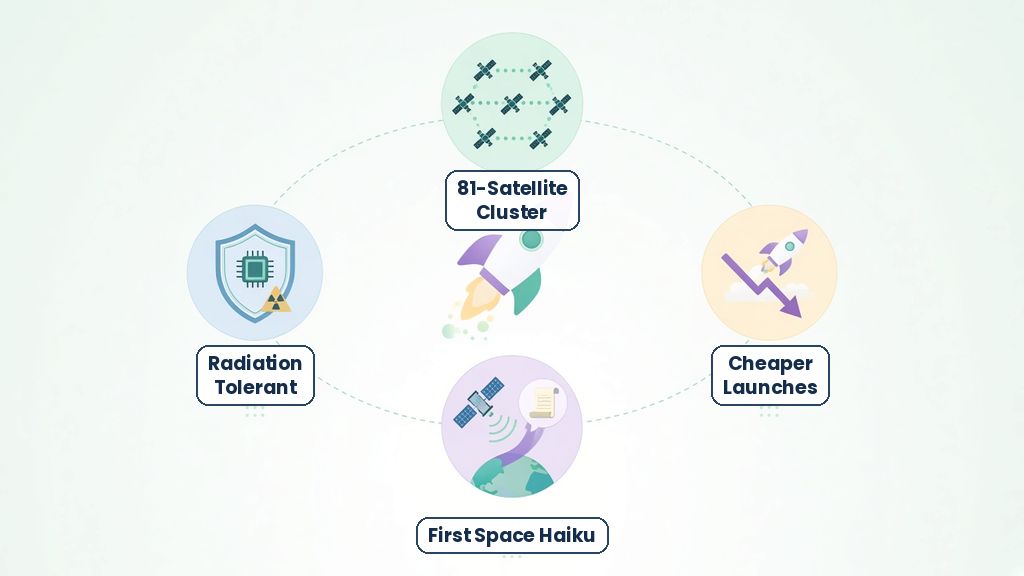
Fig. 2: Key Takeaways From Project Suncatcher
Conclusion: Sunlight, Chips and a Long Road Ahead
Project Suncatcher asks whether AI data centers in space can someday work at scale. The Google team identified no fundamental physical barrier preventing the idea. Its lab tests showed laser links reaching 1.6 terabits per second. In addition, Trillium TPUs survived radiation doses well beyond a five-year mission. Orbit models also showed that tight satellite clusters can stay together. Better yet, the first prototype satellite already ran an AI model in orbit.
On the other hand, major hurdles remain. Heat removal, maintenance, ground communication and debris all require solutions. Launch prices must also fall sharply for the economics to work. Moreover, no full life cycle assessment exists yet. Eventually, practical demonstrations will decide whether orbital computing becomes economically realistic. Even so, the peer-reviewed study gives engineers a clear roadmap. Next, twin satellites in 2027 will test the laser links in space. In the long run, sunlight could help power the computers behind everyday AI.
References
Agüera y Arcas, B., Beals, T., Biggs, M., Bloom, J. V., Fischbacher, T., Gromov, K., Köster, U., Pravahan, R., & Manyika, J. (2026). Toward a future space-based, highly scalable AI infrastructure system design. Joule, Article 102678. Advance online publication. https://doi.org/10.1016/j.joule.2026.102678
The story is accurate to its sources and keeps a cautious tone. Quotes match the Google posts word for word. One item needs a final check before publishing: the PDF lists both a 2026 citation line and a February 17, 2027 issue date, so confirm the Joule volume and year.
This article explains Google's Project Suncatcher for high school readers. It summarizes a peer-reviewed Joule study proposing solar-powered satellite clusters that carry Google TPUs and talk through free-space laser links. Every number comes from the paper or from Google's October 1 and October 30, 2026 posts, which report the prototype launch and its first AI response from orbit. Cost statements stay within the paper's own learning-curve estimate and its caveat that this is not a full economic analysis. The article also lists the open problems the authors name: heat removal, repairs, ground links, debris and a missing life cycle assessment. Readers should treat the concept as early-stage research, not a working product.
Aditya Joshi is an SDE Intern at Coneixement India, the company behind ENTECH STEM Magazine and STEMQuiz. He is a Computer Engineering graduate from Savitribai Phule Pune University (SPPU), with honours in Machine Learning and Data Science. His academic background and hands-on project experience have developed his interest in artificial intelligence, emerging technologies, software development, and the practical applications of computing.
His areas of technical interest include Artificial Intelligence (AI), Generative AI, Machine Learning, Data Science, Large Language Models (LLMs), Natural Language Processing (NLP), Retrieval-Augmented Generation (RAG), GraphRAG, and knowledge graphs. Through projects involving locally hosted language models, Neo4j knowledge graphs, multilingual chatbots, and AI-powered analytics, he has explored how emerging technologies can be used to solve practical problems.
Aditya's professional experience includes work in frontend development, AI/ML application development, and full-stack software projects. During his internships at Maharashtra Knowledge Corporation Limited (MKCL) and Hilwitz Solutions, he worked on applications involving web technologies, Python, Flask, and AI-driven functionality. He has also developed projects such as SalesCope, an AI-assisted sales analytics platform, and a multilingual chatbot designed to help users explore Indian government schemes.
At ENTECH STEM Magazine and STEMQuiz, Aditya brings a technology-focused perspective shaped by his engineering education and practical experience with AI and software systems. He is interested in making complex science and technology concepts easier to understand through clear explanations, relatable everyday examples, and an emphasis on how emerging innovations work and affect real-world applications.
His broader goal is to help bridge the gap between technical concepts and public understanding, encouraging curiosity about artificial intelligence, computing, and the technologies shaping the future.