Tick Tock: How Ticks Outsmart Inflammation with a One-Two Punch!
The Tick Hack: A New Frontier for Autoimmune Disease Treatment

Scientists are finding new ways to stop inflammation by watching how cells move. Surprisingly, when this movement gets out of control, it can lead to a chronic autoimmune disease. Also, diseases like rheumatoid arthritis and multiple sclerosis are autoimmune types. In them, the body’s defense system attacks its own healthy tissue by mistake. Traditional drugs often miss the mark, but new biological tools are providing fresh hope for a breakthrough. At last, scientists at Monash University in Australia have reported that ticks may be useful in treating autoimmune diseases.
Keywords
Ticks and Autoimmune Disease, Autoimmune Disease Treatment, EVA-ATL1001, Tick Evasins, Chronic Inflammation, Chemokine Signaling, Biotechnology Innovations.
The Key Takeaways
- Invisible Guests: Ticks produce proteins called evasins to jam your body’s alarm system.
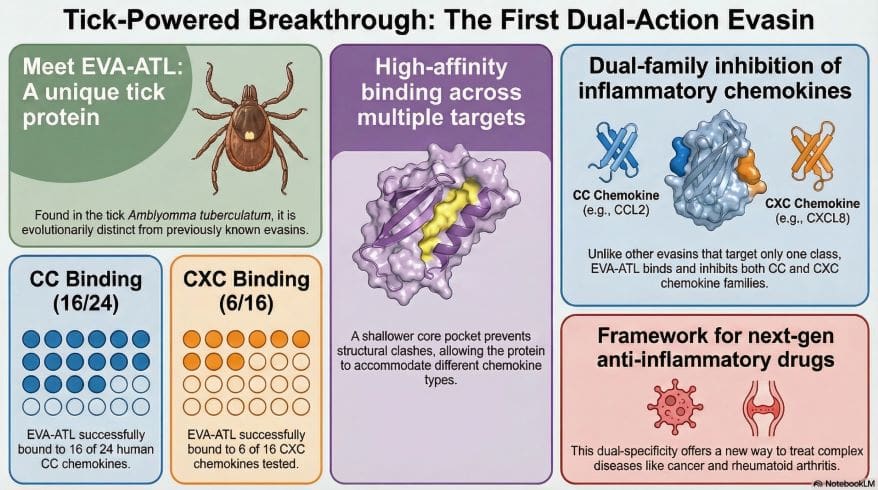
- The “One-Two” Punch: Most evasins only block one protein family, but EVA-ATL blocks two at once!
- Molecular Flexibility: A “shallow pocket” in the protein allows it to grab different targets.
- Drug Blueprint: Particularly, this discovery helps scientists create broad-spectrum treatments for any autoimmune disease involve chronic inflammation.
How the Tick “Hacks” Your Body
Ticks are blood-sucking parasites, but they are also master engineers. To feed undisturbed, they release evasins that act as “signal jammers.” Thereafter, these proteins stop the immune signals that usually lead to the inflammation seen in autoimmune disease.
The Secret of the Shallow Pocket
Think of most proteins like a specific key that only fits one lock. In fact, EVA-ATL is different—it has a shallow hydrophobic pocket. Hence, this makes it flexible. Moreover, it works like a universal adapter. Finally, it connects to two different chemokine families (CC and CXC). Thus, in autoimmune disease research, stopping both signals at once changes everything.
Scientific Highlights of Ticks and Autoimmune disease
- Bio-Inspiration: Ticks are helping us find the next generation of medicines for autoimmune disease.
- Cell Stop-Sign: EVA-ATL stops chemokines from telling immune cells where to go.
- Better Templates: Many autoimmune diseases use several signals. Surprisingly, this protein works in two ways. It serves as a good model for new medicines.
A Little Tick Humor to Lighten Up Biology Class!
Think of ticks as tiny “immune hackers.” They carry special tools to slip past your body’s guards—the white blood cells! This proves that even animals we view as irrational use smart tricks to live on. So, if nature can engineer such specialized proteins millions of years ago, why not you? If nature could engineer a “master key” millions of years ago, imagine what you can build with modern biotech tools.
Ready to dive deeper?
Explore more in Molecular Biology.
Frequently Asked Questions (FAQs)
What is an autoimmune disease?
It is a condition where the immune system becomes overactive and attacks the body’s own healthy cells.
How do ticks help autoimmune disease research?
They produce evasins that naturally block the “distress signals” that cause the painful swelling found in many diseases.
Why is “dual inhibition” important?
Many autoimmune diseases use two signal groups to cause harm. Blocking both works much better.
What is next for this study?
Scientists want to use the EVA-ATL structure as a blueprint to “bio-engineer” better, more targeted treatments.
References
Kunwar, S., Devkota, S. R., et al. (2026). Discovery of an evolutionarily distinct evasin with dual CC and CXC chemokine inhibitory activity. Structure, 34, 1-15. https://doi.org/10.1016/j.str.2026.02.001
- Author
- Latest Posts

I am a Biotechnology postgraduate from TERI School of Advanced Studies with a specialized background in molecular biology, genomics, and bioinformatics. My research experience ranges from laboratory-based microbial studies at TERI to the digital frontier of genomic surveillance and in-silico analysis.
While my academic roots are in life sciences, I am driven by the intersections of technology, data, and the natural world. I believe that science communication is the key to making complex innovations in biotechnology, environmental science, and digital health accessible to the next generation of thinkers. By combining my technical expertise with a focus on digital content creation, I aim to provide a clear and multidimensional understanding of how modern STEM developments shape our collective future.