Tick Tock: How Ticks Outsmart Inflammation with a One-Two Punch!
Ticks and Autoimmune Disease: Discovery of Dual Evasin

A single tick bite can cause more than an itchy welt. In fact, it can introduce a powerful chemical that changes how the immune system responds. When it comes to ticks and autoimmune disease, scientists are uncovering intriguing connections worth understanding. Recently, scientists discovered a unique tick protein called an evasin. More importantly, this protein can block two major inflammation pathways at once: it stops CC and CXC chemokines, the signals that tell immune cells to attack.
As a result, this discovery could matter for people with autoimmune diseases such as rheumatoid arthritis and psoriasis, where those signals can contribute to the body attacking itself. In other words, the evasin may act like a master switch, quieting some of the inflammatory signals. Because ticks use evasins to avoid detection, researchers hope to learn from this strategy and develop a treatment that reduces inflammation. Ultimately, such a drug might offer an alternative to steroids, although more research is needed to determine its safety and effectiveness.
Key Takeaways: Ticks and Autoimmune Disease
- Ticks produce specialised proteins called evasins. These proteins neutralise the body’s chemokine signals.
- A newly characterised evasin shows dual activity. It blocks both CC and CXC chemokine receptors.
- This dual inhibition is rare. It represents an evolutionary adaptation against diverse host immune responses.
- The specific protein holds promise for treating autoimmune conditions. It could reduce joint swelling and skin lesions.
- Current research focuses on creating synthetic versions. These might offer a safer alternative to immunosuppressants.
The Evolution of a Master Manipulator
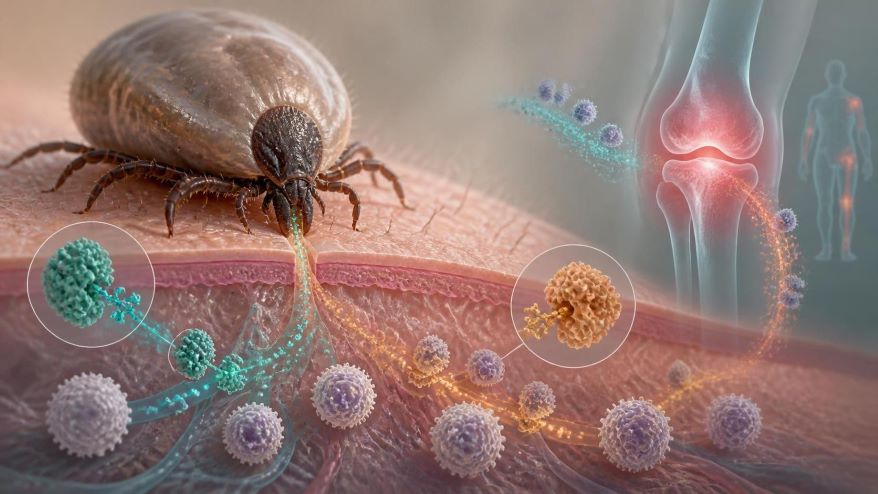
Ticks are tiny arachnids that can feed on blood for days. During this time, their saliva introduces more than a thousand proteins, including many called evasins. Over time, these proteins evolved to help ticks evade a host’s immune system. In particular, evasins target chemokines—small proteins that act like traffic signals, guiding white blood cells to sites of injury or infection.
The connection between ticks and autoimmune disease involves the way these proteins influence immune signals. Normally, a tick bite prompts the body to send immune cells to the area, causing redness, itching, and inflammation. However, ticks need a relatively calm environment to keep feeding, so their saliva contains substances that inhibit some of these signals.
One recent discovery is a dual inhibitor that blocks two chemokine families, CC and CXC. Unlike most evasins, which block only one family, this protein acts on both. As researchers explore ticks and autoimmune disease, this dual action may help explain how ticks evade immune detection—and may offer clues for future inflammation research.
How CC Chemokines Drive Autoimmunity
In Ticks and Autoimmune Disease, CC chemokines attract monocytes and T cells, which play important roles in rheumatoid arthritis. Normally, these immune cells help fight infection; however, in autoimmune disease, they can attack the joint lining, causing pain and swelling.
To avoid detection, ticks use evasins that bind to chemokines, preventing them from attaching to immune cells. As a result, those cells may not receive signals to move into the bite area, creating a localised “safe zone” for the tick. Similarly, a synthetic evisceration might one day limit immune-cell movement into arthritic joints. In theory, as Ticks and Autoimmune Disease research advances, this targeted approach could reduce inflammation without widespread immune suppression, though its safety and effectiveness remain to be tested.
Ticks and Autoimmune Disease: From Bite to Therapy
Ticks and Autoimmune Disease presents a paradox: although ticks can trigger inflammation, their saliva also contains proteins that may inspire new treatments. However, Lyme disease is caused by bacteria transmitted by certain ticks. Persistent symptoms after treatment do not necessarily mean the bacteria remain or that the condition is autoimmune. Separately, evasins are tick proteins—not bacteria—that researchers can isolate and study.
Because scientists can also produce these proteins, evasins may offer a starting point for drug development. For example, researchers could investigate modified evasins, delivered by injection or another method, to target specific inflammatory signals. Ideally, such a treatment would reduce inflammation without suppressing the immune system throughout the body. Still, Ticks and Autoimmune Disease research is at an early stage: this is a potential research direction, not an established treatment or a proven “natural solution” for patients
Data on Current Chemokine Inhibitors
| Drug Type | Target | Side Effects | Source |
|---|---|---|---|
| Steroids | General Immune System | High (infection, weight gain) | Synthetic |
| TNF Blockers | Tumor Necrosis Factor | Moderate (infection risk) | Synthetic Antibody |
| Evasins (Tick) | CC and CXC Chemokines | Low (predicted) | Natural Protein |
| Jak Inhibitors | Intracellular Signals | High (blood clots) | Synthetic |
How This Discovery Changes Drug Engineering
The newly identified evasin has a distinctive structure that may allow it to bind to two different targets. For drug designers, this could offer a valuable starting point: they might study its binding sites and use that knowledge to develop smaller molecules that work in the body.
In addition, the protein is reported to be unusually stable in the bloodstream, which could make it a promising candidate for further research. Previously, researchers may have expected that blocking both targets would require two separate drugs; however, this evasin raises the possibility that a single treatment could affect both. If future studies confirm its safety and effectiveness, that approach might simplify treatment and reduce the number of pills or injections patients need.
Current Research and the Path to the Clinic
Research on tick evasins and autoimmune disease is progressing. For example, scientists are testing these proteins in mouse models of arthritis by administering them and monitoring joint swelling. Although early findings have been encouraging, further research is needed before researchers can know whether the approach is safe and effective in people.
Next, scientists must carefully assess potential side effects, including allergic reactions. Because some tick bites can trigger alpha-gal syndrome—an allergy to a carbohydrate found in certain animal products—researchers will also need to evaluate whether an evasin could cause unwanted immune responses. Even though the protein is different from the carbohydrate associated with alpha-gal syndrome, that alone cannot establish that it is safe. Therefore, researchers may modify or “humanise” the protein to reduce the risk of immune reactions, then test those changes thoroughly
Frequently Asked Questions: Ticks and Autoimmune Disease
What is an autoimmune disease?
It is a condition where the immune system becomes overactive and attacks the body’s own healthy cells.
How do ticks help autoimmune disease research?
They produce evasins that naturally block the “distress signals” that cause the painful swelling found in many diseases
Why is “dual inhibition” important?
Many autoimmune diseases use two signal groups to cause harm. Blocking both works much better.
Reference
Kunwar, S., Devkota, S. R., et al. (2026). Discovery of an evolutionarily distinct evasin with dual CC and CXC chemokine inhibitory activity. Structure, 34, 1-15. https://doi.org/10.1016/j.str.2026.02.001
- Author
- Latest Posts

Ayushi Shukla is a biotechnologist and science communicator specializing in the intersection of genomic data and public health. Previously, she served as a Core Member and R&D Lead at the HealthTech venture Eat Wisely Bro, where she spearheaded research initiatives and translated emerging medical data into product strategy. She holds an M.Sc. in Biotechnology from the TERI School of Advanced Studies, where her research at The Energy and Resources Institute (TERI), New Delhi, focused on Environmental Biotechnology and Bioremediation.
As a Research Scholar at TERI, Ayushi developed a plant growth-promoting bacterial consortium for high-salinity agricultural conditions, managing daily laboratory procedures and molecular workflows. Her technical portfolio on GitHub demonstrates her dry lab expertise, featuring end-to-end bioinfomatics pipelines for RNA-Seq analysis, Phylogenetic modeling, and a functional prototype for Mycobacterium tuberculosis Genomic Surveillance & Dashboard.
Her clinical foundation includes advanced training in Somatic NGS and Precision Oncology from the Cancer Research Centre at Tata Memorial Centre, and a professional certification in Good Clinical Practice (GLP) from the NIDA Clinical Trials Network. Ayushi bridges the gap between raw genomic data and student-friendly narratives to help the next generation of scientist understand the transformative power of modern biology.
- Author
- Latest Posts

I completed my Master of Science from the University of Allahabad in 2017 with a strong academic background in life sciences and chemistry. My specialization included Molecular Biology, Microbiology, Genetics, Plant Breeding, Phycology, Paleobotany, and Bioinformatics, along with Organic Chemistry, Inorganic Chemistry, and Physical Chemistry. This multidisciplinary training provided me with a comprehensive understanding of biological systems and analytical scientific approaches.
After completing my postgraduate studies, I gained valuable professional experience in both the education and social development sectors. I worked at A.M. Oxford Public School, where I was actively involved in guiding students toward academic excellence. In this role, I focused on creating an engaging learning environment, encouraging critical thinking, and nurturing students’ curiosity for scientific learning. My experience as an educator strengthened my communication, mentoring, and classroom management skills.
In addition to my teaching experience, I worked with Jeevan Jagriti Foundation, where I contributed to community-based initiatives aimed at improving educational access and awareness among underprivileged sections of society. Through this work, I participated in programs designed to support social development and promote the value of education in marginalized communities.
These professional experiences helped me develop strong interpersonal, leadership, and organizational skills while reinforcing my commitment to education and community service.