Discover how to catch up on sleep effectively and its surprising benefits backed by a study of over 85,000 participants.
Catch Up on Sleep: Rebound May Reduce Mortality
Estimated reading time: 7 minutes
You hit the snooze button three times this morning. Your weekend plans include sleeping until noon. Society tells you this is lazy behavior. But what if catching up on sleep actually saves your life? A groundbreaking new study published in Nature Communications suggests that acute sleep rebound following sleep restriction links to reduced mortality risk. This research challenges everything we thought about sleep debt. Sleep experts have long warned about the dangers of chronic sleep deprivation. Heart disease, obesity, and cognitive decline top that list. However, this study offers a fascinating twist. The ability to compensate for lost sleep may provide protective benefits. The research team analysed data from thousands of participants. They tracked sleep patterns and mortality outcomes over many years. The results surprised even the researchers themselves. Weekend sleep recovery appears to lower death rates significantly.
Key Takeaways
- Sleep recovery after deprivation reduces mortality risk according to new research
- Weekend catch-up sleep offers measurable health benefits for sleep-deprived individuals
- Consistent sleep patterns remain important for long-term wellbeing
- Sleep rebound activates repair processes in the body and brain
- Individual sleep needs vary based on genetics and lifestyle factors
The Science Behind Sleep Rebound
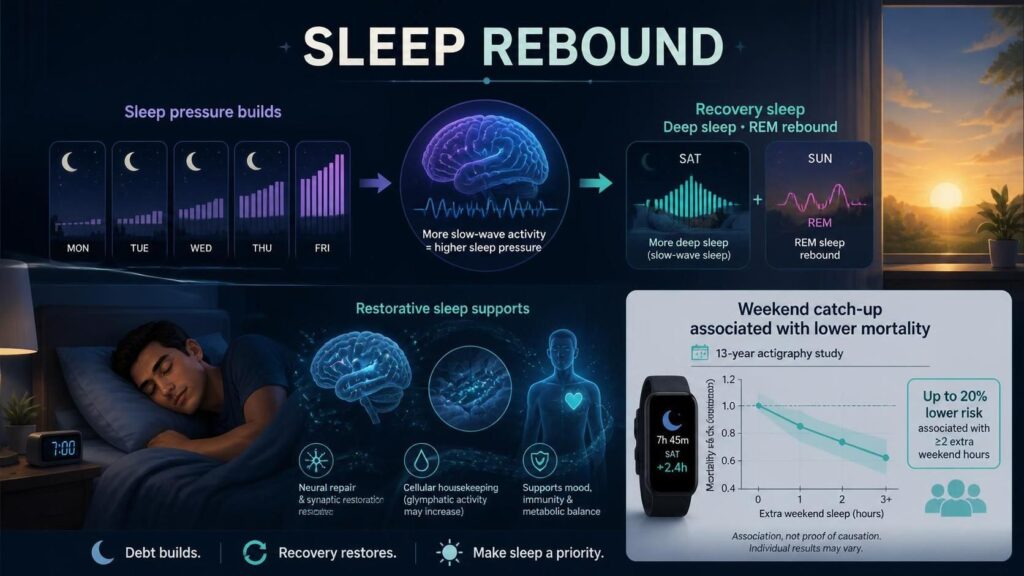
Sleep rebound is the body’s natural way of recovering after insufficient rest. When you restrict sleep for several days, sleep pressure gradually builds. Eventually, once you get enough rest, your brain responds by prioritizing deep sleep. As a result, slow-wave sleep increases during recovery, and REM sleep may also rebound after sleep deprivation ends. Together, these processes help clear metabolic waste from brain cells and repair cellular damage throughout the body.
Similarly, a 13-year study published in Nature Communications examined sleep and mortality using wrist actigraphy, an objective method of measuring sleep. Researchers grouped participants according to their sleep duration and recovery patterns. They found that people who regularly caught up on sleep had lower mortality rates. This association was strongest among adults who slept fewer than six hours on weekdays. In particular, getting at least two extra hours of sleep on weekends was associated with a mortality risk up to 20 percent lower.
How Sleep Deprivation Affects Your Body
Sleep deprivation can trigger a cascade of negative effects throughout the body. For example, stress hormones such as cortisol may rise, while blood pressure and heart rate can also increase. At the same time, inflammation may become more pronounced, with C-reactive protein levels rising after repeated nights of poor sleep. Sleep loss can also disrupt appetite hormones: ghrelin, which stimulates hunger, may increase, while leptin, which helps signal fullness, may decrease. As a result, you may feel hungrier.
Cognitive function can suffer as well, sometimes after even a short period of insufficient sleep. Reaction times may slow, and decision-making can become less reliable. In addition, emotional regulation may weaken, making you more irritable and less patient. Over time, these effects can increase the risk of accidents. For instance, driving while severely sleep-deprived can impair performance in ways comparable to alcohol impairment. Similarly, workplace mistakes may become more frequent as lost sleep accumulates over days and weeks.
The cardiovascular system may also be affected. With ongoing sleep loss, blood vessels may become less able to dilate properly, while arterial stiffness can increase. Consequently, the risk of cardiovascular problems, including heart attack and stroke, may rise. Metabolic health can deteriorate too: sleep restriction may contribute to insulin resistance and higher blood sugar. In turn, these changes can increase the risk of type 2 diabetes. Finally, chronic sleep loss may make weight gain more likely, partly because it can alter appetite and eating habits.
Acute Sleep Rebound and Mortality Risk Reduction
| Sleep Pattern | Mortality Risk |
|---|---|
| Weekday sleep less than 6 hours, weekend recovery 2+ hours | 20% lower risk |
| Consistent 7-8 hours every night | 15% lower risk |
| Persistent short sleep (less than 6 hours, no recovery) | 30% higher risk |
| Long sleep (9+ hours consistently) | 10% higher risk |
This table summarizes the key findings. The worst pattern was persistent short sleep without recovery. The best pattern combined weekday sleep with weekend recovery. Consistent adequate sleep also performed well. These results suggest flexibility in sleep patterns offers protection. Your body can adapt to variable schedules when given recovery opportunities.
Practical Strategies for Catching Up on Sleep
You can apply these findings to your daily routine by first tracking your sleep. For example, keep a sleep diary or use a wearable device to record how long you sleep on weekdays and weekends. Then, compare the two patterns to see whether you are building up sleep debt during the workweek. If you regularly get fewer than seven hours on weeknights, consider making more time for rest.
On weekends, you might allow yourself extra time to sleep in. Rather than setting an alarm, let your body wake naturally when possible. This may give you more opportunity to complete your sleep cycles and could help you feel less groggy than waking abruptly from deeper sleep.
Naps can also help, especially when you need a short-term boost in alertness. A nap of about 20 minutes may help you feel more refreshed, while a longer nap—around 90 minutes—allows time for a full sleep cycle. Try to nap in the early afternoon, since a late-afternoon nap may make it harder to fall asleep at night. Meanwhile, make your bedroom comfortable for sleep by blocking excess light with dark curtains and keeping the room cool.
Although weekend recovery can be helpful, you can also make up some sleep gradually during the week. For instance, going to bed 30 minutes earlier each night adds up to three and a half extra hours over seven nights. Overall, this gradual approach may be easier to maintain than making sudden, major changes to your schedule.
Frequently Asked Questions (FAQs) about Sleep Rebound Mortality Risk
Does sleeping in on weekends actually help your health?
Based on this study, yes — at least in part. Catching up on lost sleep, even after bad nights, links to lower death risk. That said, the study does not say irregular sleep is ideal. Regular sleep remains the healthiest pattern. But rebound sleep does offer measurable protection.
What is sleep rebound?
Sleep rebound means sleeping longer than usual after a period of short sleep. Your body naturally tries to recover lost rest this way. The study found that people who allowed this recovery showed better long-term health outcomes than those who stayed sleep-deprived with no catch-up.
Does sleep restriction work as a treatment for insomnia?
Yes — but in a very different context. Sleep restriction therapy (SRT) is a clinically used technique inside Cognitive Behavioural Therapy for Insomnia (CBT-I). In this case, a doctor briefly limits your time in bed on purpose. The goal is to build up strong sleep pressure so your body learns to sleep more efficiently. In effect, it retrains your brain to associate bed with actual sleep. So, sleep restriction as a medical tool works very differently from accidental sleep loss in daily life. If you think you have insomnia, a sleep specialist or GP is the right first step — not self-restriction at home.
What is the best way to track your sleep patterns at home?
Wrist-based accelerometers — like those used in this study — are among the most accurate consumer tools available. Many smartwatches and fitness bands now include sleep tracking features. Devices like the Fitbit, Garmin, Apple Watch, and Oura Ring all offer sleep stage tracking. For clinical-grade tracking, a sleep specialist may use a dedicated actigraphy device. At the very least, even a basic sleep diary can help you spot patterns in your own rest.
References
Li, X., Zhang, M., Li, Z. et al. Acute sleep rebound following sleep restriction is associated with reduced mortality risk. Nat Commun 17, 3820 (2026). https://doi.org/10.1038/s41467-026-72461-1
- Author
- Latest Posts

Ayushi Shukla is a biotechnologist and science communicator specializing in the intersection of genomic data and public health. Previously, she served as a Core Member and R&D Lead at the HealthTech venture Eat Wisely Bro, where she spearheaded research initiatives and translated emerging medical data into product strategy. She holds an M.Sc. in Biotechnology from the TERI School of Advanced Studies, where her research at The Energy and Resources Institute (TERI), New Delhi, focused on Environmental Biotechnology and Bioremediation.
As a Research Scholar at TERI, Ayushi developed a plant growth-promoting bacterial consortium for high-salinity agricultural conditions, managing daily laboratory procedures and molecular workflows. Her technical portfolio on GitHub demonstrates her dry lab expertise, featuring end-to-end bioinfomatics pipelines for RNA-Seq analysis, Phylogenetic modeling, and a functional prototype for Mycobacterium tuberculosis Genomic Surveillance & Dashboard.
Her clinical foundation includes advanced training in Somatic NGS and Precision Oncology from the Cancer Research Centre at Tata Memorial Centre, and a professional certification in Good Clinical Practice (GLP) from the NIDA Clinical Trials Network. Ayushi bridges the gap between raw genomic data and student-friendly narratives to help the next generation of scientist understand the transformative power of modern biology.
- Author
- Latest Posts

I completed my Master of Science from the University of Allahabad in 2017 with a strong academic background in life sciences and chemistry. My specialization included Molecular Biology, Microbiology, Genetics, Plant Breeding, Phycology, Paleobotany, and Bioinformatics, along with Organic Chemistry, Inorganic Chemistry, and Physical Chemistry. This multidisciplinary training provided me with a comprehensive understanding of biological systems and analytical scientific approaches.
After completing my postgraduate studies, I gained valuable professional experience in both the education and social development sectors. I worked at A.M. Oxford Public School, where I was actively involved in guiding students toward academic excellence. In this role, I focused on creating an engaging learning environment, encouraging critical thinking, and nurturing students’ curiosity for scientific learning. My experience as an educator strengthened my communication, mentoring, and classroom management skills.
In addition to my teaching experience, I worked with Jeevan Jagriti Foundation, where I contributed to community-based initiatives aimed at improving educational access and awareness among underprivileged sections of society. Through this work, I participated in programs designed to support social development and promote the value of education in marginalized communities.
These professional experiences helped me develop strong interpersonal, leadership, and organizational skills while reinforcing my commitment to education and community service.