Learn about the groundbreaking RNA virus disease outbreak research that identifies new viruses and helps predict future health crises.
239 Viruses Mapped: Can This Database Stop the Next RNA Virus Disease Outbreak?
Estimated reading time: 7 minutes
Picture a master list that holds every virus that can infect you. Scientists have now built it. A new 2026 study in Scientific Data mapped all 239 RNA viruses known to harm humans. At first, this sounds like just a science project. But in reality, it is far more than that. What’s more, this list could help predict the next RNA virus disease outbreak before it spreads. To that end, it could help stop the next COVID-level crisis early. In short, this database might be one of the most useful tools in global health right now.
Key Takeaways
Before we go further, here is what this RNA virus disease outbreak study found:
- Scientists catalogued 239 RNA virus species that can infect humans.
- The previous list from 2018 had only 214 species — 25 new ones were added.
- The study covers viruses found up to the end of 2024.
- Each virus entry includes where and when humans first got infected.
- It shows how each virus spreads — through air, blood, animals, or insects.
- It maps the host range — which animals carry each virus.
- Scientists linked genome sequence data for each virus in the catalogue.
- Researchers worldwide can use the full dataset for free.
What Is This RNA Virus Disease Outbreak Study About?
A team of researchers from the University of Edinburgh built this updated list. They searched through decades of published science literature. At length, they compiled data on every RNA virus known to infect humans. After that, Nature’s Scientific Data published the full dataset. Anyone can access and download it for free. The study covers all 239 species of human-infective RNA viruses confirmed by the end of 2024.
Prior to this update, the last major list came out in 2018. That list had 214 viruses. So, all in all, scientists confirmed 25 new human-infective RNA viruses in just six years. That rate of discovery should make us all pay attention.
What Exactly Is an RNA Virus?
To explain briefly, not all viruses are the same. In fact, viruses store their genetic code in either DNA or RNA. RNA viruses are especially tricky. Here is why they matter so much in the context of disease outbreaks:
- RNA viruses mutate much faster than DNA viruses.
- Fast mutation means they adapt to new hosts quickly — including humans.
- Many of the world’s worst outbreaks came from RNA viruses.
- COVID-19, Ebola, influenza, HIV, and dengue are all RNA viruses.
- Seeing that RNA viruses mutate so fast, they are harder to control with vaccines.
Table 1: Famous RNA Viruses You Have Heard Of
| Virus Name | Disease It Causes | How It Spreads |
|---|---|---|
| SARS-CoV-2 | COVID-19 | Air / respiratory droplets |
| Influenza A | Flu | Air / contact |
| HIV | AIDS | Blood / bodily fluids |
| Ebola | Ebola disease | Blood / direct contact |
| Dengue virus | Dengue fever | Mosquito bite |
| Zika virus | Zika disease | Mosquito / sexual contact |
| Rabies virus | Rabies | Animal bite |
| Norovirus | Stomach flu | Contaminated food / surfaces |
Why Does Mapping RNA Viruses Help Predict a Disease Outbreak?
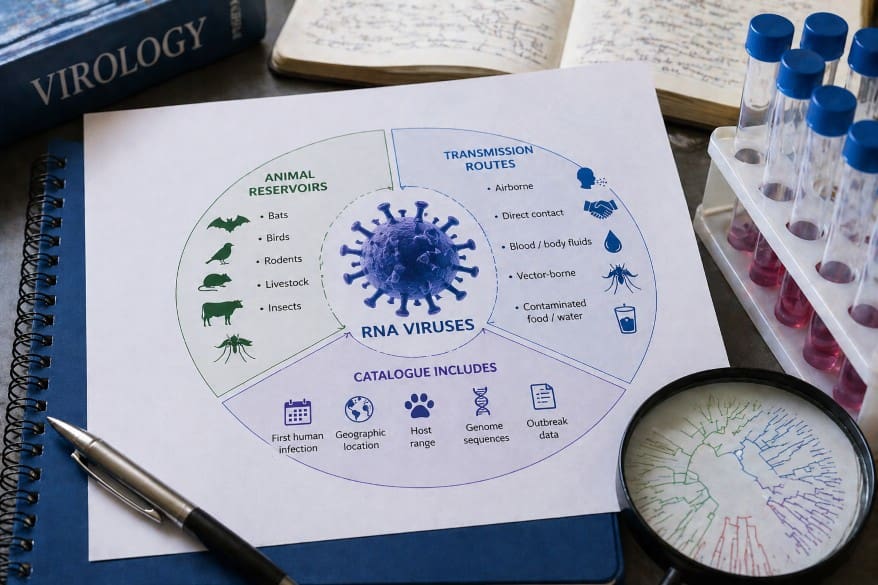
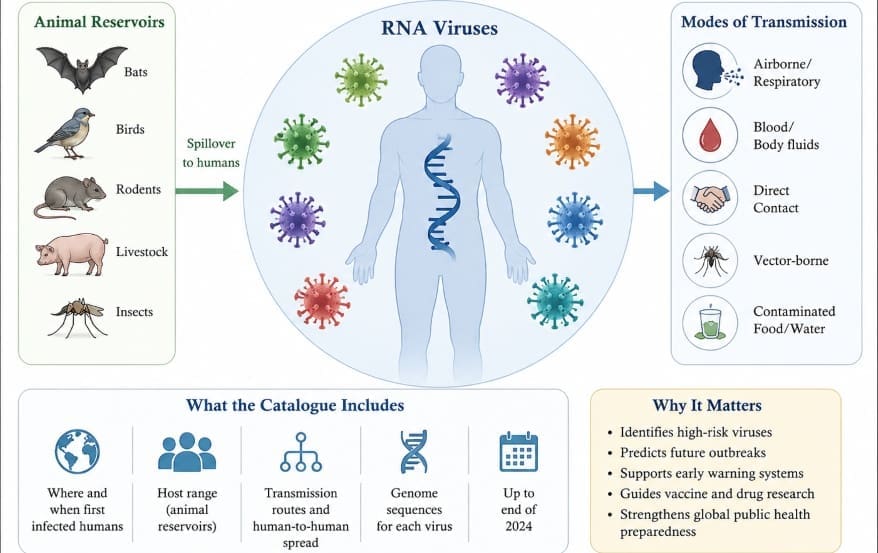
In essence, this is where the study connects to real-world impact. In fact, the researchers did not just list the viruses. Instead, they added metadata — extra information — for each one. To illustrate, think of it like a virus passport. Each virus entry in the database contains:
- The date of the first known human infection.
- The location where the first case was reported.
- How easily the virus spreads between people.
- Which animals carry the virus (its host range).
- All known routes of transmission.
- Direct links to publicly available genome sequences.
The database covers all 239 RNA virus species confirmed to infect humans up to end of 2024. Researchers tracked when, where, and how each virus first reached humans — and how each one spreads. — Zhang et al., Scientific Data, 2026
As a result, public health scientists can now use this data to spot patterns. In like manner, they can compare viruses to find which ones are most likely to cause outbreaks. So, at this point, this database is not just a list — it is a prediction tool.
How Can This Database Stop the Next RNA Virus Disease Outbreak?
To enumerate the ways this database can protect public health, here is what researchers say it can be used for:
- Studying which virus traits are linked to high public health risk.
- Tracking the geography of where new RNA viruses tend to emerge.
- Projecting how many more viruses we might discover in the future.
- Estimating how much viral diversity still exists in animals and nature.
- Building better early warning systems for pandemic threats.
With this in mind, understanding how viruses jump from animals to humans is key to making sense of why this database matters so much.
Old List vs. New List — What Changed?
| Feature | 2018 Catalogue | 2026 Catalogue |
|---|---|---|
| Number of RNA viruses | 214 species | 239 species |
| Coverage period | Up to ~2017 | Up to end of 2024 |
| Genome sequence links | Partial | Full, publicly linked |
| Dataset availability | Open access | Open access (CC BY 4.0) |
| Research groups | Edinburgh team | Edinburgh + expanded team |
| Key use | Comparative studies | Outbreak prediction + phylogenetics |
Where Do Most RNA Viruses Come From?
Here is what the biology tells us. In fact, most RNA viruses that infect humans did not start in humans. In general, they came from animals first. This process is called spillover, or zoonotic transmission. At first, a virus lives in a bat, a bird, a pig, or a rodent. Then it crosses over into humans. Seeing that humans now live closer to wildlife than ever before, this happens more often.
The 2026 catalogue tracks the host range of each virus. In turn, scientists can now see which animals are the biggest sources of new human viruses. Above all, this helps us know where to watch for the next disease outbreak before it begins.
Most new RNA viruses that infect humans come from animal reservoirs. The 2026 catalogue links each virus to its known animal hosts — helping predict where future spillovers might happen. — Zhang et al., Scientific Data, 2026
At the same time, the dataset links directly to genome sequences for each virus. This is vital. In particular, when a new outbreak starts, scientists must identify the virus fast. In effect, having the genome data ready can cut detection time by days or even weeks.
Understanding how genome sequencing helps during outbreaks shows just how important this kind of open database can be.
What Can You Do with This Information?
All things considered, this study is a big step for global health. But it also opens doors for curious people right now. Here is how this kind of research connects to real careers and choices:
- Epidemiology — studying how diseases spread across populations.
- Virology — understanding how viruses work at the molecular level.
- Bioinformatics — using computers to analyse virus genome data.
- Public health policy — using data to make health decisions for whole communities.
- Microbiology — studying microorganisms including bacteria and viruses.
To sum up, the scientists behind this study spent years reading research papers and building this database. In fact, it is careful, detailed, open science. Provided that more databases like this get built and shared freely, we have a much better shot at catching the next RNA virus disease outbreak early.
After all, COVID-19 caught the world off guard. With this in mind, this database is part of the effort to make sure that does not happen again.
Frequently Asked Questions (FAQs) about RNA Virus Disease Outbreak
What is the RNA virus disease outbreak database about?
The 2026 study by Zhang et al. catalogued all 239 RNA virus species known to infect humans as of end of 2024. It includes data on when and where each virus first infected a human, how it spreads, which animals carry it, and links to its genome sequence.
Why are RNA viruses more dangerous than DNA viruses?
RNA viruses mutate at a much faster rate than DNA viruses. This lets them adapt to new hosts — like humans — more quickly. Most of the world’s biggest viral outbreaks, including COVID-19, Ebola, and flu, are caused by RNA viruses.
How many RNA viruses can infect humans?
As of the end of 2024, scientists have confirmed 239 RNA virus species that can infect humans. That is 25 more than the previous catalogue from 2018 — showing that new human-infective viruses are still being discovered.
How does this help predict the next disease outbreak?
The database lets scientists compare virus traits — like how fast a virus spreads or how many animal hosts it has. By spotting patterns, researchers can rank viruses by how likely they are to cause future outbreaks.
References
Zhang, F., Lu, L., Brierley, L., Hietanen, H., & Woolhouse, M. E. J. (2026). A complete catalogue of human-infective RNA viruses. Scientific Data. https://doi.org/10.1038/s41597-026-07281-5
Editorial Note: This article was written by Ayushi Shukla and reviewed for editorial accuracy by our editorial team. It has not yet undergone independent review by a professional.
- Author
- Latest Posts

Ayushi Shukla is a biotechnologist and science communicator specializing in the intersection of genomic data and public health. Previously, she served as a Core Member and R&D Lead at the HealthTech venture Eat Wisely Bro, where she spearheaded research initiatives and translated emerging medical data into product strategy. She holds an M.Sc. in Biotechnology from the TERI School of Advanced Studies, where her research at The Energy and Resources Institute (TERI), New Delhi, focused on Environmental Biotechnology and Bioremediation.
As a Research Scholar at TERI, Ayushi developed a plant growth-promoting bacterial consortium for high-salinity agricultural conditions, managing daily laboratory procedures and molecular workflows. Her technical portfolio on GitHub demonstrates her dry lab expertise, featuring end-to-end bioinfomatics pipelines for RNA-Seq analysis, Phylogenetic modeling, and a functional prototype for Mycobacterium tuberculosis Genomic Surveillance & Dashboard.
Her clinical foundation includes advanced training in Somatic NGS and Precision Oncology from the Cancer Research Centre at Tata Memorial Centre, and a professional certification in Good Clinical Practice (GLP) from the NIDA Clinical Trials Network. Ayushi bridges the gap between raw genomic data and student-friendly narratives to help the next generation of scientist understand the transformative power of modern biology.