A biology student stares at a spreadsheet of immune-cell data. Each row holds a different cell type. Each column holds a signaling protein. Somewhere in that grid, she tells herself, a pattern predicts when labor will start. Until now, no tool could explore every cell at once. A team at Stanford Medicine just built one. Their single-cell digital twin mimics a pregnant person’s immune system in a computer. It ran virtual drug tests before any patient took a single pill. The result points to two common, low-cost medicines. Together, they may help hold off early labor.
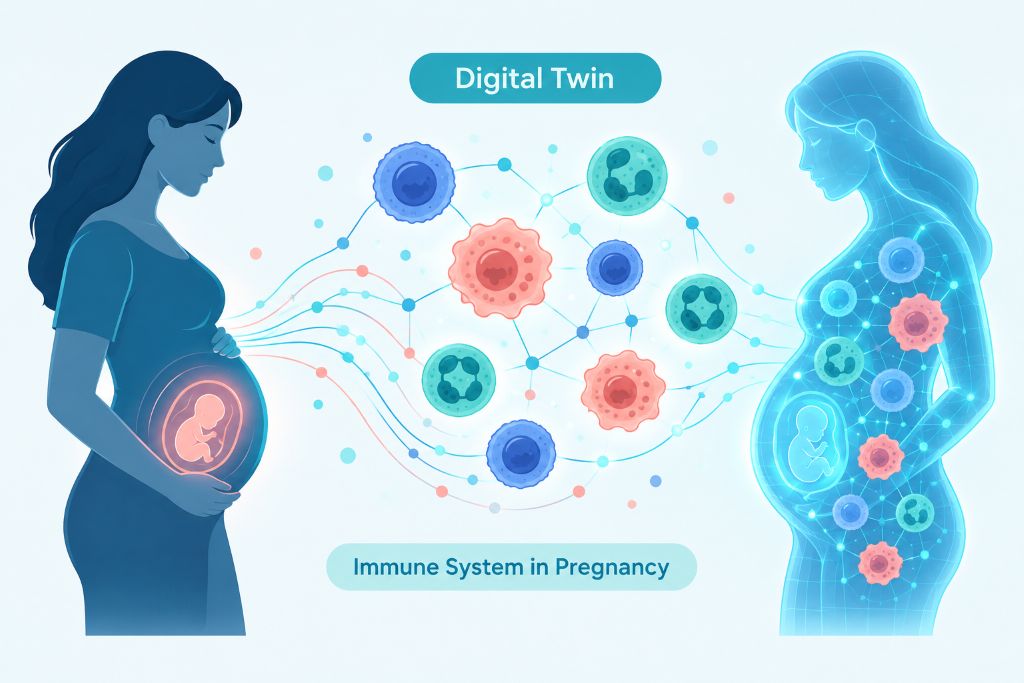
What a Digital Twin of the Immune System Actually Is
Think of a flight simulator for a pilot. She can crash safely in software, learn the controls, and only then touch a real cockpit. A medical digital twin does the same for a patient’s biology. Instead of a plane, the software models living cells. Instead of weather, it models how those cells respond to drugs.
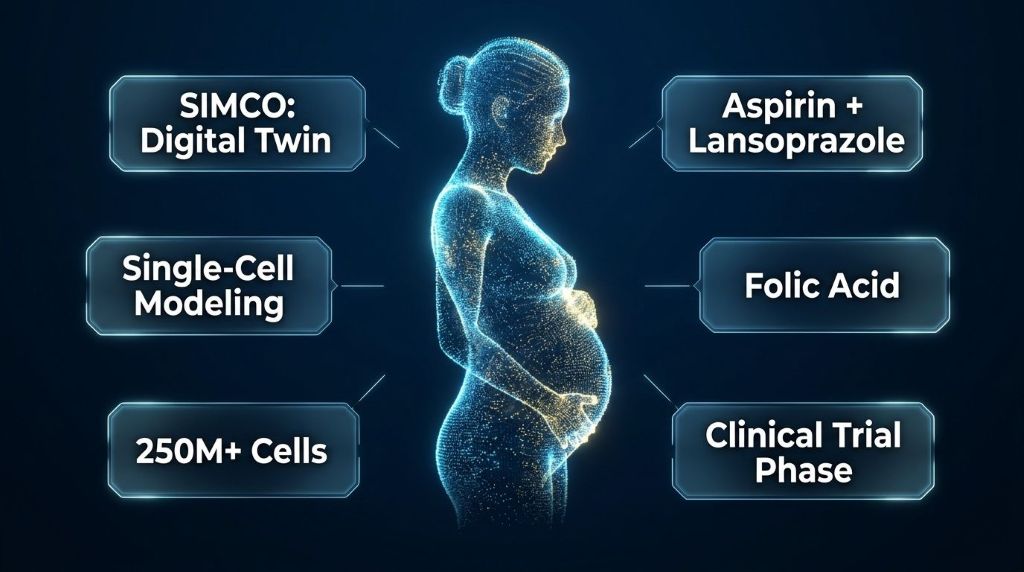
Five connected takeaways summarize how a digital twin screened safe drugs against early labor.
Doctors cannot ethically test risky drugs on a pregnant person. Nor can they replay the same pregnancy over and over. A digital twin of the immune system in pregnancy solves both problems at once. The model runs trials inside a computer. Researchers change a drug, re-run the simulation, and watch the predicted outcome shift. No mother or baby is ever exposed. Stanford Medicine describes the tool as a way to screen drugs before any real patient takes them. This kind of AI screening is part of a broader wave reshaping how students and clinicians alike approach AI in STEM education.
Why Single Cells Matter Here
Earlier models treated the immune system like one big blob. They averaged all cells into a single number. That average hides the interesting detail. One drug might calm a T cell but fire up a neutrophil. The two effects could cancel out in the average. Only a cell-by-cell view reveals the true story.
SIMCO changes this. It simulates twenty-eight distinct immune cell populations separately. Each has its own predicted response to each drug. This granularity is the heart of the new work. It lets scientists see which cell types do the heavy lifting.
How the Researchers Built the Model
The team started with real blood, not just theory. They collected samples from nineteen volunteers. Eight were not pregnant. Eleven were between twenty and twenty-seven weeks into pregnancy. Every sample then met nine different drug regimens. The drugs were chosen because they were already considered safe in pregnancy.
Machines measured how each cell type reacted to each drug. The screen captured 218 million white blood cells across eighty test conditions. Every condition required only 100 microliters of blood. Mass cytometry read twenty functional markers inside each cell. This produced a vast atlas of the pregnant immune system.
Turning Cells Into a Simulation
Raw data alone cannot predict labor. The researchers paired two clever algorithms. One, called CellOT, learns how a cell’s state shifts under a drug. It uses a branch of math called optimal transport. The other, called Stabl, builds a sparse prediction model. It finds the few immune features that best forecast time to labor.
Together, the two tools form SIMCO, which stands for Simulated Immunome Modeling of Clinical Outcomes. The system predicts how an individual’s immune clock will run faster or slower under a given drug. It then links that clock to a projected delivery date. This is the core of the digital twin framework. The underlying drug science behind these models blends pharmacology with data-driven simulation.
Checking the Model’s Accuracy
A model is only useful if it predicts well. The team tested SIMCO against a separate dataset of sixty-three pregnancies. Those records held 177 blood samples taken in the final weeks of pregnancy. SIMCO compared its predictions to the real delivery dates. The match gave the researchers confidence to trust the virtual drug runs. You can read the full method in the open-access paper in Science Advances.
The Search for Drugs That Delay Labor
The digital twins then went to work, screening nine candidate drugs. Two clear winners emerged from the simulations. One was tetrahydrofolate, the active form of the B vitamin folic acid. The other was the pairing of aspirin with lansoprazole. Both appeared to push the immune clock of labor backward.
The aspirin-lansoprazole combination stood out most. In the digital twins, it showed an effect on delaying labor roughly fifteen times greater than aspirin alone. Aspirin by itself has long held a modest reputation in this area. Lansoprazole is a familiar stomach-acid drug. Together, the model says, they work far better than either would suggest.
Why Folic Acid Was a Surprise
Doctors already recommend folic acid in pregnancy. Its known job is to prevent spinal-cord defects in the fetus. The simulation now suggests a second, hidden role. Folic acid may also help the mother’s immune system adapt to pregnancy. Co-lead author Jakob Einhaus voiced the surprise plainly. He noted the vitamin’s immunomodulatory power was not something the field had appreciated. This finding reframes a humble supplement we already give every day.
Maprotiline: A Cautionary Tale
A third drug, maprotiline, also delayed labor in the model. Yet the researchers did not advance it. This old antidepressant carries burdens like fatigue and weight gain. Its side effects undercut any benefit for a preventive therapy. The decision shows the model’s real value. SIMCO weighs both good and bad effects at once. A drug must do more than move the clock — it must be worth giving.
The Challenges and the Motivation Behind the Work
Preterm birth remains stubborn and serious. It is the leading cause of death in children under five worldwide. One pregnancy in ten ends before the thirty-seventh week. Most of these are spontaneous, arriving with no warning signs. Current options, low-dose aspirin and progesterone, help only some patients. The results have stayed modest and inconsistent for years.
Why has progress been so slow? Testing new drugs in pregnancy is hard for two reasons. Ethically, a trial exposes both mother and fetus to risk. Financially, such trials are slow and costly. These twin barriers leave promising therapies stuck on the shelf. The Stanford team built SIMCO to crack exactly this knot. Their goal was a faster, safer screening route for drugs against early labor.
A Different Kind of Risk
Modeling raises a fair question. Can a simulation ever be trusted with a pregnancy? The researchers argue the alternative is worse. Leaving the field with no new drug in decades also carries a real cost. Ten percent of births stay at risk. A validated digital twin offers a middle path. It narrows down candidates before a single patient is enrolled. That is a measured, ethical way forward.
From Virtual Test to Real Trial
The journey did not end inside the computer. The researchers confirmed the drug pair in an animal model of inflammation during pregnancy. There, the combination again delayed the onset of labor. Then they approached the U.S. Food and Drug Administration. The FDA approved moving the aspirin-lansoprazole combination into a human clinical trial.
This speed is what excites senior author Brice Gaudilliere. He described going from a mechanistic discovery to a patient-ready treatment in a short stretch. The trial, registered as NCT07337655, is now underway. Its design leans on the model’s other gift. SIMCO can flag likely responders in advance. As a result, trials could enroll only the patients most likely to benefit.
What This Means for Personalized Care
Not everyone responds to the same drug equally. Pregnancy varies from person to person, and so does the immune clock. The digital twin captures that spread of variation. In time, a small blood sample could tune a model to a specific patient. Her own twin would then predict which therapy fits her best.
I see this same principle in the classroom every semester. Two students can receive identical instruction and arrive at different answers. The teaching that works for one misses the other entirely. Personalized medicine follows the same logic. A digital twin of the immune system in pregnancy makes that logic concrete. It treats each pregnancy as its own problem, with its own solution.
Conclusion
SIMCO turns a hard problem into a tractable one. It models the immune system of pregnancy cell by cell. It tested safe, everyday drugs without touching a single patient. And it surfaced a combination that may genuinely delay early labor. Aspirin plus lansoprazole now heads to real-world testing. Folic acid gains a surprising second purpose.
The bigger lesson reaches beyond obstetrics. A faithful digital twin lets scientists ask what-if questions safely. That power could reshape how we screen drugs across many conditions. For now, the immediate hope is specific and human. A mother may one day hold her baby a little closer to full term, thanks to a model that lived only in a computer.
References
Einhaus, J., Neidlinger, P., Fondeur, O., Sato, M., Miyazaki, K., Maechler, A., Amar, J. N., Ando, K., Badea, V., Gaudilliere, D. K., Sabayev, M., Feyaerts, D., Diop, M., Tsai, A. S., Cambriel, A., Ganio, E. A., Lagarde, R., O’Kelly, E., … Gaudilliere, B. (2026). Single-cell–level digital twins for preterm birth prevention strategies. Science Advances, 12, eaed2741. https://doi.org/10.1126/sciadv.aed2741
This article reports on a proof-of-concept study that has not yet produced an approved treatment. The aspirin–lansoprazole combination and tetrahydrofolate were identified through computational simulation and one animal model; their effect in human pregnancy remains unconfirmed and is now under investigation in a clinical trial (NCT07337655). As a science-communication piece for a general audience, this report summarizes the peer-reviewed work of Einhaus et al. (Science Advances, 2026) and should not be read as medical advice. Pregnant individuals must not start, stop, or change any medication, including aspirin, lansoprazole, or folic acid, based on this article alone.
Readers should note a disclosed commercial interest. Three senior authors — Brice Gaudilliere, Dyani K. Gaudilliere, and Julien Hedou — sit on the advisory board of SurgeCare, and Hedou serves as its CEO. Five authors, including Gaudilliere and senior author Jakob Einhaus, are named inventors on a Stanford-filed patent application (PCT/US2026/017168). These interests do not invalidate the findings, which were externally peer-reviewed and published open access under a Creative Commons Attribution License (CC BY 4.0), but we flag them for transparency.
All underlying data and code are publicly available: preprocessed data on Dryad (DOI 10.5061/dryad.sqv9s4ngm) and source code on GitHub and Zenodo (DOI 10.5281/zenodo.20481641), enabling independent verification.
Mohammed Aftab is a Science Communicator at ENTECH STEM Magazine and a Doctor of Pharmacy (Pharm.D) graduate with a strong interest in pharmaceutical sciences, medicine, and public science education. His areas of interest include pharmacology, pharmacotherapeutics, clinical pharmacy, clinical research, rational drug use, evidence-based medicine, medication safety, and medication errors. His research focuses on assessing intravenous-to-oral drug switching practices in a tertiary-care teaching hospital, reflecting his interest in appropriate medication use and evidence-based healthcare.
Aftab specializes in explaining complex medical and pharmaceutical concepts in simple, clear, and easy-to-understand language. Using relatable everyday examples and practical analogies, he helps teenagers and the general public understand medicines, how drugs work in the body, common health conditions, and the science behind medical treatments. Through his work at ENTECH STEM Magazine, he aims to bridge the gap between scientific knowledge and public understanding, making reliable medical and scientific information engaging, accessible, and relevant to everyday life.