Two early trials of an engineered tumor-fighting cell therapy found responses in two-thirds of 15 patients at the chosen dose, without the harsh drug IL-2.
Your immune system already fights cancer every day. Some of its best soldiers, in fact, live inside tumors. Doctors can collect these cells, grow billions more, and return them to the patient. Now a new study tests an engineered TIL cell therapy that adds an on-off switch. The product, called amsoki-cel, comes from the company Obsidian Therapeutics. It targets advanced melanoma, a dangerous skin cancer. Rodabe Amaria at MD Anderson Cancer Center led the work as first author. Doctors from several other US cancer centers also joined the trials. The team published its results in Nature Medicine on November 3, 2026. Its DOI is 10.1038/s41591-026-04743-6. Obsidian sponsored both trials, and several authors work for the company. As a result, readers should weigh the findings with that funding in mind.
The trials enrolled patients whose melanoma kept growing after standard immune drugs. In total, 37 patients received the cells across two studies. At the chosen dose, 10 of 15 patients saw their tumors shrink. Two of them, notably, had no detectable tumors left on scans. The key trick lies in a drug switch built into the cells. A common water pill, acetazolamide, turns on a growth signal inside them. That signal replaces IL-2, a harsh drug older cell therapies still need. Even so, side effects remained common, mostly from the chemotherapy given beforehand. No patient died from treatment, and none needed intensive care. On the other hand, the trials had no comparison group and short follow-up. In this article, we explain how the switch works and why caution still matters.
Why Melanoma Patients Need Engineered TIL Cell Therapy
Melanoma starts in the cells that give skin its color. Over the past decade, drugs called immune checkpoint inhibitors changed its treatment. These drugs release the brakes on immune cells. Even so, most patients with advanced disease eventually see their cancer grow again. After that, the paper notes, few options offer much benefit. Our story on a new pancreatic cancer immunotherapy shows how fast this field moves. Tumor-infiltrating lymphocytes, or TILs, offer one more path. These T cells already sit inside the tumor and recognize it. Researchers at the US National Institutes of Health pioneered the method in the 1980s. A non-engineered TIL product now holds US approval for some melanoma patients. Even so, that approach carries real burdens. For example, patients need surgery to supply tumor tissue.
The Problem With High-Dose IL-2
Older TIL methods depend on a drug called interleukin-2, or IL-2. Lab workers use it to grow the cells. Doctors then give high doses after infusion to keep the cells alive. Unfortunately, high-dose IL-2 can cause substantial toxicity. According to the paper, this limits which patients can safely receive the treatment. Patients also need strong hearts and lungs to cope. On top of that, standard chemotherapy clears space for the new cells first. That step, called lymphodepletion, wipes out many blood cells for a time. As a result, these burdens shrink the pool of eligible patients. For this reason, the Obsidian team asked a simple question. Could the cells make their own growth signal instead? In that case, patients could skip IL-2 entirely. That idea shaped the design of amsoki-cel.
How the Amsoki-cel Trials Worked
The paper pools two single-arm trials. To begin with, a single-center study at MD Anderson treated 17 patients. The second, called Agni-01, ran at several centers and treated 20 more. In total, 45 people enrolled, and 37 received cells. All had advanced melanoma that grew after checkpoint drugs. Doctors collected tumor tissue by surgery or by a thin needle. Notably, ten patients needed only a core needle biopsy rather than surgery. Lab teams then grew the cells into billions of copies. Patients next received chemotherapy, one cell infusion, and acetazolamide pills. For example, full methods appear in the Nature Medicine paper. Unlike a randomized study, both trials gave every patient the same treatment. In other words, no group received a different therapy for comparison. Because of this design, the results need careful reading.
A Rocky Start and a Dose Change
The very first patient received the highest planned dose of cells. On day 4, that patient developed blurry vision. Scans then showed vasogenic edema, or swelling, around a treated brain tumor. That tumor measured 2.5 cm and had received radiation before. At that point, the new cells made up nearly all of the patient’s lymphocytes. As a result, doctors stopped acetazolamide right away. Afterward, the team rewrote the protocol for later patients. They cut the maximum cell dose by 80%. In addition, the acetazolamide dose fell by 75%. Once the lower doses proved safe, doses rose again step by step. In the end, the team chose a maximum of 100 billion cells. Patients took acetazolamide 500 mg daily in two 7-day periods. Later, doctors could re-dose the pill to boost the cells.
Tumor Responses to Engineered TIL Cell Therapy
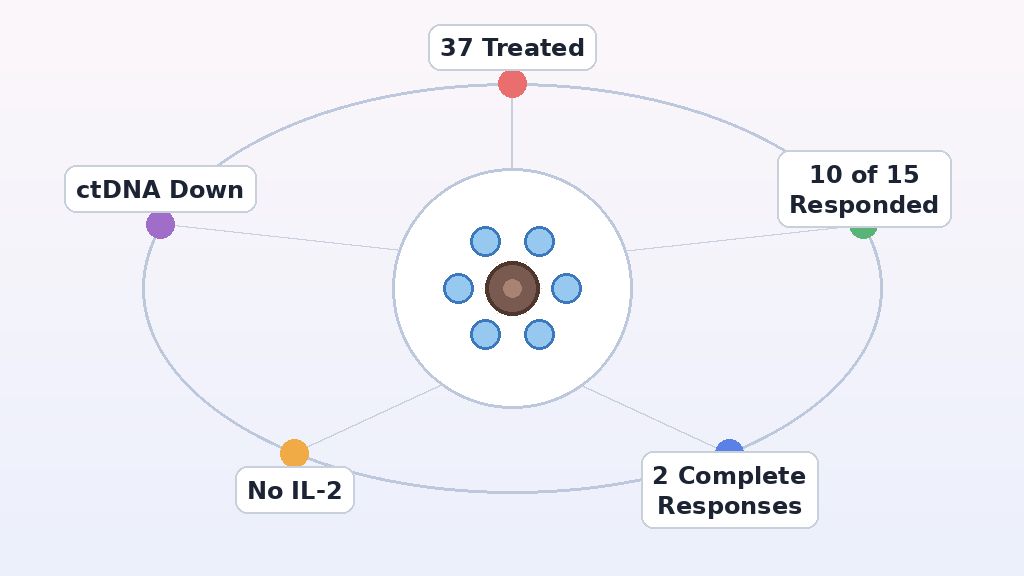
Fifteen Agni-01 patients received the chosen dose. Researchers call this group the Key Efficacy Set. Tumors shrank enough to count as responses in 10 of them. That equals 66.7%, with a 95% confidence range of 38% to 88%. Two patients had complete responses, and eight had partial ones. Most responses, in particular, appeared early, by week 6. Two responses that started partial later deepened to complete. In the phase 2 portion alone, 6 of 9 patients responded. Median progression-free survival reached 8.1 months. At the same time, follow-up lasted only 8.3 months at the median. Tumor DNA in the blood also fell sharply by day 14. On average, levels dropped about 122.7-fold. That fast drop hints that the cells attacked tumors quickly. Even so, doctors themselves judged the responses, without independent review.
Fig. 1: Key Results From the Amsoki-cel Trials
Safety Results and an Early Warning
Across all 37 patients, nobody had a dose-limiting toxicity. No one needed intensive care, and no deaths came from treatment. Still, serious side effects were common. Low white blood cell counts, or neutropenia, hit 64.9% at grade 3 or worse. Other low blood counts also appeared often. These effects mostly followed the chemotherapy given before infusion. Most patients, 70.3%, received a gentler low-dose chemotherapy plan. Those patients showed lower rates of blood-related side effects. In fact, the paper treats that comparison as descriptive only. Ten patients reported serious adverse events of some kind. Meanwhile, doctors gave all acetazolamide re-dosing in outpatient clinics. Four patients even received chemotherapy without a hospital stay. In short, the safety picture looks manageable but far from harmless. That first patient’s brain swelling also shows why careful dosing matters.
Explainer: How a Drug Switch Controls TIL Therapy
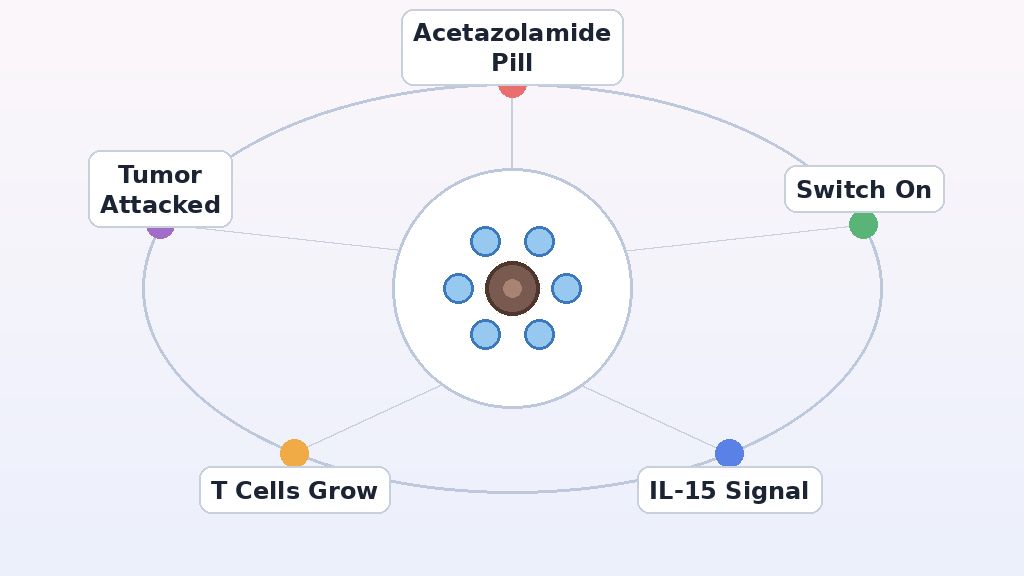
Every T cell needs growth signals to multiply and survive. Amsoki-cel carries an added gene for a signal called IL-15. The cells display this signal on their own surface. Scientists call this form membrane-bound IL-15. On the other hand, the gene also attaches a deliberately unstable protein tag. Without a drug, the cell’s recycling system destroys the whole protein. Acetazolamide changes that by binding to the tag. As a result, the protein folds properly and reaches the cell surface. In other words, doctors control the signal with a simple pill. Our article on a universal cancer vaccine covers another way to train immunity. Acetazolamide itself has served as a diuretic since 1953. In this way, a very old drug now works as a remote control. Put simply, the pill decides when the cells get their boost.
Why TIL Therapy Can Skip IL-2
With IL-15 on board, the cells can grow without IL-2 in the lab. According to the authors, this gives a sturdier manufacturing process. The resulting cells also look less worn out and more stem-like. That matters because of one problem: tired T cells stop fighting tumors. After infusion, patients take acetazolamide instead of high-dose IL-2. The cells then expand when the pill is present. Later, doctors can give the pill again to wake them up. In fact, two responses in the trial came after such re-dosing. IL-15 can also activate nearby immune cells, such as natural killer cells. Unlike IL-2, the signal stays on the engineered cells themselves. Taken together, these features aim to improve safety and lasting control. Still, the paper notes that this mechanism remains unproven in patients.
Fig. 2: How a Drug Switch Controls the Cells
Challenges and Motivation Behind the Trials
The researchers wanted to make TIL treatment easier on patients. First, needle biopsies could replace surgery for tissue collection. Second, gentler chemotherapy could reduce blood-related side effects. Third, a pill switch could replace high-dose IL-2. Each change aims to widen the group of patients who qualify. Even so, making personal cell products remains hard work. Each batch starts from one patient’s tumor and takes weeks to grow. Of 45 enrolled patients, eight never received cells. The paper reports the reasons in its patient flow data. Meanwhile, the first patient’s brain swelling forced a major protocol rewrite. Testing a living drug, after all, means watching for surprises. The ongoing pivotal cohort appears in the ClinicalTrials.gov study record. Above all, the team now needs larger and longer studies.
Limits the Researchers Report
The authors list several clear limits. To start, both trials were single-arm and non-randomized. For this reason, nobody can say how amsoki-cel compares with other treatments. Second, the cohorts stayed small and used different doses. Third, the treating doctors judged responses rather than an independent panel. Fourth, follow-up remains short, at a median of 8.3 months. The paper calls its findings descriptive and not proof of superiority. On top of that, doctors took few tumor biopsies after infusion. That gap limits direct study of the cells inside tumors. Finally, Obsidian designed the trials and handled the statistics. The company also approved the manuscript for submission. In the end, an independent, randomized comparison would offer stronger evidence. For now, the pivotal cohort will test the treatment in more patients.
Conclusion: What Comes Next for Melanoma Patients
This pooled analysis offers early support for engineered TIL cell therapy in resistant melanoma. At the chosen dose, two-thirds of 15 patients responded. The cells grew without IL-2, guided instead by a cheap old pill. Even so, side effects from chemotherapy remained common. In addition, the evidence comes from small trials with no comparison group. A pivotal Agni-01 cohort is now enrolling patients. Obsidian also plans a cohort for a type of lung cancer. If those studies succeed, the switch idea could spread to other cell therapies. Such work needs biologists, engineers, nurses, and data scientists together. At the same time, early detection still saves many lives. Our feature on a skin cancer detection app explores that side of the fight. In the end, larger trials will decide whether this living drug earns its promise.
References
Amaria, R. N., Chesney, J. A., Betof, A. S., In, G. K., Shoushtari, A. N., Johnson, T. T., Hamid, O., Samhouri, Y., Davies, M. A., Tawbi, H. A., Glitza Oliva, I. C., Aksoy, B. A., Kelly, A. M., Duan, R., Prabhakar, P., Ramsingh, G., Jagasia, M., & Hari, P. (2026). Regulatable membrane-bound IL-15 engineered TIL cell therapy for immune checkpoint inhibitor-resistant advanced melanoma: Pooled analysis of phase 1 and 1/2 trials. Nature Medicine. https://doi.org/10.1038/s41591-026-04743-6
U.S. National Library of Medicine. (2026). A study of OBX-115 in patients with advanced solid tumors (Agni-01) (NCT06060613). ClinicalTrials.gov. https://clinicaltrials.gov/study/NCT06060613
The living-drug switch concept is explained with welcome restraint around patient hopes. Consider one more sentence separating early trial signals from everyday care options. A useful revision would flag what independent clinicians still need to see before broader use. Independently review and verify the claims; do not treat this summary as medical advice or confirmation.
Editorial note
We published interest in the engineered TIL approach because cancer immunotherapy careers and biotech design are rising topics for students. The editorial voice here is cautious on purpose. Please independently verify all claims with the source paper and qualified clinicians.
Mohammed Aftab is a Science Communicator at ENTECH STEM Magazine and a Doctor of Pharmacy (Pharm.D) graduate with a strong interest in pharmaceutical sciences, medicine, and public science education. His areas of interest include pharmacology, pharmacotherapeutics, clinical pharmacy, clinical research, rational drug use, evidence-based medicine, medication safety, and medication errors. His research focuses on assessing intravenous-to-oral drug switching practices in a tertiary-care teaching hospital, reflecting his interest in appropriate medication use and evidence-based healthcare.
Aftab specializes in explaining complex medical and pharmaceutical concepts in simple, clear, and easy-to-understand language. Using relatable everyday examples and practical analogies, he helps teenagers and the general public understand medicines, how drugs work in the body, common health conditions, and the science behind medical treatments. Through his work at ENTECH STEM Magazine, he aims to bridge the gap between scientific knowledge and public understanding, making reliable medical and scientific information engaging, accessible, and relevant to everyday life.
Sailee has verified the fatcs from the original research paper cited in this article
Sailee Pakhare holds a Master's degree in Biotechnology, with a research background spanning microbiology, molecular biology, and disease biology. Her postgraduate dissertation examined the antimicrobial potential of bioactive peptides from lactic acid bacteria, and her research experience includes molecular identification of bacterial isolates (with sequencing data submitted to NCBI) and work as a Research Assistant at SafeWright Laboratory. She also completed a summer internship at IIT Hyderabad studying circadian rhythms and disease biology using Drosophila melanogaster as a model organism.
Her work has been recognized with the Best Poster award at the 3rd International Conference on Innovations in Biotechnology Research for Sustainable Bioresources and Bioeconomy (2025), and she has contributed to a book chapter on the role of AI and machine learning in climate change.
Sailee is also a co-founder of LifeXtension, a community focused on longevity, ageing, and health science awareness in India. An interdisciplinary thinker, she explores questions ranging from disease biology to space and the origins of life, approaching science as a way of asking questions rather than a fixed body of facts. As a science communicator and researcher, she is committed to translating complex research into writing that is clear, accurate, and engaging.