Aging Immune Memory Cells adapt and strengthen over time, helping the immune system respond better to infections and protect aging tissues.
Ageing Immune Memory Cells: How Immunity Adapts Over Time
Estimated reading time: 5 minutes
A recent study published in Science Immunology based on ageing immune memory cells offers new insight into sex-related differences in pain duration. The findings may also help us better understand how ageing immune memory cells influence pain and recovery over time. Rather than prolonging pain, IL-10 produced by certain monocytes appears to help resolve inflammatory pain. In mouse models, males had more IL-10-producing monocytes and recovered from pain more quickly than females. Researchers also observed an association between higher monocyte and IL-10 levels and faster pain resolution in men after traumatic injury.
Importantly, the study did not identify ageing immune memory cells as the cause. Instead, it suggests that immune cells communicate with pain-sensing neurones and that this process is influenced by androgen signalling. Together, the findings highlight a possible biological factor in sex differences in pain resolution and may guide future research into treatments. However, further study is needed before these findings can be used to develop or recommend therapies for patients.
Key Takeaways: Ageing Immune Memory Cells
- Monocyte-derived IL-10 drives longer pain duration in females.
- Aging immune memory cells show enhanced IL-10 production.
- Sex differences in pain are linked to immune system aging.
- Targeting IL-10 pathways may offer new pain therapies.
- The study uses mouse models and human data for validation.
How Monocyte-Derived IL-10 Shapes Pain Duration
The Role of Monocytes in Pain Signaling
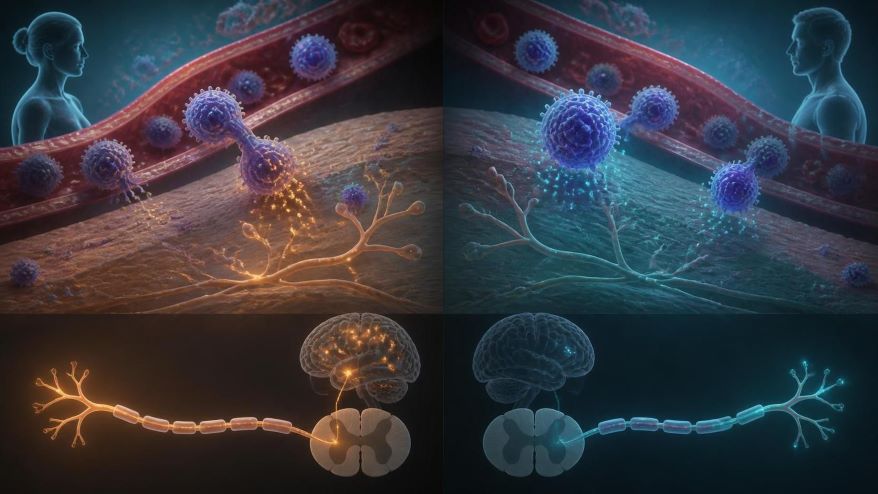
Monocytes are immune cells that circulate in the bloSignallingod and respond to injury and infection. Among other things, some monocytes produce IL-10, a molecule that can reduce inflammation and also act on pain-sensing neurons.
In this study, researchers found that male mice had more IL-10-producing monocytes and resolved pain faster than female mice. In a mouse model of inflammatory pain, reducing monocytes or disrupting IL-10 signaling delayed pain resolution. Similarly, data from people recovering from traumatic injuries linked higher monocyte and IL-10 levels with faster pain resolution in men. The researchers did not report that senescent immune memory cells in females release more IL-10 and prolong pain.
Therefore, the findings suggest that IL-10 may help switch off pain rather than extend it. They offer a possible explanation for some sex-related differences in pain resolution, but they do not prove why women experience higher rates of particular conditions, such as fibromyalgia or migraine. Further research will be needed to determine whether targeting this pathway can lead to effective treatments.
Aging Immune Memory Cells: A New Player in Pain Biology
Immunosenescence and Its Impact on Pain
The study does not show that immunosenescence or the senescence-associated secretory phenotype (SASP) drives pain. Instead, researchers found that IL-10-producing monocytes helped resolve inflammatory pain by signaling to sensory neurons. Male mice had more of these monocytes and recovered faster; disrupting IL-10 signaling impaired pain resolution in both sexes. In addition, the researchers linked higher monocyte and IL-10 levels with faster pain resolution in men after traumatic injury.
Rather than showing that female mice produce more IL-10, the study found that androgen signaling promoted IL-10 production by monocytes. Although these results may help guide future pain research, they do not establish a mechanism involving aged immune memory cells, explain pain in older women, or prove that estrogen drives the differences.
Study Methods and Validation
Animal Models Used
Researchers studied inflammatory pain in mouse skin rather than using spared nerve injury, von Frey filaments, thermal tests, or bone-marrow chimeras. They found that male mice had more IL-10-producing monocytes and resolved pain faster than female mice. To test the mechanism, they deleted Il10 in monocytes and Il10ra in sensory neurons. Pain resolution then slowed in both sexes. They also found that androgen signaling increased monocyte IL-10 production. In human data, higher monocyte and IL-10 levels correlated with faster pain resolution in men after traumatic injury.
Overall, the findings support a role for monocyte-derived IL-10 in pain resolution. However, they do not show that aged immune memory cells cause the sex difference or that replacing those cells reverses it. Researchers should report SNI, chimera experiments, or statistical significance only if the study documented them.
Implications for Pain Management
Sex-Specific Treatments
Current pain treatments do not routinely target sex-specific immune pathways. However, the study suggests that researchers could explore ways to strengthen pain-resolution signals. In mouse experiments, the team found that IL-10-producing monocytes helped resolve pain, and Resolvin D1 treatment increased these cells and accelerated pain resolution in both sexes.
Importantly, the study did not recommend blocking IL-10; its findings point toward supporting IL-10 signaling instead. Ustekinumab targets IL-12 and IL-23, not IL-10, so it does not provide a direct example of an IL-10 treatment. Likewise, the study did not test IL-10 receptor antagonists or senolytics. Those approaches should not be presented as proven or promising pain treatments based on these results. For now, researchers need to test whether boosting this pathway can safely help prevent persistent pain in people.
Frequently Asked Questions (FAQs): Ageing Immune Memory Cells
What makes tissue-resident memory T cells (TRM cells) different from other immune cells?
TRM cells stay permanently in tissues like the skin instead of circulating in the blood. This allows them to respond faster and more effectively to infections exactly where they occur.
Do immune cells become weaker or stronger as we age?
This research suggests that some immune cells, especially TRM cells, can actually become more effective over time by adapting to their environment and improving their memory of past infections.
How can this research help in real-world medicine?
Understanding aging immune memory cells can lead to better vaccines, improved treatments for older adults, and new therapies that boost the body’s natural immune defenses.
Reference
- Jergović, M., Miller, M., Saitovitch, D., et al. (2022). Age-associated tissue-resident memory T cells adapt and maintain protective immunity in the skin. Science Immunology, 7(70), eadx0292. https://doi.org/10.1126/sciimmunol.adx0292
Disclaimer: This article is for informational and educational purposes only and does not constitute medical advice. The content is based on published scientific research and is not intended to diagnose, treat, cure, or prevent any disease. Always consult a qualified healthcare professional for medical concerns or treatment decisions.
- Author
- Latest Posts

Lubna Nabi is a zoologist, science communicator, and life sciences specialist with a Master’s degree in Zoology and research focus in Limnology (the study of inland aquatic ecosystems). She combines hands-on laboratory experience with an interdisciplinary approach to biological and environmental research, bridging academic science with public literacy.
With a strong foundation in aquatic biology, laboratory techniques, and scientific outreach, Lubna excels at translating complex medical, biological, and ecological research into engaging, educational content. Her work focuses on fostering scientific curiosity, advancing environmental awareness, and promoting lifelong learning through clear, creative science communication.
- Author
- Latest Posts

I completed my Master of Science from the University of Allahabad in 2017 with a strong academic background in life sciences and chemistry. My specialization included Molecular Biology, Microbiology, Genetics, Plant Breeding, Phycology, Paleobotany, and Bioinformatics, along with Organic Chemistry, Inorganic Chemistry, and Physical Chemistry. This multidisciplinary training provided me with a comprehensive understanding of biological systems and analytical scientific approaches.
After completing my postgraduate studies, I gained valuable professional experience in both the education and social development sectors. I worked at A.M. Oxford Public School, where I was actively involved in guiding students toward academic excellence. In this role, I focused on creating an engaging learning environment, encouraging critical thinking, and nurturing students’ curiosity for scientific learning. My experience as an educator strengthened my communication, mentoring, and classroom management skills.
In addition to my teaching experience, I worked with Jeevan Jagriti Foundation, where I contributed to community-based initiatives aimed at improving educational access and awareness among underprivileged sections of society. Through this work, I participated in programs designed to support social development and promote the value of education in marginalized communities.
These professional experiences helped me develop strong interpersonal, leadership, and organizational skills while reinforcing my commitment to education and community service.


