Have you ever had a stomach bug that knocked you out for days?
How Norovirus Hijacks Gut Bacteria to Spread Infection
Estimated reading time: 6 minutes
The human gut houses trillions of microorganisms, and these bacteria can shape our health in surprising ways. However, recent research has revealed a darker side to this relationship: norovirus may exploit gut bacteria to spread infection.
On studying how norovirus hijacks gut bacteria, norovirus causes severe vomiting and diarrhoea worldwide, infecting nearly 700 million people each year. Until recently, scientists did not fully understand how it interacts with the gut. Now, a study analysing more than 11,000 metagenomes from around the world has identified bacterial patterns linked to health and explored how viruses may take advantage of these microbial communities.
As a result, researchers are gaining a clearer picture of the complex relationship between viruses and bacteria. Ultimately, understanding this process could help guide the development of better treatments. This article explains the findings in simple terms.
Key Takeaways
- Norovirus requires specific gut bacteria to start an infection
- The study analyzed 11,115 metagenomes from people worldwide
- A healthy gut microbiome shows a distinct bacterial signature
- Bacterial cell surface sugars help norovirus attach and enter cells
- Targeting bacterial interactions could prevent norovirus infections
- The research identified candidate biomarkers for gut health
- Understanding this process may lead to new probiotic therapies
What The Global Metagenome Study Reveals About Gut Health
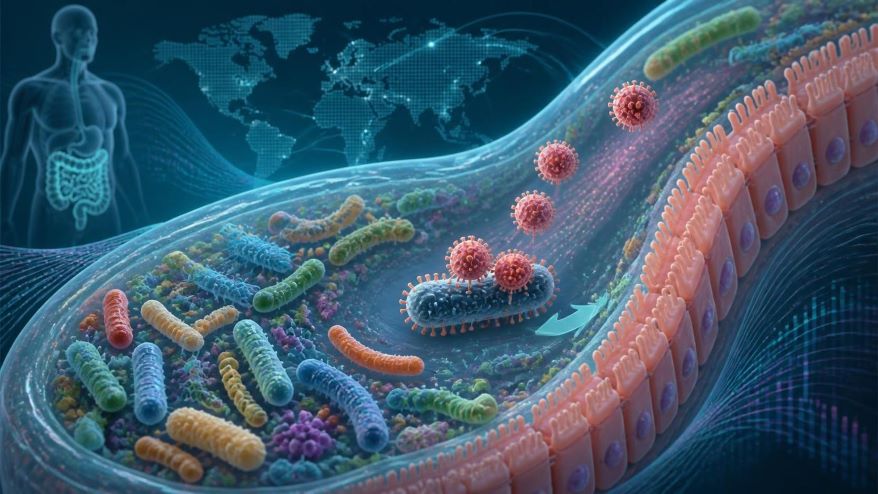
Scientists from multiple institutions worked together to analyse 11,115 metagenomes, making this the largest study of its kind. To begin, they set out to identify a universal signature of gut health by comparing healthy people with people affected by various diseases.
Across the data, the researchers found that healthy guts shared consistent bacterial patterns, despite differences in countries and diets. In particular, they identified 15 bacterial species strongly associated with good health. These bacteria produce short-chain fatty acids and help maintain the gut barrier.
By contrast, patients with infections had more disrupted bacterial communities. To uncover these patterns, the team used advanced machine learning, which can detect connections that might be difficult for people to spot. The findings, published in Cell Host & Microbe, on norovirus hijacking gut bacteria provide a baseline for comparing healthy and sick microbiomes. Ultimately, this research could have major implications for medicine.
How Researchers Analyzed 11,115 Global Metagenomes
The research team began by pooling data from more than 40 previous studies. To ensure consistency, they used stool-sample metagenomes and filtered out low-quality data. Next, they applied MetaPhlAn, a tool that identifies bacterial species from DNA sequences. The software detected thousands of bacterial types, which the researchers then compared across healthy and sick groups.
Moreover, the study included participants from 24 countries, giving the findings global relevance. To make the comparisons more reliable, the team accounted for factors such as age, diet, and antibiotic use. Previously, no study had attempted an analysis on this scale. Finally, the researchers published their code openly so other scientists can verify and reproduce their work.
| Feature | Details |
|---|---|
| Total metagenomes analyzed | 11,115 |
| Countries represented | 24 |
| Disease conditions studied | 15 |
| Key health bacteria identified | 15 species |
Understanding How Norovirus Hijacks Gut Bacteria At The Cellular Level
Norovirus may rely on certain bacteria to infect human cells. First, the virus attaches to sugar molecules on bacterial surfaces, including structures called histo-blood group antigens. Then, the bacteria may carry the virus toward intestinal cells, where it can detach and enter the cells.
In support of this idea, studies in mice have found that antibiotic treatment can reduce susceptibility to norovirus infection. Additionally, research in people suggests that gut bacteria may influence infection risk. However, bacterial diversity alone may not determine the outcome; rather, the specific types of bacteria present may matter, since some may assist the virus more than others.
The Role Of Bacterial Surface Sugars In Viral Entry
Bacterial surfaces contain complex sugar chains called glycans. Remarkably, norovirus has evolved to recognize some of these sugars using proteins known as P domains. Because this binding is highly specific, different norovirus strains may prefer different types of glycans. For example, the GII.4 strain, which causes many outbreaks, is reported to bind to type B sugars, while other strains may favor type A or H sugars.
As a result, differences in the bacteria people carry could influence their susceptibility to infection. Some bacterial species, including Bacteroides vulgatus and Escherichia coli, may provide sites that help norovirus attach. Therefore, when these bacteria are abundant, infection risk could rise. Conversely, other microbes may lack the sugars the virus recognizes, potentially making it harder for the virus to reach human cells.
Taken together, these findings suggest that the microbiome may affect viral infection not only through immune responses but also by shaping the virus’s access to cells. In the future, this idea could inform research into probiotic approaches.
| Bacterial Species | Glycan Type | Norovirus Binding |
|---|---|---|
| Enterobacter cloacae | Type B | High |
| Bacteroides vulgatus | Type A | Medium |
| Escherichia coli | Type H | Medium |
| Faecalibacterium prausnitzii | None | Low |
The Health Signature: What A Healthy Gut Microbiome Looks Like
The study identified a health signature made up of 15 core bacterial species. Together, these bacteria may help maintain gut health by producing beneficial substances. For example, the short-chain fatty acids they make nourish gut cells and help regulate the immune system.
Among these microbes, Akkermansia muciniphila may strengthen the gut barrier, while Bifidobacterium longum helps break down complex carbohydrates. In addition, gut bacteria can produce vitamins, including B vitamins and vitamin K.
At the same time, the health signature is characterized by low levels of potentially harmful bacteria and greater microbial diversity. This diversity may offer resilience: when one species declines, others can help fill its role. Notably, the researchers found similar patterns across cultures, suggesting that some features of gut health may be shared widely.
Frequently asked Questions
What is the human gut microbiome, and why is it important for health?
The human gut microbiome consists of microorganisms, including bacteria, that live in the digestive tract. Together, these microbes contribute to digestion, nutrient metabolism, and immune function, thereby supporting overall health. For this reason, studying the microbiome helps researchers better understand how microbial communities relate to disease
What are uncultured gut bacteria, and why are they important?
Uncultured gut bacteria are microorganisms that scientists have not yet been able to grow under standard laboratory conditions. Despite this limitation, they may play important roles in the intestinal ecosystem. In fact, more than 60% of gut microbial species remain uncultured. Therefore, learning more about these bacteria could reveal previously overlooked connections between the gut microbiome and human health.
What is CAG-170, and how is it associated with health?
CAG-170 is a bacterial genus that emerged as the strongest health-associated lineage in the study. Its abundance and diversity were associated with healthier gut microbial communities across multiple diseases and geographical regions. Researchers also found that it may contribute to microbial community stability.
Reference
da Silva, A. C., Lapkin, J., Yin, Q., Muller, E., & Almeida, A. (2025). Meta-analysis of the uncultured gut microbiome across 11,115 global metagenomes reveals a new candidate biomarker of health. bioRxiv, 2025-09. https://doi.org/10.1016/j.chom.2026.01.013
- Author
- Latest Posts

I am a Master’s qualified in Science with focus on Zoology and Entomology and am a passionate, curiosity-driven science enthusiast aiming to transform complex scientific ideas in a manner that are easy to understand hence, educate, and inspire.
I have an experience of working on the projects in the field of Entomology which has provided me hands-on experience with various research techniques. Besides, I have also gained experience of lab work as well as developed communication skills during the course of my bachelors and masters.
With a strong foundation in life sciences and a growing interest in Medical and Biological research, I have cultivated a writing style that merges scientific facts with creativity.
My experience in teaching has also taught me to develop an understanding of what are the interests of people and how to communicate them effectively.
I am committed to lifelong learning, actively engaging in Interdisciplinary learning, so as to broaden my perspective.
- Author
- Latest Posts

I completed my Master of Science from the University of Allahabad in 2017 with a strong academic background in life sciences and chemistry. My specialization included Molecular Biology, Microbiology, Genetics, Plant Breeding, Phycology, Paleobotany, and Bioinformatics, along with Organic Chemistry, Inorganic Chemistry, and Physical Chemistry. This multidisciplinary training provided me with a comprehensive understanding of biological systems and analytical scientific approaches.
After completing my postgraduate studies, I gained valuable professional experience in both the education and social development sectors. I worked at A.M. Oxford Public School, where I was actively involved in guiding students toward academic excellence. In this role, I focused on creating an engaging learning environment, encouraging critical thinking, and nurturing students’ curiosity for scientific learning. My experience as an educator strengthened my communication, mentoring, and classroom management skills.
In addition to my teaching experience, I worked with Jeevan Jagriti Foundation, where I contributed to community-based initiatives aimed at improving educational access and awareness among underprivileged sections of society. Through this work, I participated in programs designed to support social development and promote the value of education in marginalized communities.
These professional experiences helped me develop strong interpersonal, leadership, and organizational skills while reinforcing my commitment to education and community service.