We often think of our immune system as a noble army, fighting off invaders like bacteria and viruses. When it comes to cancer, we imagine immune cells help cancer by killing tumour cells. This view…
When Immune Cells Help Cancer: CCL3 and Aged Neutrophils Across Cancer Types

We often think of our immune system as a noble army, fighting off invaders like bacteria and viruses. When it comes to cancer, we imagine immune cells help cancer by killing tumour cells. This view is partially correct, but it is also dangerously incomplete. Recent research published in Cancer Cell reveals a troubling twist in this story. A specific type of immune cell, the ageing neutrophil, can betray the body. Instead of fighting the disease, these cells produce a signal called CCL3. This protein actively promotes tumour growth. This finding challenges our basic assumptions about cancer immunity. It forces us to rethink how immune cells help cancer progress rather than stop it. My goal here is to explain this complex biology in simple terms. We will explore the science behind this study. We will see why this matters for future treatments.
Key Takeaways
- Aged neutrophils are a specific subtype of white blood cell.
- These cells produce a protein called CCL3.
- CCL3 directly stimulates tumor growth across multiple cancer types.
- This process represents a form of immune suppression.
- Targeting this pathway could lead to new cancer therapies.
- The immune system’s role in cancer is complex and dual.
The Unexpected Role of the Immune System in Tumours
For decades, the central dogma of cancer immunology was simple: the body’s defenses hunt down and destroy abnormal cells. However, researchers once believed that protecting us was the immune system’s primary role. Today, though, they know the story is more complicated. Tumors are not passive targets; instead, they actively manipulate their surroundings and recruit normal cells to do their bidding.
That’s why the idea that immune cells can help cancer grow is so important. In effect, the tumor microenvironment behaves like a corrupt city, turning police officers into gang members. Here, the “police” are neutrophils. And, as the Cancer Cell study shows, this is how that corruption happens.
CCL3: The Growth Signal from Aged Neutrophils
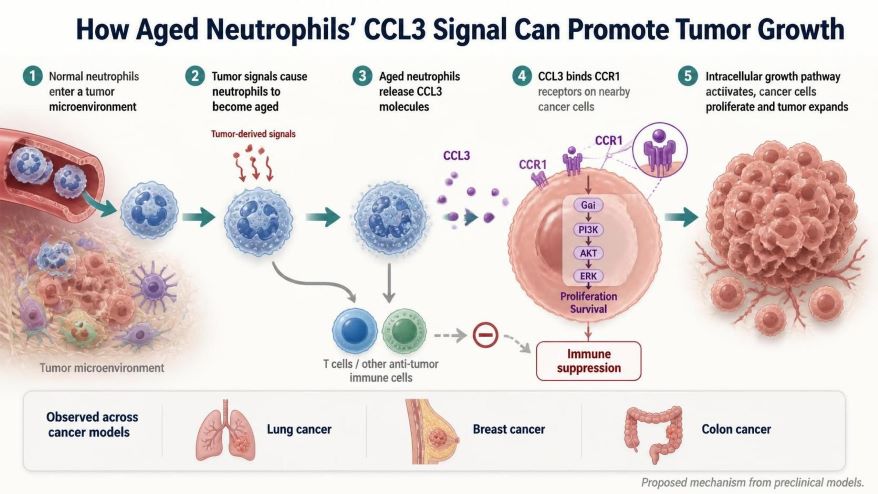
The discovery of CCL3’s role marks a significant step forward. Previously, researchers knew that tumors attracted myeloid cells, but they did not know which molecular signal prompted the process. Now, the Cancer Cell paper identifies the CCL3–CCR1 signalling axis—a lock-and-key mechanism. Aged neutrophils produce the “key,” CCL3, while cancer cells carry the “lock,” the CCR1 receptor. When CCL3 binds to CCR1, it sends a signal that can promote tumor growth.
The process unfolds in several stages:
- First, normal neutrophils enter the tumor.
- Then, the tumor environment changes the neutrophils as they age.
- As a result, these aged neutrophils produce high levels of CCL3.
- Next, CCL3 binds to CCR1 receptors on cancer cells.
- In turn, this binding activates growth pathways inside the cancer cells, helping the tumor expand.
- At the same time, the process suppresses other immune cells that might otherwise fight the tumor.
Thus, this is one example of how immune cells can support cancer by supplying growth signals. The study examined models of lung, breast, and colon cancer; across these models, CCL3 from aged neutrophils was associated with faster tumour growth. Taken together, the findings suggest that this mechanism may extend beyond a single cancer type, making it a potential target for therapies across multiple cancers.
How Do Immune Cells Help Cancer Evade Destruction?
Beyond promoting tumour growth, CCL3 also reshapes the immune landscape. In particular, it attracts more myeloid cells while helping create an environment that suppresses immune activity. As a result, the immune system’s role can shift from attacking the tumour to supporting its survival. The study found that higher CCL3 levels are associated with fewer active T cells—the immune cells that directly kill cancer cells. Thus, while aged neutrophils accumulate, the tumour’s killer cells may be reduced or impaired.
Together, these effects form a sophisticated survival strategy. The tumour effectively uses aged neutrophils to build a shield, with CCL3 helping suppress the body’s natural defences. At the same time, that signal can promote tumour growth. In other words, CCL3 may give the tumour both a growth boost and added protection.
Implications for Cancer Therapy and the Immune System
This research could have important implications for cancer treatment. Although checkpoint inhibitors have transformed care, they work for only some patients. One possible reason is that CCL3 creates a suppressive shield: when aged neutrophils produce high levels of CCL3, tumors may be better able to resist immune attack. Therefore, the study raises the possibility that blocking CCR1 could improve the effects of existing immunotherapies.
To put it another way, checkpoint inhibitors release one brake on the immune system, while CCL3 may apply another. So, blocking both signals could help restart the cancer-immunity cycle—the process that enables immune cells to recognize and kill cancer cells. Targeting CCL3 or CCR1 could be like removing a roadblock that is preventing that cycle from progressing.
Potential clinical applications include:
- Combination therapy: Pairing a CCR1 blocker with a PD-1 inhibitor.
- Biomarker testing: Measuring CCL3 levels in tumours to help predict treatment response.
- Disease assessment: Studying whether high levels of aged neutrophils are associated with more aggressive disease.
Overall, this research highlights how tumours can hijack the body’s own cells to support their survival. Rather than representing a failure of the immune system, this may reflect the tumour’s ability to manipulate it. Encouragingly, the findings point to a potential new target: disrupting communication between aged neutrophils and cancer cells.
The Future of Cancer Treatment: Breaking the Alliance
The discovery about CCL3 is just the beginning. The tumor microenvironment is incredibly complex. With attention to this complexity, researchers are mapping every interaction. They want to find every way that immune cells help cancer. This knowledge allows for smart drug design. We no longer have to blast the entire body with chemotherapy. That indiscriminate approach damages healthy cells too. Instead, we can design precise tools.
For example, a drug that only blocks the CCR1 receptor. This drug would not kill the neutrophil. It would just stop it from sending the bad signal. The immune system role would then be restored. The good immune cells could do their job. Meanwhile, the systemic side effects would be minimal. This is the promise of targeted immunotherapy.
So far, the data from the Cancer Cell study is pre-clinical. This means it comes from mouse models and lab experiments. Human trials are the next step. We need to confirm that the same mechanism works in people. Early evidence suggests it does. Human tumors show high levels of aged neutrophils and CCL3. This correlation is encouraging. The biology of age-related changes in cells is a hot topic. It turns out that aging is a problem for whole organisms. It is also a problem for our individual cells. An aged neutrophil is a dangerous cell.
Frequently Asked Questions
What is a neutrophil?
A neutrophil is a type of white blood cell, and it is essential for fighting bacterial infections. Additionally, it is the most common granulocyte in human blood.
What does “aged neutrophil” mean?
It refers to a neutrophil that has lived longer than usual. This ageing process changes its function. It stops killing and starts producing growth factors like CCL3.
Can we stop immune cells help cancer?
Yes, potentially. The study shows that blocking the CCL3 receptor (CCR1) can slow tumour growth. This approach represents a new therapeutic strategy.
Reference
Bolli, E., Wirapati, P., Hicham, M., Xie, Y., Siwicki, M., Duval, F., … & Pittet, M. J. (2026). CCL3 is produced by aged neutrophils across cancers and promotes tumor growth. Cancer Cell. https://doi.org/10.1016/j.ccell.2026.01.006
- Author
- Latest Posts

Lubna Nabi is a zoologist, science communicator, and life sciences specialist with a Master’s degree in Zoology and research focus in Limnology (the study of inland aquatic ecosystems). She combines hands-on laboratory experience with an interdisciplinary approach to biological and environmental research, bridging academic science with public literacy.
With a strong foundation in aquatic biology, laboratory techniques, and scientific outreach, Lubna excels at translating complex medical, biological, and ecological research into engaging, educational content. Her work focuses on fostering scientific curiosity, advancing environmental awareness, and promoting lifelong learning through clear, creative science communication.
- Author
- Latest Posts

I completed my Master of Science from the University of Allahabad in 2017 with a strong academic background in life sciences and chemistry. My specialization included Molecular Biology, Microbiology, Genetics, Plant Breeding, Phycology, Paleobotany, and Bioinformatics, along with Organic Chemistry, Inorganic Chemistry, and Physical Chemistry. This multidisciplinary training provided me with a comprehensive understanding of biological systems and analytical scientific approaches.
After completing my postgraduate studies, I gained valuable professional experience in both the education and social development sectors. I worked at A.M. Oxford Public School, where I was actively involved in guiding students toward academic excellence. In this role, I focused on creating an engaging learning environment, encouraging critical thinking, and nurturing students’ curiosity for scientific learning. My experience as an educator strengthened my communication, mentoring, and classroom management skills.
In addition to my teaching experience, I worked with Jeevan Jagriti Foundation, where I contributed to community-based initiatives aimed at improving educational access and awareness among underprivileged sections of society. Through this work, I participated in programs designed to support social development and promote the value of education in marginalized communities.
These professional experiences helped me develop strong interpersonal, leadership, and organizational skills while reinforcing my commitment to education and community service.