MOGAD Symptoms and Treatment: From a biological glitch to a 2026 medical breakthrough.
Satralizumab MOGAD Breakthrough: Scientists Cut Rare Brain Disease Relapses by 68%

Estimated reading time: 11 minutes
Picture waking up one morning — and you can’t see clearly. Your legs feel numb. Your body attacks its own nerves. This is the daily reality for people with MOGAD. It is a rare autoimmune disease that strikes without warning. Prior to this month, no drug had a specific approval for it. All of a sudden, that changed. On April 21, 2026, Roche and Genentech announced a massive win. Their drug satralizumab — sold as ENSPRYNG — cut attack risk by 68% in a Phase III clinical trial. MOGAD treatment 2026 just took its biggest leap forward — and science made it happen.
Key Takeaways
- What happened: Roche and Genentech hit the biggest MOGAD treatment 2026 milestone.
- The result: Satralizumab cut MOGAD relapse risk by 68% versus placebo.
- The drug: ENSPRYNG (satralizumab) targets the interleukin-6 (IL-6) receptor. The trial: Phase III METEOROID study — the first Phase III MOGAD trial ever succeed.
- Who it helps: People aged 12 and older with MOGAD.
- What’s next: Roche plans to submit data to health regulators for approval.
- Also in the pipeline: SAR445088, a new drug in trials for a related nerve disease called CIDP.
What Is MOGAD — and Why Does MOGAD Treatment 2026 Matter?
You may know about the nervous system in biology class. In general, nerves in your brain and spinal cord sit inside a protective layer called the myelin sheath. Think of it like the plastic coat on an electric wire. Without it, signals get scrambled. In fact, they can even stop completely.
MOGAD stands for Myelin Oligodendrocyte Glycoprotein Antibody-Associated Disease. That is a mouthful, so let us break it down:
- Myelin oligodendrocyte glycoprotein (MOG) is a protein that sits on the outer surface of the myelin sheath.
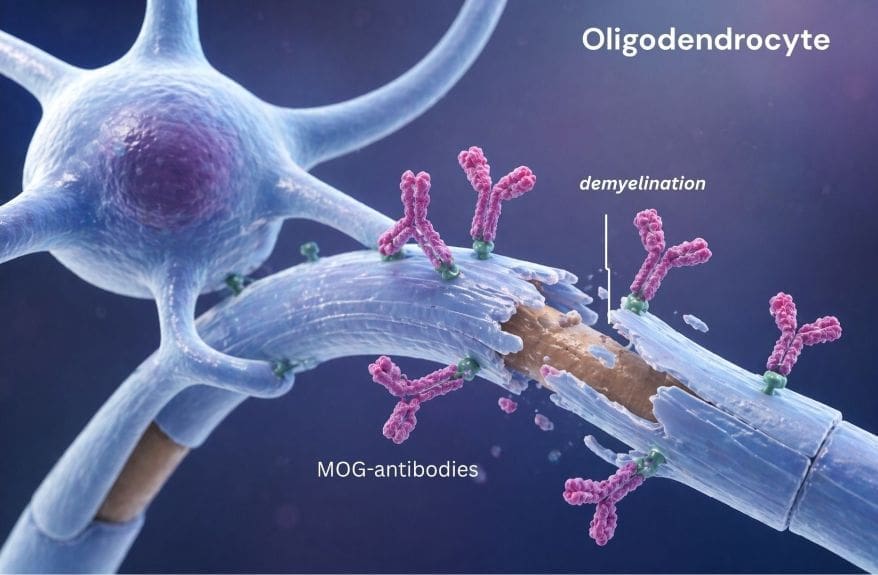
- In MOGAD, the immune system makes a mistake. As a result, It fires antibodies that attack MOG — targeting the body’s own nerve coating.
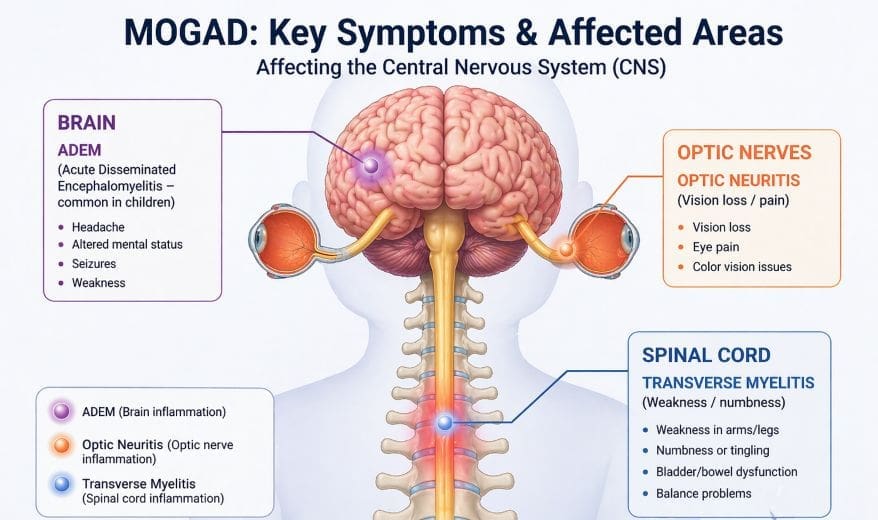
- In effect, this triggers inflammation in the optic nerves, spinal cord, and brain.
Up to now, no drug held a specific approval for MOGAD. That is exactly why the MOGAD treatment 2026 news matters so much for patients worldwide.
What Does MOGAD Actually Feel Like?
Symptoms hit fast. In addition, they vary from person to person. To enumerate the most common ones:
- Sudden eye pain or blurred vision (optic neuritis)
- Muscle weakness or numbness in the limbs
- Loss of bladder or bowel control
- Confusion, seizures, or brain swelling (encephalitis)
- Extreme fatigue and chronic pain
At any rate, MOGAD follows two patterns. On one hand, some people get a monophasic course. That means one episode that clears up. On the other hand, others get a relapsing course. As a result, attacks keep coming back. Relapsing MOGAD does the most damage over time. To that end, MOGAD treatment 2026 research targets this group most.
How Is MOGAD Different From MS and NMOSD?
While it may be true that MOGAD looks like multiple sclerosis (MS) on paper, doctors now treat them as two different diseases. As a matter of fact, they once mixed them up. MOGAD also differs from neuromyelitis optica (NMOSD). NMOSD is another autoimmune disease. It hits the optic nerves and spinal cord too. In contrast to MS — where CD8+ T cells lead — MOGAD lesions use CD4+ T cells. What’s more, MOGAD affects all genders almost equally. It also shows up more in children than adults, unlike NMOSD.
| Feature | MOGAD | NMOSD | Multiple Sclerosis |
| Primary Antibody | MOG-IgG | AQP4-IgG | None (Oligoclonal Bands) |
| Gender Ratio | Equal (1:1) | Mostly Women (9:1) | Mostly Women (3:1) |
| Typical Onset | Optic Neuritis / ADEM | Optic Neuritis / TM | Variable |
| MRI Pattern | Large, “fluffy” lesions | Long spinal lesions | Small, “Dawson’s fingers” |
MOGAD Treatment 2026 — How Does Satralizumab Actually Work?
The Drug: Satralizumab (ENSPRYNG)
Satralizumab is a monoclonal antibody. To explain, it is a lab-made protein. It hits one specific target in the body. That target is the interleukin-6 (IL-6) receptor. This precise aim makes it one of the best MOGAD treatment options tested so far.
Here is how it works, step by step:
- First, IL-6 is a signal molecule (cytokine). The body releases it when there is swelling.
- In MOGAD, IL-6 levels go up. This happens in the blood and in the fluid around the brain (CSF).
- As a result, high IL-6 drives T cells to cause more harm. It also tells plasma cells to make more bad antibodies. And it breaks down the blood-brain barrier.
- So, satralizumab blocks the IL-6 receptor. This cuts the chain reaction short.
- With IL-6 blocked, the drug lowers bad antibody levels. It calms T cells. It also helps fix the blood-brain barrier.
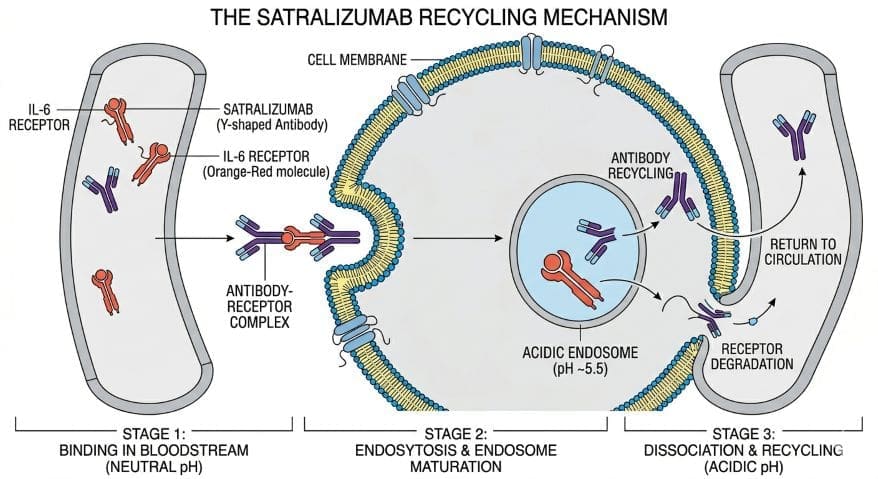
To put it differently — the drug shuts off the signal. That signal tells the immune system to keep hitting your own nerves. Chugai, part of the Roche Group, built it with a new method. They call it “recycling antibody technology.” In effect, it keeps the drug active in the body far longer than most drugs.
What Is NMOSD — and Why Does That Matter Here?
Seeing that satralizumab already holds approval for neuromyelitis optica (NMOSD) since 2020, researchers felt sure it could work as a MOGAD treatment too. Both diseases involve immune attacks on the optic nerves and spinal cord. At the present time, ENSPRYNG holds approval in about 90 countries for NMOSD. Doctors have treated over 9,000 patients with it. As a result, that gave scientists a head start. They already knew the drug was safe and worked well in a similar disease.
The METEOROID Trial — MOGAD Treatment 2026 Numbers That Matter
Roche ran the Phase III trial. It is called METEOROID (NCT05271409). To this end, this trial is the heart of all MOGAD treatment 2026 progress. Here is what stood out:
- First, the team enrolled people aged 12 and older with MOGAD.
- In addition, each person had at least one relapse in the past 12 months. Or two attacks in 24 months.
- The trial was random, double-blind, and placebo-controlled. In other words, this is the gold standard in research.
- Each person got satralizumab or a placebo. It went in as a shot under the skin. This happened every 4 weeks.
- In total, the blind phase ran for up to 44 months.
The result: Satralizumab cut new relapse risk by 68% versus placebo. The trial hit its main goal. In fact, the result was solid and reliable. If regulators say yes, this will be the first approved MOGAD treatment ever.
Why the MOGAD Treatment 2026 Breakthrough Matters for You as a Science Student
What Biology Concepts Are at Work Here?
All in all, this story brings your Grade 11 and 12 science to life:
- Antibodies and the immune system — B cells make antibodies to fight germs. In MOGAD, however, they turn on the body’s own proteins. Satralizumab is a monoclonal antibody used as a drug to stop this.
- Receptors and signal transduction — IL-6 binds its receptor to start swelling. In the same way, satralizumab blocks that receptor. This is the lock-and-key idea from cell biology class.
- Neurons and myelin — The myelin sheath speeds up nerve signals. When it breaks, signals slow or stop. In other words, this links to your Nervous System chapter.
- Clinical trials and the scientific method — METEOROID is a Phase III trial. To illustrate, It follows the same steps as the hypothesis-experiment-result cycle you learn in class.
In short, the MOGAD treatment 2026 story shows how your biology notes turn into real medicine.
How Could This Inspire Your Career?
At this point, many students think only doctors work in medicine. That is not true. In reality, a drug like satralizumab needs a full team:
- Biochemists who build antibody molecules in the lab.
- Immunologists who study how the immune system goes wrong.
- Neurologists who lead trials and treat patients.
- Data scientists who read and make sense of the trial data.
- Clinical research coordinators who run global trials day to day.
- Pharmacologists who track how drugs move through the body.
Above all, the entire MOGAD treatment 2026 journey — from a biology lab bench to a patient’s injection — only happens because people with a passion for science choose to make it their work.
What’s Next for MOGAD Treatment 2026 — and Beyond?
Regulatory Approval Is the Next Step
Roche and Genentech shared the METEOROID data on April 21, 2026. After that, they plan to send it to health regulators. This includes the US FDA and the European Medicines Agency. In other words, they want full approval for satralizumab as a MOGAD treatment. Sooner or later, if regulators say yes, this will be the first approved MOGAD treatment in history. At this time, patients and doctors watch that process with great hope.
What About CIDP — Another Nerve Disease?
In similar fashion to MOGAD, a rare nerve disease called Chronic Inflammatory Demyelinating Polyneuropathy (CIDP) is also getting research focus. CIDP hits the peripheral nervous system. To explain, these are the nerves outside the brain and spinal cord. Like MOGAD, CIDP is an autoimmune disease. It breaks down the myelin sheath. In addition, it has very few good treatments right now.
Sanofi runs a Phase 2 trial (NCT04658472) on SAR445088. This is a new monoclonal antibody. Notably, SAR445088 works differently from satralizumab. It targets the complement system. This is a separate part of the immune response. In fact, it is the part that damages peripheral nerves in CIDP.
To list the key details of this trial:
- Study ID: NCT04658472
- Drug: SAR445088 — a humanized IgG4 monoclonal antibody
- Target: Complement C1s protein in the immune cascade
- Design: Open-label, Phase 2 proof-of-concept study
- Participants: Adults aged 18 and older with a confirmed CIDP diagnosis
- Groups: Standard-of-care treated, standard-of-care refractory, and treatment-naïve patients
- Duration: Part A = 24 weeks; Part B = 52-week extension
Seeing that CIDP has so few good options, this trial fills a real gap in neurology. To sum it up, it is doing for CIDP what MOGAD treatment 2026 research does for MOGAD patients.
Is There a Bigger Picture Here?
While this may be true that MOGAD, NMOSD, and CIDP are each rare on their own, they all fall under autoimmune demyelinating diseases. At this time, researchers take what they learn from one disease and use it in the next. What’s more, each new drug teaches science more about how the immune system sends signals — and how to stop it when it targets the wrong cells.
In conclusion, we are in a golden era of targeted medicine for rare nerve diseases. The MOGAD treatment 2026 breakthrough is one big landmark in that journey.
2026: A Breakthrough Year for Autoimmunity
Beyond the success of the METEOROID trial for MOGAD, 2026 has been a landmark year for understanding how external triggers affect our immune systems. In the same way, environmental factors can spark similar neurological responses. To see how, read the recent article on the link between [Ticks and Autoimmune Disease].
Frequently Asked Questions (FAQs) about MOGAD treatment
What is the biggest MOGAD treatment 2026 news?
In April 2026, Roche and Genentech announced that satralizumab (ENSPRYNG) cut MOGAD relapse risk by 68% in the Phase III METEOROID trial. Notably, this is the first Phase III MOGAD treatment trial to ever succeed.
What is MOGAD in simple terms?
MOGAD is a rare autoimmune disease. The immune system mistakenly fires antibodies at the myelin sheath — the protective layer around nerve cells. This triggers sudden episodes of vision loss, weakness, and other neurological symptoms.
Is there any approved MOGAD treatment right now?
As of April 2026, no drug holds a specific MOGAD treatment approval. Satralizumab cut relapse risk by 68% in trials, and Roche plans to seek regulatory approval soon. For now, doctors rely on steroids and immunosuppressants to manage acute attacks.
How does satralizumab work as a MOGAD treatment?
Satralizumab blocks the interleukin-6 (IL-6) receptor. Blocking this receptor reduces inflammation, lowers autoantibody production, and protects the blood-brain barrier — all key drivers of MOGAD attacks.
Does satralizumab already hold approval for another disease?
Yes. Regulators in roughly 90 countries have approved satralizumab for neuromyelitis optica spectrum disorder (NMOSD) in AQP4 antibody positive patients. It does not yet hold a specific MOGAD treatment approval.
What is CIDP, and how is SAR445088 related?
CIDP is a rare autoimmune disease that attacks the peripheral nerves. Sanofi is testing SAR445088 (NCT04658472), a drug that targets the complement system, in a Phase 2 trial. Like the MOGAD treatment 2026 effort, it aims to close a major gap in rare disease care.
Can teenagers join MOGAD treatment trials?
Yes. In fact, the METEOROID trial enrolled people aged 12 and older alongside adults. As a result, this makes it one of the few large trials to include younger patients with MOGAD.
References
Marignier, R. et al (2021). Myelin-oligodendrocyte glycoprotein antibody-associated disease. The Lancet Neurology, 20(9), 762–772. https://doi.org/10.3389/fneur.2023.1137998
Wojciech Ambrosius et al (2021). Myelin oligodendrocyte glycoprotein antibody–associated disease: Current insights into the disease pathophysiology, diagnosis and management. International Journal of Molecular Sciences, 22(22), 12205. https://doi.org/10.3390/ijms22010100
Sechi, E. et al (2022). Myelin oligodendrocyte glycoprotein antibody-associated disease (MOGAD): A review of clinical and MRI features, diagnosis, and management. Frontiers in Neurology, 13, Article 885225. https://doi.org/10.3389/fneur.2022.885218
ClinicalTrials.gov. (2022). A study to evaluate the efficacy, safety, pharmacokinetics, and pharmacodynamics of satralizumab in patients with myelin oligodendrocyte glycoprotein antibody-associated disease (METEOROID). NCT05271409. U.S. National Library of Medicine. https://clinicaltrials.gov/study/NCT05271409
ClinicalTrials.gov. (2021). Proof-of-concept study for SAR445088 in chronic inflammatory demyelinating polyneuropathy (CIDP). NCT04658472. U.S. National Library of Medicine. https://clinicaltrials.gov/study/NCT04658472
Corbali, O., & Chitnis, T. (2023). Pathophysiology of myelin oligodendrocyte glycoprotein antibody disease. Frontiers in Neurology, 14, 1137998. https://doi.org/10.3389/fneur.2023.1137998
Querol, L., et al (2023). An innovative phase 2 proof-of-concept trial design to evaluate SAR445088, a monoclonal antibody targeting complement C1s in chronic inflammatory demyelinating polyneuropathy. Journal of the Peripheral Nervous System, 28(2), 276–285. doi: 10.1111/jns.12551.
- Author
- Latest Posts

Ayushi Shukla is a biotechnologist and science communicator specializing in the intersection of genomic data and public health. Previously, she served as a Core Member and R&D Lead at the HealthTech venture Eat Wisely Bro, where she spearheaded research initiatives and translated emerging medical data into product strategy. She holds an M.Sc. in Biotechnology from the TERI School of Advanced Studies, where her research at The Energy and Resources Institute (TERI), New Delhi, focused on Environmental Biotechnology and Bioremediation.
As a Research Scholar at TERI, Ayushi developed a plant growth-promoting bacterial consortium for high-salinity agricultural conditions, managing daily laboratory procedures and molecular workflows. Her technical portfolio on GitHub demonstrates her dry lab expertise, featuring end-to-end bioinfomatics pipelines for RNA-Seq analysis, Phylogenetic modeling, and a functional prototype for Mycobacterium tuberculosis Genomic Surveillance & Dashboard.
Her clinical foundation includes advanced training in Somatic NGS and Precision Oncology from the Cancer Research Centre at Tata Memorial Centre, and a professional certification in Good Clinical Practice (GLP) from the NIDA Clinical Trials Network. Ayushi bridges the gap between raw genomic data and student-friendly narratives to help the next generation of scientist understand the transformative power of modern biology.