What if the cure for cancer wasn't a drug made in a factory, but a "software update" for your own blood?
Why In Vivo CAR-T Just Became a $7 Billion Reality for Eli Lilly

What if your body could build its own cancer drug? No lab. No weeks of waiting. Just one quick injection — and your immune cells do the rest. This is not a dream. It is called in vivo CAR-T, and it just became the hottest idea in cancer research. On April 20, 2026, Eli Lilly agreed to pay up to $7 billion for a small biotech company called Kelonia Therapeutics. Kelonia built the tool that makes in vivo CAR-T work.
Key Takeaways
- In vivo CAR-T skips the lab entirely — your body makes the cancer-fighting cells itself.
- Eli Lilly is paying $3.25 billion upfront and up to $7 billion total for Kelonia Therapeutics.
- Kelonia built iGPS® — a system that places a new gene into your immune cells inside your body.
- The lead drug, KLN-1010, fights a blood cancer called multiple myeloma.
- In early trials, all four patients showed zero detectable cancer after treatment.
- Patients needed no harsh chemotherapy before taking this drug.
- This story connects to genetics, cell biology, and immunity — all topics from your class.
What Is In Vivo CAR-T and How Is It Different From Old CAR-T?
First, What Is CAR-T at All?
CAR-T therapy is a way to train your immune cells to fight cancer. CAR stands for Chimeric Antigen Receptor. Your immune system has cells called T-cells. These cells hunt and kill threats in your body. In CAR-T therapy, scientists give T-cells a new protein called a CAR. This protein helps T-cells spot and destroy cancer cells.
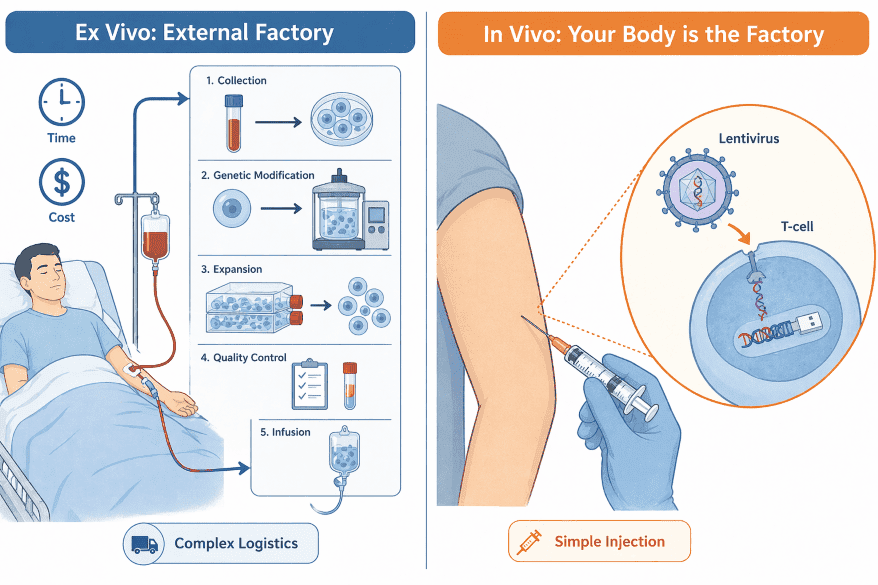
Prior to in vivo CAR-T, doctors used the old approach. To enumerate, the old method goes like this:
- Doctors pull T-cells out of the patient’s blood
- Scientists modify those cells in a lab for weeks
- Patients get heavy chemotherapy to prepare the body
- Doctors put the new T-cells back into the patient
While this works, it has serious barriers. In effect, it takes weeks to make. It costs hundreds of thousands of dollars. At the same time, most hospitals in the world simply cannot offer it.
So What Makes In Vivo CAR-T Special?
To put it simply, in vivo means “inside the living body.” In contrast to the old method, in vivo CAR-T skips the lab. In short, it works like this:
- Scientists build a tiny gene-carrying particle
- A doctor gives it to the patient as a simple injection
- The particle finds T-cells inside the patient’s body
- It drops a new gene into those T-cells
- The patient’s T-cells then become cancer fighters on their own
To rephrase it, your body becomes the factory. As a result, there is no costly lab. There is no long wait. What’s more, there is no need for pre-treatment chemotherapy. In vivo CAR-T makes cancer treatment faster, simpler, and far more accessible.
How Does In Vivo CAR-T Actually Work? The Science Behind iGPS®
This is where your biology and chemistry come alive. Kelonia built a system called iGPS® — the in vivo Gene Placement System. To illustrate, think of iGPS® as a smart delivery drone. It knows which cells to target. It drops off the right package. Then it leaves.
What Carries the Gene Into the Cell?
Kelonia uses a lentiviral particle to carry the gene. A lentivirus is a type of virus. Viruses are expert at getting inside cells. Scientists strip out the harmful parts of the virus. What is left is a safe, hollow shell. In like fashion, this shell carries the new CAR gene straight into a T-cell.
Kelonia made two key changes to this shell:
- Envelope changes — these help the particle enter T-cells easily
- Targeting molecules — these act like an address label, pointing only to T-cells
As a result, the particle goes to the right place. It does not enter other cells. To point out, this level of targeting is what makes in vivo CAR-T so precise and safe.
What Does the Gene Actually Do Inside the T-Cell?
To explain, the gene tells the T-cell to grow a new protein on its surface. This new protein is the CAR receptor. It acts like a lock that fits a specific key on cancer cells. Seeing that Kelonia’s lead drug targets a protein called BCMA on cancer cells, the T-cells can now spot and destroy those cells directly.
In essence, this connects three topics you already study:
- Genetics — how genes are placed and expressed in cells
- Cell biology — how T-cells respond and grow new surface proteins
- Biochemistry — how proteins on cell surfaces bind to each other
What Did the Clinical Trial Show?
The Phase 1 Results That Got the World’s Attention
At the present time, the KLN-1010 drug is being tested in a Phase 1 clinical trial called in MMyCAR. This is the first stage of testing in humans. The early data were shown at the American Society of Hematology (ASH) 2025 Annual Meeting. Seeing that this was the top session at the event, it shows how big these results were.
To list, here is what the data showed from the first four patients:
- 100% of patients had zero detectable cancer left after treatment
- Responses lasted at least five months in the two longest follow-up cases
- T-cells expanded to make up 85% of all circulating T-cells in the blood
- No severe side effects like cytokine release syndrome were seen
- Patients needed no pre-treatment chemotherapy at all
All things considered, a 100% early response rate with a clean safety profile is rare even for proven treatments. What’s more, this was achieved without the harsh steps that make old CAR-T so hard to access.
How Does the Chicken Egg Model Connect to In Vivo CAR-T Research?
In similar fashion, a published research paper adds another layer to this story. Wang et al. (2026) tested CAR-T cells using a chicken egg model — called the CAM assay. To explain, the CAM is a thin membrane inside a growing chicken egg. Scientists place human cancer cells on it. Then they test whether CAR-T cells can stop the cancer.
The study confirmed that CAR-T cells stopped tumour growth, spread, and new blood vessel growth. Balanced against standard lab mouse models, the chicken egg has a key advantage:
- It has a real, active immune system
- It is faster and cheaper to use
- It follows the 3Rs principle — Replacing, Reducing, and Refining animal use in research
To sum up, this model gives scientists a better, more ethical tool to develop drugs like those used in in vivo CAR-T research. In light of this, it is the kind of method that connects directly to your biology topics on experimental models and immune response.
What Does This Mean for Your Future?
All things considered, the Eli Lilly and Kelonia deal is not just business news. It is a signal of where science is going. In vivo CAR-T is a young field that still needs many more trained researchers. To list, here are the careers that directly built this technology:
- Molecular Biologist — designed the gene that gives T-cells new powers
- Immunologist — studied how T-cells find and destroy cancer cells
- Biomedical Engineer — built the tiny gene-delivery particles
- Clinical Researcher — designed and ran the Phase 1 trial
- Bioinformatician — read and made sense of the genetic data
- Pharmacologist — tested how the drug behaves safely in the body
Provided that you are you are already building the base for each of these careers. In fact, DNA, cell structure, immunity, and protein reactions all show up across every role listed above.
Frequently Asked Questions (FAQs) about In-vivo CAR-T
What is in vivo CAR-T in the simplest words?
In vivo CAR-T is a way to fight cancer using your own immune cells. A tiny particle carries a new gene into your T-cells — inside your body. Your T-cells then grow a new protein that spots and kills cancer cells. To sum up, no lab is needed. Your body builds the drug itself.
Why is in vivo CAR-T better than old CAR-T therapy?
Old CAR-T takes weeks in a lab. It costs hundreds of thousands of dollars. It also needs strong chemotherapy before treatment. In contrast, in vivo CAR-T is a simple injection. It works inside the body. At this point, it has no need for pre-treatment chemo. As a result, it could help far more patients around the world.
Why did Eli Lilly pay $7 billion for Kelonia?
Kelonia built the iGPS® system that makes in vivo CAR-T work. This technology removes the biggest barriers to making CAR-T therapy — the lab, the cost, and the wait. To that end, Lilly sees it as the future of cancer treatment. The total deal is worth up to $7 billion in cash.
What is multiple myeloma?
Multiple myeloma is a blood cancer that grows in the bone marrow. It affects a type of white blood cell. So far, existing treatments have helped some patients. In contrast, most patients have no access to current CAR-T options due to cost and complexity. In vivo CAR-T aims to change that.
Is KLN-1010 approved yet?
At the present time, KLN-1010 is still in Phase 1 trials — the first stage of human testing. It has not been approved by the FDA. So long as results stay positive, later trial phases and regulatory review will follow.
References
Eli Lilly and Company. (2026, April 20). Lilly to acquire Kelonia Therapeutics to advance in vivo CAR-T cell therapies [Press release]. https://investor.lilly.com/news-releases/news-release-details/lilly-acquire-kelonia-therapeutics-advance-vivo-car-t-cell
Wang, Y. et al (2026). An innovative in vivo model for CAR-T-cell therapy development: Efficacy evaluation of CD19-targeting CAR-T cells on human lymphoma, using the chicken CAM assay. International Journal of Molecular Sciences, 27(2), 795. https://doi.org/10.3390/ijms27020795
Disclaimer: This article is for educational purposes only. It does not constitute medical or financial advice. Clinical trial results are early-stage and not yet approved for wide use.
- Author
- Latest Posts

Ayushi Shukla is a biotechnologist and science communicator specializing in the intersection of genomic data and public health. Previously, she served as a Core Member and R&D Lead at the HealthTech venture Eat Wisely Bro, where she spearheaded research initiatives and translated emerging medical data into product strategy. She holds an M.Sc. in Biotechnology from the TERI School of Advanced Studies, where her research at The Energy and Resources Institute (TERI), New Delhi, focused on Environmental Biotechnology and Bioremediation.
As a Research Scholar at TERI, Ayushi developed a plant growth-promoting bacterial consortium for high-salinity agricultural conditions, managing daily laboratory procedures and molecular workflows. Her technical portfolio on GitHub demonstrates her dry lab expertise, featuring end-to-end bioinfomatics pipelines for RNA-Seq analysis, Phylogenetic modeling, and a functional prototype for Mycobacterium tuberculosis Genomic Surveillance & Dashboard.
Her clinical foundation includes advanced training in Somatic NGS and Precision Oncology from the Cancer Research Centre at Tata Memorial Centre, and a professional certification in Good Clinical Practice (GLP) from the NIDA Clinical Trials Network. Ayushi bridges the gap between raw genomic data and student-friendly narratives to help the next generation of scientist understand the transformative power of modern biology.