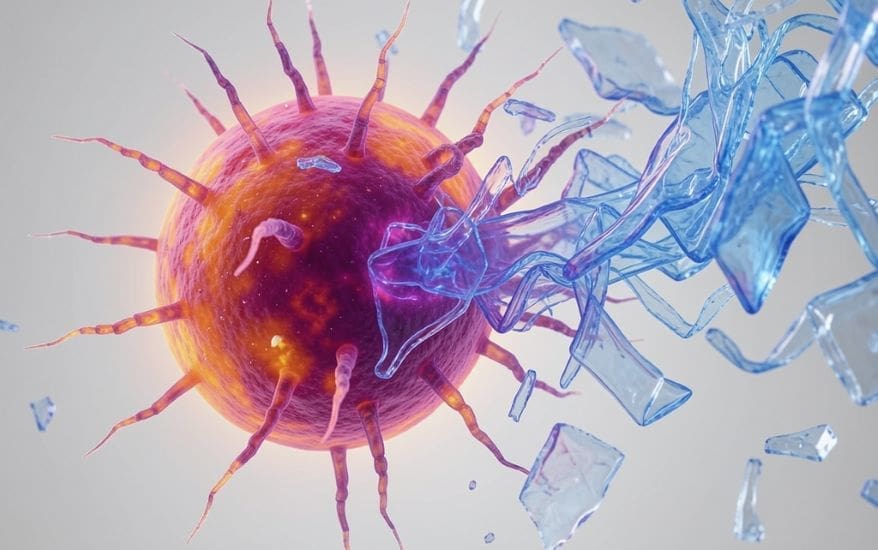
What if the secret to cleaning our oceans wasn't a bigger net, but a smarter AI?
AI Rewrites DNA to Eat Plastic 10x Faster!
Estimated reading time: 6 minutes
For decades, we’ve tried to teach bacteria to eat our plastic waste, but they’ve been ‘slow eaters.’ Traditional biotech could only change the ‘font’ of genetic instructions. However, a new AI called Ortholog Transformer for cross species genetics research is rewriting the entire script—making enzymes that are 10x more powerful.
Seeing that, plastic waste fills our oceans today. Now, scientists found a bacteria that eats plastic. However, this bacteria grows very slowly. Because of this, it is hard to use in factories. As I have said, a new AI now helps us fix this. Specifically, it rewrites instructions for fast-growing bacteria. This process is called cross-species gene redesign. Essentially, it changes the DNA of the enzyme. Ultimately, this makes the enzyme work in a new host. Consequently, common bacteria can eat plastic. This tech helps environmental protection immensely.
Highlights
Scientists used a new AI called Ortholog Transformer. Specifically, this tool performs cross species genetics research. It rewrites DNA for different bacteria. Most tools only change simple code parts. This AI actually changes the protein sequence. It learns from how nature evolves. Researchers tested this on plastic-eating enzymes. The results were remarkable: the redesigned enzyme works in common bacteria. It breaks down plastic 10 times faster. Ultimately, this discovery helps clean our planet.
Key Takeaways
- Traditional tools only swap synonymous codons.
- However, Ortholog Transformer changes the actual protein sequence.
- The AI mimics how nature evolves genes.
- Consequently, the model adapts genes for specific target species.
- As a result, protein expression improves significantly.
- Modified enzymes then produce 10 times more product.
- Machine learning solves complex biological problems.
- This improves protein expression significantly
Prior to this, scientists faced many limits, as they could only change small DNA parts. By contrast, AI now looks at the evolutionary history to find better solutions. You can read more biotechnology news here.
How AI Powers Cross Species Genetics Research
To explain, every species has its own language. Specifically, they use different DNA codons for amino acids. While standard tools just swap these codons, orthologous genes in nature do more. In fact, they change the amino acids themselves. Ultimately, this helps the protein fit its home.
Breaking the Synonymous Barrier
- The model uses a 20-layer architecture.
- It trains on millions of gene pairs.
- The AI acts like a language translator.
- It adds or removes small DNA bits.
- These bits are called indels.
- This makes the gene look native.
- It avoids translational bottlenecks effectively
What’s more, this AI goes much further by suggesting very strategic amino acid changes. These changes improve the enzyme stability. Genetic engineering is now more flexible.
Learning from Natural Evolution
- Nature adapts genes over millions of years.
- The AI learns these successful patterns.
- It keeps the important parts of proteins.
- The model changes less important areas.
- This preserves the biological function perfectly.
- It uses a two-stage learning strategy.
- This makes the AI very accurate
After that, the AI tests the new instructions. It predicts how the DNA will behave. It ensures the host can read it.
The Battle Against Global Plastic Pollution
Take the case of the PETase enzyme. It breaks down plastic water bottles. But the original source is very slow. To point out, the AI redesigned it. It put the gene into Bacillus subtilis. This host grows very fast.
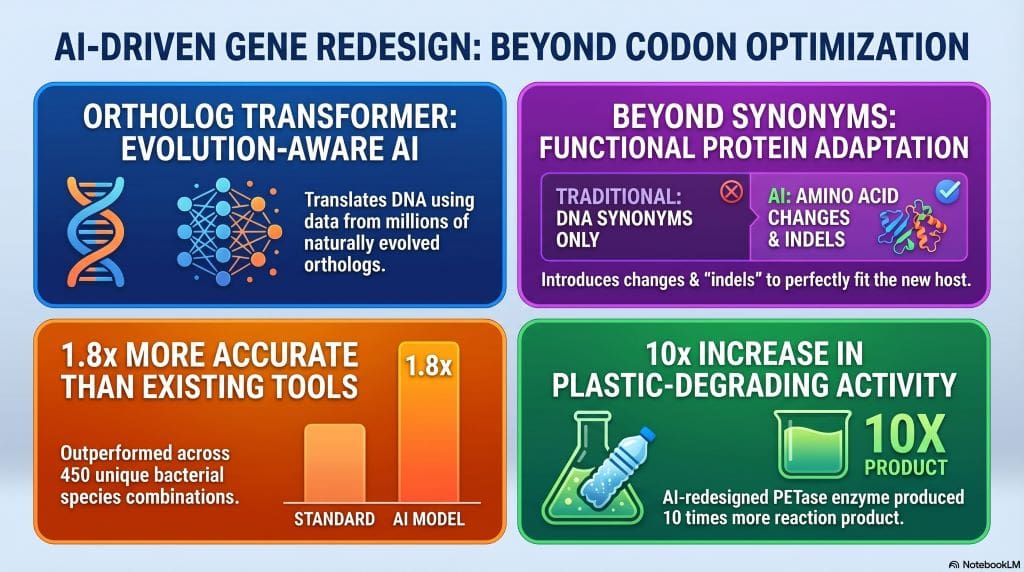
The AI model leverages evolutionary data from millions of orthologous genes to perform cross-species redesign. Unlike traditional codon optimization, which only swaps synonymous DNA “fonts,” this model suggests functional amino acid changes and indels. Results show a 1.8x improvement in accuracy over standard tools and a 10-fold increase in plastic-degrading product yield when applied to the PETase enzyme.
Results of the AI Experiment
- AI-designed genes produced much more mRNA.
- The protein levels were very high.
- The plastic showed deep holes and pits.
- The reaction produced 10-fold more product.
- The enzyme had higher activity overall.
- It worked well in different bacteria types.
- The catalytic efficiency jumped significantly.
So far, the results are very promising. The AI-designed enzyme is a top performer. It eats plastic much better than before.
From Lab to Real-World Application
All in all, this is a big win because we can now process plastic waste faster. Furthermore, the AI makes synthetic biology easier, as it allows us to use better bacteria.
Why This Research is Unique
- First, it goes beyond simple codon optimization.
- Moreover, the model handles insertions and deletions.
- Specifically, it uses Transformer-based deep learning.
- In doing so, the AI creates “ortholog designers”.
- Additionally, it balances host adaptation and function.
- Furthermore, the system is very fast to use.
- Ultimately, It provides a comprehensive approach.
In short, the AI is a game changer. Because it learns from nature’s own best solutions. It creates genes that feel at home. Ultimately, this is the future of sustainable technology.
Your Path with AI Power Cross Species Genetics Research
So, STEM is changing fast. You do not have to choose one path. Instead, you can study genetic coding and AI. This creates new types of jobs. To explore further, check out our STEM career guide for more.
How to Join This Field
- Learn the basics of DNA and RNA.
- Study how computer algorithms work.
- Explore how AI can help the environment.
- Practice coding in languages like Python.
- Stay curious about biological discoveries.
- Look for interdisciplinary university programs.
- Start your own small science projects.
In reality, the world needs your help. After all, you are the next science generation. With this intention, start exploring today. You can make a real difference.
Frequently Asked Questions (FAQs)
What is cross-species gene redesign?
It is an AI-guided way to rewrite DNA. It helps genes work in new species.
How does the AI learn to do this?
It studies millions of natural gene pairs. It learns how evolution changes DNA.
Can this AI fix other environmental problems?
Yes, it can redesign many different enzymes. It could help clean water or soil.
Why do we need AI for this?
DNA is very complex to rewrite manually. AI finds the best patterns quickly.
Is this safe for the environment?
Yes, it uses patterns found in nature. It makes natural processes work better.
Reference:
- Akiyama, M., Tashiro, M., Huang, Y. et al. Cross-species gene redesign leveraging ortholog information and generative modeling. Nat Commun 17, 2120 (2026). https://doi.org/10.1038/s41467-026-69966-0
- Author
- Latest Posts

Ayushi Shukla is a science communicator with a strong interest in biology, biotechnology, and emerging medical research. She focuses on translating complex research studies into clear and engaging content for students and early learners.
She holds an M.Sc. in Biotechnology, with expertise in microbial pathogenesis. During her postgraduate research, she worked on diverse areas ranging from in-silico analysis of Mycobacterium tuberculosis to environmental sustainability. As part of this work, she developed a plant growth-promoting bacterial consortium designed to improve crop productivity in high-salinity agricultural conditions.
She has also received training in precision oncology, with experience in RNA-seq analysis and next-generation sequencing (NGS). Her work spans both wet lab and dry lab research, allowing her to connect experimental science with data-driven insights.
Through her work, she aims to bridge the gap between academic science and real-world applications, helping readers understand how modern biology is shaping healthcare and the future of medicine.