The Battle for the Bio-Code!
Is Genetic Warfare Next? The Eight Trillion Dollar DNA Lock.
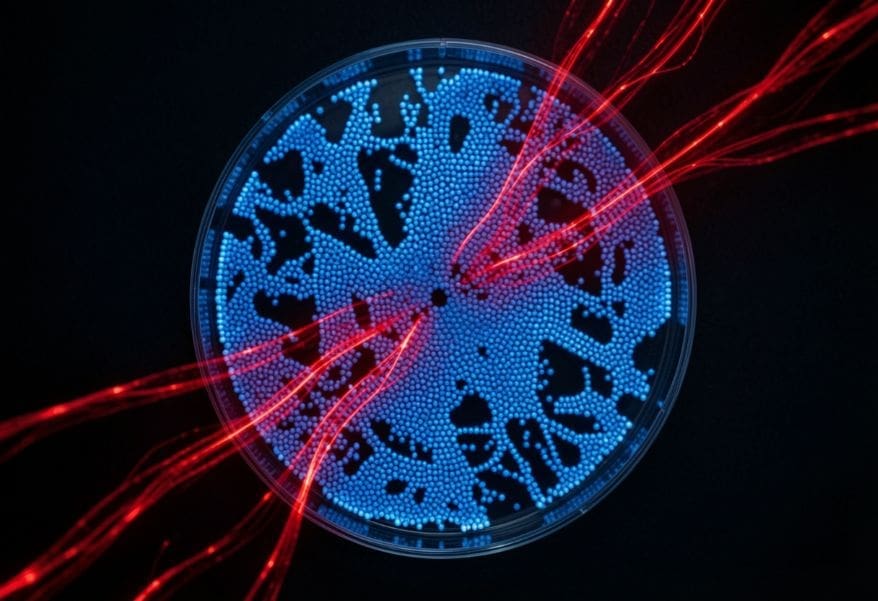
Genetic warfare is no longer just science fiction. It is a real security threat today. New technologies bring both power and risk. Therefore, cyber-biosecurity is now a major concern. Hostile acts could target our genetic material. However, scientists are building new defenses. In a recent study, researchers from Georgia Tech and MIT offer a solution. They use biohackathons as a genetic firewall. This approach brings diverse experts together. Consequently, they find hidden flaws in our biology. Then, they design strong countermeasures. This work offers hope for public safety. We can now protect life at the molecular level.
Highlights
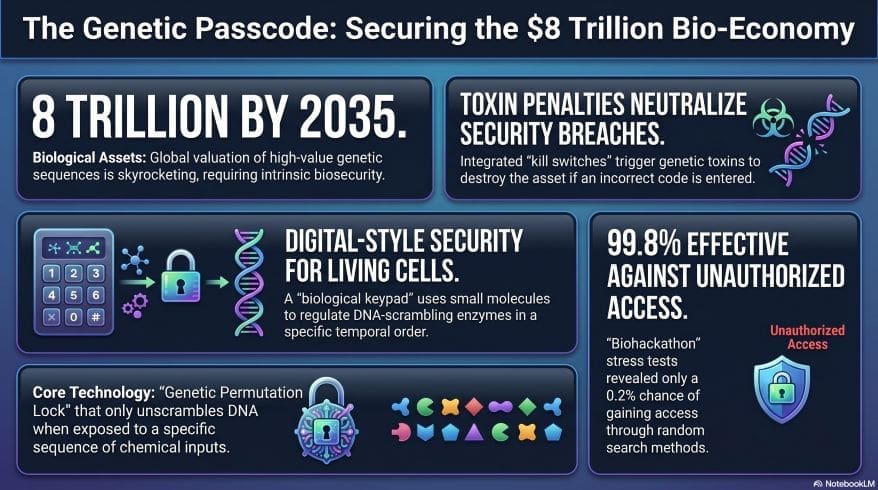
In Science Advances, scientists presented a cybersecurity platform. In reality, it gives built-in security to genetic assets. To explain, this technology uses DNA encryption and chemical passcodes. Prior to this, biological items were often left open to theft. What’s more, it protects these assets at the molecular level. Unauthorized tampering could lead to genetic warfare. Above all, biological items now become data to hack or protect.
Key Takeaways
Biosecurity is a race between attackers and defenders:
- Mixing biology with cybersecurity makes us much safer.
- Physical fences cannot stop a digital DNA hack.
- Biohackathons help experts find and fix security flaws.
- We must watch for the misuse of gene-editing tools.
- These new careers protect our health and our data.
The Science Behind Genetic Warfare Defense
To explain how these safeguards work, here’s what the study reveals:
- Biohackathons recruit diverse teams to find hidden security flaws.
- These events simulate hacks on protected genetic material.
- Teams try to break codes made of chemical passcodes.
- This approach helps experts build much stronger genetic locks.
- This method creates adaptive defenses against new biological threats.
Stopping Genetic Warfare
The Science Advances study described a war game. Researchers split into two groups: Red and Blue Teams. They mimicked a cyber-attack on high-value cell lines.
- The Blue Team (Defenders): At first, they built the genetic firewall. They used a special tool called orthogonal recombinases to scramble the Escherichia coli DNA. This strain was designed to produce a valuable chemical. While this may be true, without the correct molecular passcode, the cell stayed in a “locked state”. The genetic instructions looked like pure gibberish to anyone trying to steal the recipe.
- The Red Team (Attackers): In contrast, this group acted as the genetic warfare aggressors. Prior to this, they were given the encrypted DNA sequences. Their goal was to use computational algorithms and AI to “crack the code”. To the end, they tried to identify the hidden promoters and terminators that would turn the locked cell back on. All things considered, it was a high-stakes digital battle.
For the Next two weeks, war game continued:
- The Red Team tried to hack the DNA code.
- Meanwhile, defenders used logic gates using site-specific recombinase to hack the DNA code.
- Hackers only had a 0.2 percent success rate.
- This proves we can successfully lock our biology.
- Thieves can steal cells but not your designs.
- As a result, encryption stops people from copying DNA.
- Only authorized users can activate secret cell functions.
This ensures that only approved individuals can activate specific biological processes, protecting the planet from genetic warfare. All things considered, the biohackathon demonstrated that inviting everyone to attempt to breach your genetic firewall is the most effective way to identify a vulnerability.
From the Classroom to the Front Lines
The genetic warfare defense systems mentioned here rely on the very concepts you are studying right now.
- DNA Replication: At first, learn how code copies itself. In fact, scientists use this to scramble genetic data.
- Protein Synthesis: The “Genetic Firewall” blocks transcription. As a result, this stops genes from working without a key.
- Mendelian Genetics: You study how traits pass down. This helps keep the code steady. Consequently, security lasts for many cell generations.
Why Students Should Care About Genetic Warfare and Cyber-Biosecurity
- You can defend public health against advanced biological threats.
- To explain, this field uniquely combines technology, biology, and problem-solving.
- Careers include research labs, government agencies, and biotech startups.
- You’ll work where innovation meets global ethical responsibility.
- What’s more, your role could prevent outcomes caused by malicious genetic attacks
The Future Is Now: Genetic Warfare needs next-generation STEM leaders
Sooner or later, you will soon make the connection between genetics and cybersecurity. In reality, you are more prepared for this if you understand cyber-biosecurity. People will be shielded from emerging biological dangers by you. You have the necessary skills from your coursework. By comparison, careers in STEM fields are rewarding and full of responsibility. As has been noted, recent biohackathons demonstrate that collaboration prevents abuse. By working together, we can guarantee a safer future for all.
Frequently Asks Questions (FAQs)
What exactly is Genetic Warfare?
It involves using biological agents, manipulated via cyber systems for harmful purposes against people or ecosystems.
Is this threat theoretical or real?
While still emerging, experts warn it’s happening gradually due to cheap gene-editing tools spreading worldwide.
How does cyber-biosecurity help?
By monitoring digital pipelines entering labs and medical facilities it spots unauthorized genetic manipulations fast.
This sounds complicated; do I need special skills?
This field benefits from interdisciplinary training including computer science basics plus molecular biology concepts taught at grade 11–12 level.
What is a genomic hackathon/ biohackathon?
It is a competition to find security flaws. Consequently, researchers use these events to build a stronger firewall.
Can I build a career in this field?
Yes, and these roles are highly rewarding. Above all, can help protect the entire world.
How does AI play a role in Genetic Warfare?
AI can design new and deadly pathogens. In contrast, we use AI to detect these bio-attacks early.
What is a ‘Molecular Passcode’ in simple terms?
it is like a password for living cells. To list, you need specific chemicals to unlock locked DNA.
Is my personal DNA at risk right now?
While this may be true, the current risk is very low. However, we must build defenses now to stay fully safe.
Reference
Nielsen AH et al., (2026). Biohackathon Framework Advancing Cyber-Biosecurity Defenses Against Synthetic Biology Threats. Science Advances, 12(4). https://doi.org/10.1126/sciadv.aeb8556
- Author
- Latest Posts

Ayushi Shukla is a biotechnologist and science communicator specializing in the intersection of genomic data and public health. Previously, she served as a Core Member and R&D Lead at the HealthTech venture Eat Wisely Bro, where she spearheaded research initiatives and translated emerging medical data into product strategy. She holds an M.Sc. in Biotechnology from the TERI School of Advanced Studies, where her research at The Energy and Resources Institute (TERI), New Delhi, focused on Environmental Biotechnology and Bioremediation.
As a Research Scholar at TERI, Ayushi developed a plant growth-promoting bacterial consortium for high-salinity agricultural conditions, managing daily laboratory procedures and molecular workflows. Her technical portfolio on GitHub demonstrates her dry lab expertise, featuring end-to-end bioinfomatics pipelines for RNA-Seq analysis, Phylogenetic modeling, and a functional prototype for Mycobacterium tuberculosis Genomic Surveillance & Dashboard.
Her clinical foundation includes advanced training in Somatic NGS and Precision Oncology from the Cancer Research Centre at Tata Memorial Centre, and a professional certification in Good Clinical Practice (GLP) from the NIDA Clinical Trials Network. Ayushi bridges the gap between raw genomic data and student-friendly narratives to help the next generation of scientist understand the transformative power of modern biology.