The study focuses on identifying stable, high-performing upland rice genotypes to support sustainable agricultural systems under varying environmental conditions.
Upland Rice Stability and Performance Under Water Deficit
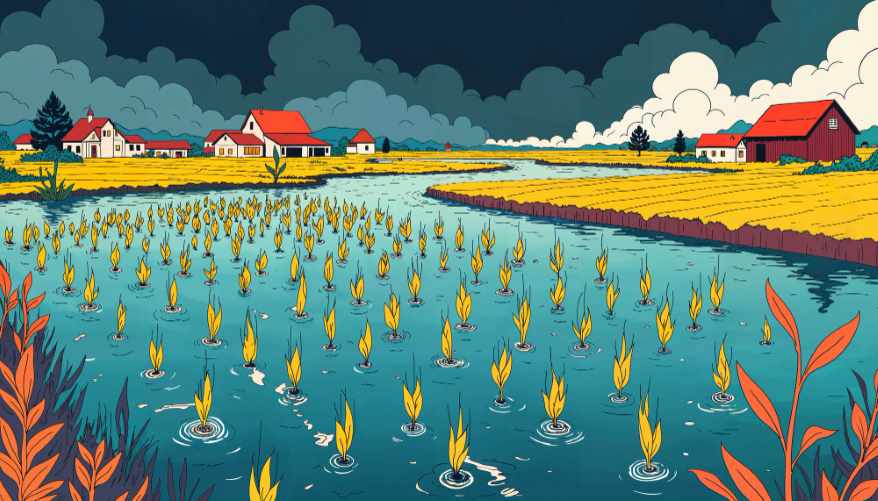
Water deficit threatens the food we rely on every day. Rice, a staple for billions, requires large amounts of water. The challenge lies in growing rice under water deficit conditions. A recent study identified four upland rice lines that remain stable and productive even during water deficit. These resilient plants can help farmers produce more food with lesgs water. This is exciting news for scientists, students, and future engineers who aim to solve global challenges through science..
TL;DR ‘Water Deficit’
Drought stress significantly threatens rice productivity and global food security, making stability and resilience key research priorities. By bringing together multiple disciplines, this breakthrough connects biology, chemistry, and health science. In doing so, it inspires students to pursue future careers in STEM fields.
Key Takeaways
- Scientists grew 25 rice lines.
- They used nine different environments.
- Some environments had severe droughts.
- Others had plenty of water.
- Experts measured the grain yield.
- They checked the flowering time
Key Discoveries About Drought-Resistant Rice
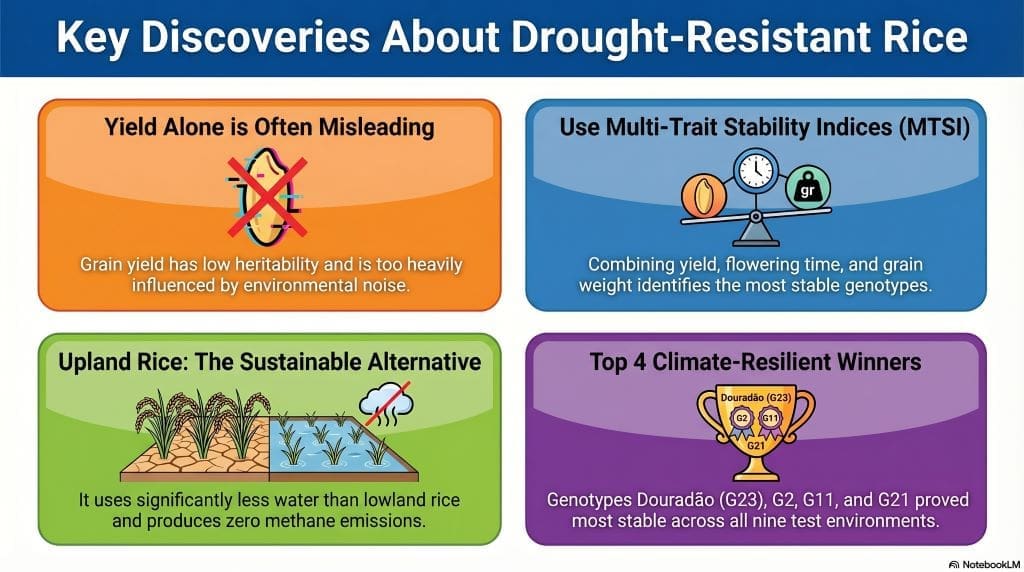
The research tested 25 types of upland rice across nine locations for three years.
- Douradão (G23), G2, G21, and G11 showed the best yield and stability across dry and wet conditions.
- Multi-trait indices helped select plants that perform well in many traits at once.
- Drought reduces grain yield, but these new lines manage stable production.
- Water-efficient farming with upland rice could cut down overall water use in agriculture.
This approach moves beyond focusing on just one trait like yield. It looks at flowering time, grain size, spikelets per panicle, and sterile spikelets too.
The Big Challenge
Growing upland rice is actually quite hard. At first, the weather changes very constantly. Unexpected dry spells really hurt the crops. Plants struggle to make any good grains.
- To begin with, water deficit severely reduces crop yield.
- In particular, the reproductive stages of the plant are highly critical.
- At the same time, genetics play a key role in controlling these traits.
- On the other hand, environmental conditions can drastically influence plant growth.
- For this reason, scientists need to develop adaptable crop types
The Power of Data
Modern digital farming needs massive big data. In similar fashion, new tech helps immensely. Computers reliably run complex models every day. This greatly speeds up all crop selection.
- They used mixed statistical models.
- They checked the genetic variance.
- Computers removed the environmental noise.
- Math finds the hidden patterns.
- Data protects our future food
Why Multi-Trait Selection Matters in Crop Science
A key step was using special math called the Multi-Trait Stability Index (MTSI). It combines data from many traits to find genotypes closest to an ‘ideal’ plant. That way:
- Researchers select crops that balance performance and stability.
- The risk of picking only drought-sensitive high-yield plants falls.
- Selecting for one trait alone can be misleading due to environment effects.
This science shows how combining biology with statistics helps crop breeders pick winners faster — a skill vital for STEM careers like agricultural engineering or data science.
The Technology Behind Cultivar Testing
The study used BLUP (Best Linear Unbiased Prediction) to estimate how each line performs under different environments. Then WAASB indices quantified stability by summarizing complex interactions on genotype-by-environment effects. This statistical power lets breeders know which varieties will thrive not just now but also under climate challenges ahead.
Overcoming Bad Soil
Farming desperately needs very good soil quality. At the same time, bad weather hurts. A strong seed resists all daily stress. This eventually saves farmers much precious money.
- To begin with, fields face intense dry heat conditions.
- In response to this, seeds must sprout very quickly.
- At the same time, roots need to grow deep into the soil.
- As a result, deeper roots can access hidden water sources.
- With these advancements, science makes this entirely possible.
The Real-World Impact for You and Farmers Everywhere
Drought-resistant upland rice means farmers can grow crops with less irrigation while maintaining good yields. Some benefits include:
- Sustainability: Less water use preserves precious freshwater reserves worldwide.
- Food Security: Resilient crops secure supplies during dry seasons or climate change impacts.
- Ecosystem Protection: Upland cultivation reduces methane emissions versus lowland flooding methods.
If you’re interested in environmental science or engineering careers focused on sustainability, this is an inspiring field worth exploring further through platforms like ENTECH Online’s STEM resources here.
Cultivating Your STEM Passion Through Plant Science
This real-world example connects biology, statistics, environmental science, and technology — all fields teens study in grades 11-12:
- You learn about genetics when selecting superior rice lines from parents BRS Soberana and Douradão under drought stress.
- Your chemistry knowledge helps explain plant responses to water shortage during flowering stages impacting grain quality.
- Your math skills grow as you apply statistical models to handle genotype-environment interactions accurately for selection advice to farmers worldwide.
- Your tech enthusiasm expands with lab tools plus weather sensors tracking soil moisture during the experiment’s dry periods helping manage irrigation smartly
Reference
- De Moura, A. M., Berchembrock, Y. V., De Castro, A. P., Tomé, L. M., Da Silva Reis, C. S. C., Simão, J. M. G., & Botelho, F. B. S. (2026). Stability and phenotypic performance of upland rice subjected to water deficit using a multi‐trait index. Agronomy Journal, 118(2). https://doi.org/10.1002/agj2.70368
- Author
- Latest Posts

I completed my Master of Science from the University of Allahabad in 2017 with a strong academic background in life sciences and chemistry. My specialization included Molecular Biology, Microbiology, Genetics, Plant Breeding, Phycology, Paleobotany, and Bioinformatics, along with Organic Chemistry, Inorganic Chemistry, and Physical Chemistry. This multidisciplinary training provided me with a comprehensive understanding of biological systems and analytical scientific approaches.
After completing my postgraduate studies, I gained valuable professional experience in both the education and social development sectors. I worked at A.M. Oxford Public School, where I was actively involved in guiding students toward academic excellence. In this role, I focused on creating an engaging learning environment, encouraging critical thinking, and nurturing students’ curiosity for scientific learning. My experience as an educator strengthened my communication, mentoring, and classroom management skills.
In addition to my teaching experience, I worked with Jeevan Jagriti Foundation, where I contributed to community-based initiatives aimed at improving educational access and awareness among underprivileged sections of society. Through this work, I participated in programs designed to support social development and promote the value of education in marginalized communities.
These professional experiences helped me develop strong interpersonal, leadership, and organizational skills while reinforcing my commitment to education and community service.