How do massive planets form? Webb telescope reveals 29 Cygni b's secrets through metal-enriched atmosphere detection. Perfect for aspiring astronomers and scientists
Giant Planet Mystery Solved: Webb Telescope Shows How Planets Form
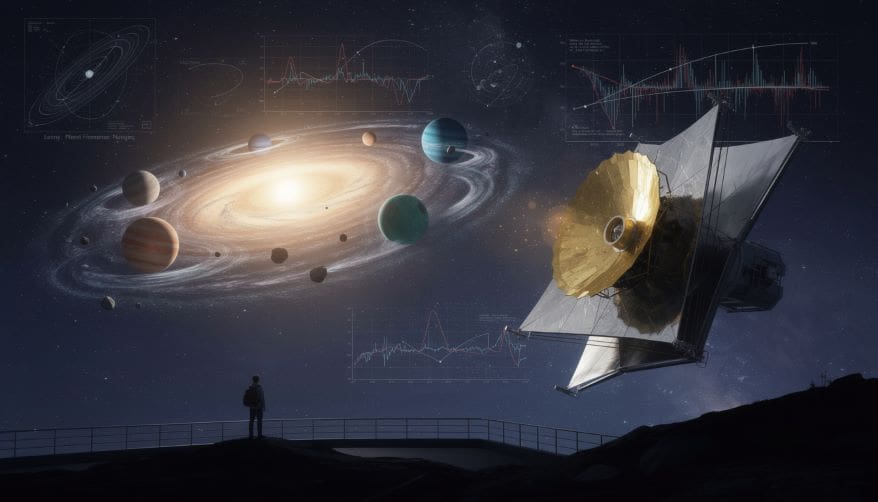
What if a planet weighs fifteen times more than Jupiter? Scientists just discovered one orbiting a nearby star. The James Webb Space Telescope found surprising evidence about how planets form. The discovery rewrites our understanding of planet formation in the universe. It suggests that truly massive planets grow differently than we thought. This finding could reshape your career path if you love astronomy. Read on to see why this matters for your future in science.
Key Takeaways
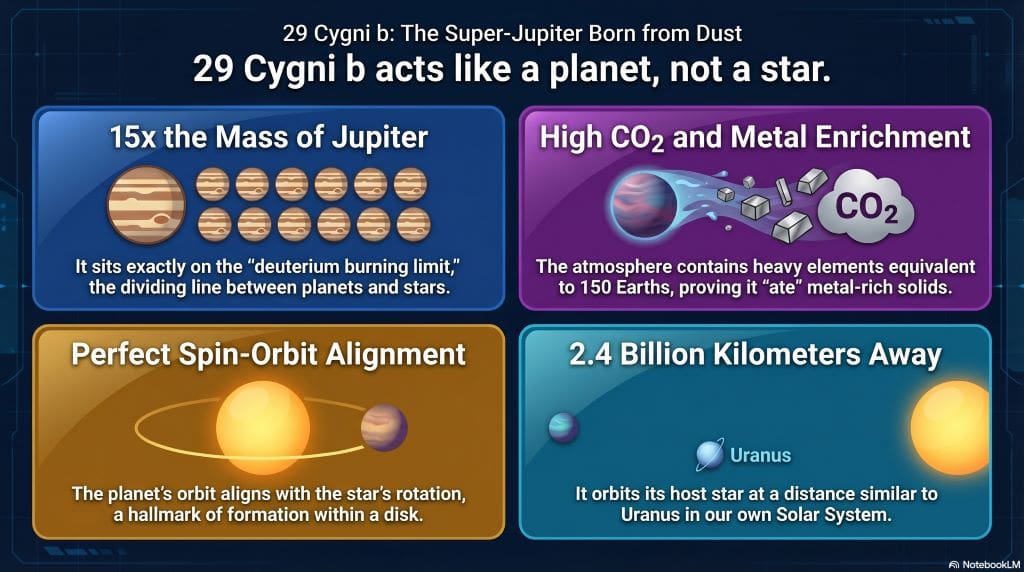
- 29 Cygni b weighs 15 times more than Jupiter. It orbits 2.4 billion kilometers from its star.
- Two formation methods exist for massive objects. Bottom-up accretion builds planets gradually. Top-down fragmentation creates them quickly.
- Webb detected metal-enriched atmospheres on this super-Jupiter. This proves it formed like a planet, not a star.
- Orbital alignment confirms planetary origin. The planet’s orbit matches the star’s rotation direction.
- This discovery opens careers in space exploration. Engineers, astronomers, and data scientists drive this research.
- Metal content equals about 150 Earths’ worth. This tells scientists how planets accumulate material.
How Webb Telescope Discovered 29 Cygni b: Giant Planet Formation Evidence
The Webb Telescope’s Breakthrough Discovery
The James Webb Space Telescope made history again. In April 2026, it captured the first detailed images of 29 Cygni b. This exoplanet sits right on the border between planets and stars. Webb used special filters to examine its atmosphere directly. Prior to this observation, scientists couldn’t confirm how it formed. The telescope spotted chemical signatures that solved this mystery. To illustrate the importance: this detection required breakthrough imaging technology.
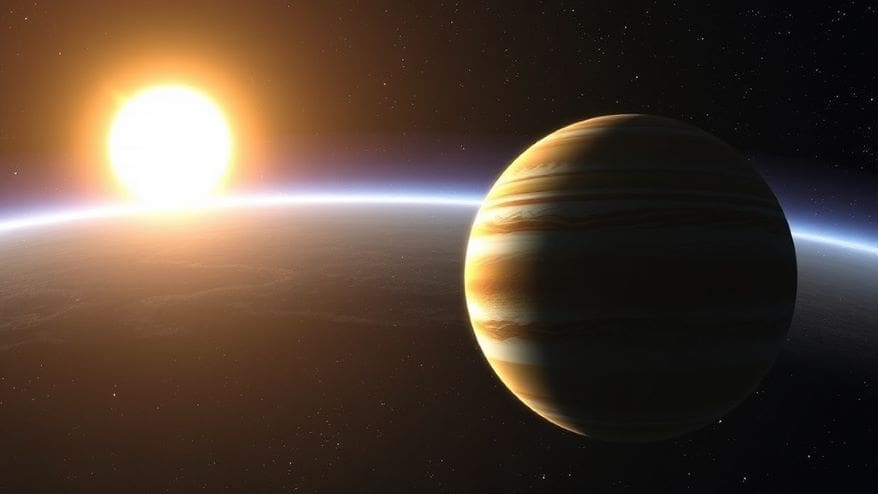
Scientists needed to block the star’s blinding light. Webb’s coronagraphic mask achieved this successfully. The companion planet became visible at 4-5 micrometers wavelength. This infrared light revealed crucial chemical information about the atmosphere. At any rate, the results surprised the entire astronomy community. What’s more, the findings matched predictions from planet-formation theory.
What the Chemical Signals Revealed
Webb detected two specific molecules: carbon dioxide and carbon monoxide. In this case, these chemicals exist at precise wavelengths in the infrared spectrum. Also, their absorption patterns tell us about atmospheric composition. To enumerate the key findings:
- Carbon dioxide appears strongly at 4.3 micrometers
- Carbon monoxide shows up at 4.6 micrometers
- The ratio between them indicates metal enrichment
- Metal content exceeds the host star’s composition by three times
- This enrichment pattern matches planetary formation processes
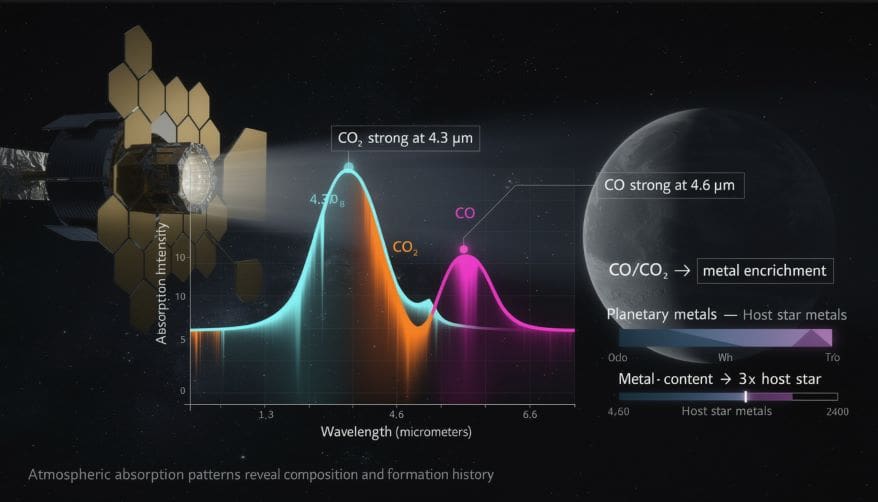
The strength of these signals proved decisive. As an illustration, metal-rich planets accumulate solids during formation. Stars, by contrast, form from pure gas collapse. This distinction made all the difference in solving the mystery.
Planet Formation Methods: Accretion vs. Fragmentation Explained
The Bottom-Up Method (Planet Growth)
Planets form through gradual accumulation in a bottom-up approach. Small dust particles collide and stick together initially. These combine into pebbles, then rocks, then planetesimals. As a result, larger and larger objects develop over time. This process takes millions of years to complete. Eventually, a massive core attracts gas from surrounding space. After that, a full-sized planet emerges from this gradual assembly.
This method creates planets with metal enrichment. Planets gather solid material before capturing gas. The metals get locked into the atmosphere permanently. On one hand, this requires tremendous amounts of time. On the other hand, it’s the only way to explain metal-rich atmospheres. 29 Cygni b shows exactly this chemical signature pattern.
The Top-Down Method (Star Formation)
The top-down approach works completely differently for massive objects. At this instant, a giant cloud of gas fragments into pieces. Each piece collapses under its own gravity independently. This fragmentation happens very quickly—in just thousands of years. For the most part, fragments become brown dwarfs or stars. This method produces objects with stellar composition, not planetary composition.
Top-down fragmentation rarely creates planets at all. When it does, those planets remain metal-poor. They never accumulate the enriched metal signatures planets show. In reality, this method favors creating brown dwarfs and stars. As I have noted, distinguishing between these methods requires careful observation. That’s exactly what Webb accomplished with 29 Cygni b observations.
How Scientists Tell Them Apart
To repeat the crucial distinction: chemistry reveals formation history. Metal enrichment points to bottom-up accretion. As a result, stellar composition indicates top-down fragmentation. Webb measured the metallicity ratio carefully. The planet contains three times more metals than its host star. This finding strongly suggests planetary formation through accretion. Prior to Webb’s observations, astronomers couldn’t measure this directly.
Orbital alignment provides another crucial clue. Planets form within protoplanetary discs around stars. Their orbits naturally align with stellar rotation. Fragmented objects from clouds orbit randomly. Scientists used ground-based telescopes to measure the host star’s spin. They found the planet’s orbit aligned with the star’s rotation. This alignment confirmed the accretion scenario. Above all, multiple independent lines of evidence converged on one conclusion.
STEM Careers in Exoplanet Research: Your Path to Space Science
Real Career Opportunities in Exoplanet Research
This discovery showcases modern astronomy at work. Multiple technologies and specialties combined to solve this mystery. Consider these career paths emerging directly from this research:
- Aerospace engineers design and build space telescopes like Webb
- Astronomers conduct observations and analyze exoplanet data
- Software developers process massive datasets from space missions
- Physicists develop new detection methods and technologies
- Data scientists identify patterns in complex astronomical information
- Instrument engineers create specialized cameras and spectrographs
- Mission planners coordinate observation schedules across the globe
At this time, these positions are in high demand. The space industry continues expanding rapidly. More missions are planned for the next decade. Seeing that Webb generates petabytes of data annually, someone needs to organize it. That someone could be you. This field needs creative problem-solvers and curious minds.
How Your High School Classes Connect Here
Your current science courses directly support this research. To put it differently, every subject interlinks with exoplanet science:
- Physics teaches orbital mechanics and Newton’s laws
- Chemistry explains atomic composition and molecular detection
- Mathematics models formation processes and data analysis
- Biology (indirectly) helps us understand potential habitability
- Computer science enables data processing and simulations
- Earth science provides context for planetary atmospheres
In essence, this career path requires mastery across all STEM subjects. What’s more, interdisciplinary thinking separates good scientists from great ones. Moreover, your teachers aren’t just teaching abstract concepts. In fact, they’re preparing you for discoveries like this one. Certainly, taking these subjects seriously now pays dividends later.
Building Your Path to Space Science
To that end, consider starting your preparation now. In short, here’s what high school students can do:
- Maintain excellent grades in math and science courses
- Join science clubs and astronomy groups at school
- Participate in science fairs and competitions
- Complete online astronomy or coding courses
- Attend space science camps during summers
- Follow NASA and ESA missions on social media
- Read peer-reviewed articles about exoplanet discoveries
- Build projects related to your interests (telescopes, spectroscopy)
All in all, success requires consistent effort and genuine curiosity. Sooner or later, university programs will evaluate your preparation. Starting early gives you significant advantages over other applicants. This discovery could inspire your entire career trajectory.
Key Facts About 29 Cygni b
To list the essential details systematically:
Physical Properties:
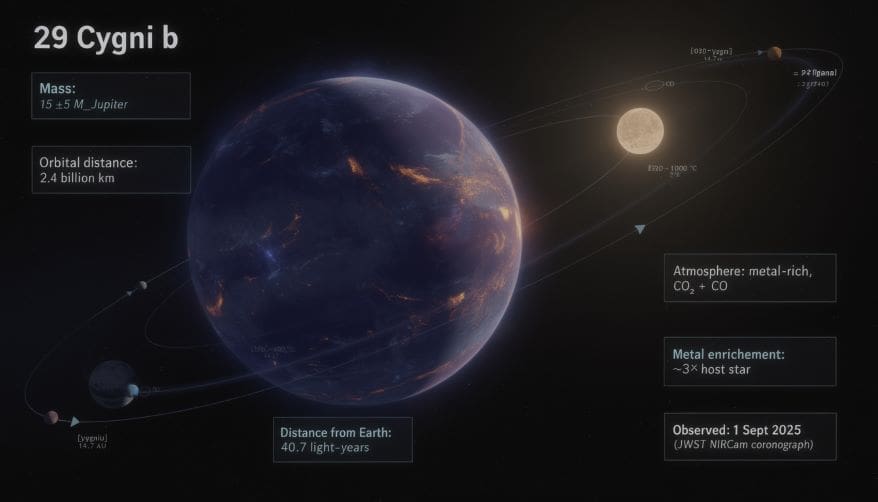
- Mass: 15 times Jupiter’s mass (±5 times uncertainty)
- Orbital distance: 2.4 billion kilometers from star
- Temperature: 530 to 1,000 degrees Celsius
- Atmosphere composition: metal-rich with CO₂ and CO
Observational Data:
- Distance from Earth: 40.7 light-years
- Detection method: Webb’s NIRCam coronagraph
- Observation date: September 1, 2025
- Metal enrichment: 3 times the host star’s value
Orbital Characteristics:
- Semi-major axis: 14.7 astronomical units
- Orbital eccentricity: 0.37 (moderately elliptical)
- Inclination alignment: 12 degrees with stellar spin
- Orbital period: approximately 60 Earth years
Frequently Asked Questions
Is 29 Cygni b Actually a Planet?
Yes, absolutely. In detail, it meets planetary definition criteria. It formed through accretion within a protoplanetary disc. This process defines planetary formation specifically. The composition confirms accretion occurred. Being that the evidence aligns with planetary formation, 29 Cygni b qualifies as a planet. However, it’s an extremely massive planet—an outlier. For the purpose of classification, astronomers call it a “super-Jupiter.”
How Do We Know Its Composition?
Webb’s filters detect specific wavelengths of light precisely. Carbon dioxide and carbon monoxide absorb particular infrared colors. By measuring this absorption, scientists determine atmospheric composition. To that end, they calculate metal abundance mathematically. This technique called spectroscopy reveals planetary chemistry directly. With this purpose in mind, Webb was specifically designed for such measurements.
Could This Planet Support Life?
No, it cannot. At this time, 29 Cygni b remains completely uninhabitable. Its temperature exceeds 530 degrees Celsius consistently. Liquid water cannot exist under those conditions. The atmosphere contains toxic gases exclusively. Being that these conditions persist, life as we know it cannot survive. To rephrase it: this planet exists in a completely different category. Nevertheless, studying it helps us understand habitability limits.
What’s the Significance for Finding Other Planets?
This research refines our planet-detection methods substantially. With attention to formation signatures, astronomers identify planets more accurately. To put it differently, we now know what to look for specifically. Metal enrichment becomes a diagnostic tool reliably. Orbital alignment becomes another important clue. All things considered, this improves our ability to catalog exoplanets systematically. The universe likely contains billions more planets like this one.
References
Balmer, W. O., Pueyo, L., Messier, A., Bruinsma, E., Jones, J., Matuszewska, K., Perrin, M. D., Girard, J. H., Leisenring, J. M., & Lawson, K. (2026). Direct images of CO₂ absorption in the atmosphere of a super-Jupiter: Enhanced metallicity suggestive of formation in a disk. The Astrophysical Journal Letters, 1001(2), L26. https://doi.org/10.3847/2041-8213/ae374a
ESA/Webb Communications. (2026, April 14). Webb redefines dividing line between planets and stars. Retrieved from https://esawebb.org/news/weic2607/?lang
- Author
- Latest Posts

Charudatta Pathak was a student at St. Aloysius High School in Bhusawal, established in 1874, making it one of India’s oldest convent institutions. He earned his bachelor’s degree in mechanical engineering from SSVPS College of Engineering, Dhule in 1995, demonstrating exceptional academic achievement. Thereafter, he launched his career as a CNC programmer in a toolroom. He has utilized FANUC, Deckel, Maho, and Mikron controllers to operate 2-axis and 3-axis machines for the fabrication of jigs, fixtures, dies, and molds. He commenced his career as an academic in 1996, when he assumed the role of lecturer at SSVPS College of Engineering, Dhule. Additionally, he earned his post-graduate degree in CAD/CAM from L. D. College of Engineering, Ahmedabad, in 2000, and then acquired a Ph.D. from COEP in 2011 while concurrently engaged in teaching. Until 2023, he occupied many academic roles, including lecturer, assistant professor, professor, dean, principal, director, and vice chancellor at both public and private universities throughout India. From 2008 to 2010, he served as the project lead in the CAE department of a European multinational firm. During his 28-year professional tenure, he identified a need for dependable books targeted at students in grades 8 to 12, particularly for nascent career planning. He founded ENTECH Digital Magazine, a free monthly publication available on entechonline.com and magzter.com. Teens with a strong interest in Science, Technology, Engineering, and Mathematics (STEM) who aspire to pursue careers in these fields may find ENTECH Digital Magazine beneficial.