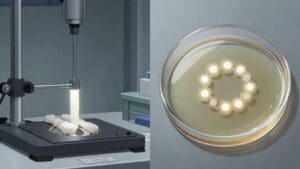
This synergy could provide a game-changing proof-of-concept demonstration for simultaneous PEC hydrocarbon generation., opening new avenues in carbon re-utilization initiatives.
Breakthrough: Artificial Leaf Transforms CO2 into Sustainable Fuel

Scientists have created a groundbreaking artificial leaf, marking a breakthrough in sustainable fuel production. This innovation efficiently converts carbon dioxide (CO₂) into valuable hydrocarbons, paving the way for a cleaner and more sustainable future. This innovative technology offers a promising alternative to traditional fossil fuels, significantly reducing our reliance on these finite resources and mitigating the impact of climate change.
Harnessing the Power of Light
Traditional methods for producing C2 hydrocarbons rely heavily on fossil fuels, contributing significantly to greenhouse gas emissions. However, photoelectrochemistry (PEC) offers a compelling alternative. This process integrates light harvesting and catalysis within a single system, operating under mild conditions and minimizing the environmental impact. By using sunlight as an energy source, this technology drastically reduces the carbon footprint associated with traditional methods.
Overcoming Challenges in PEC
Despite the potential, several hurdles have hindered the widespread adoption of PEC for C2 hydrocarbon synthesis. One major challenge has been the limited range of suitable catalysts, primarily copper-based compounds, which often require high overpotentials. Further, the photovoltages generated by existing semiconductors were insufficient to drive the reaction efficiently.
A Novel Approach: Combining Perovskites and Copper
This new research successfully addresses these limitations. Researchers combined low-overpotential copper nanoflower (CuNF) electrocatalysts with perovskite light absorbers, generating a photovoltage of 1V – sufficient to drive the reaction. The result? Significant improvement in C2 hydrocarbon production compared to previous methods. This finding has far-reaching implications for environmentally friendly fuel production.

Tandem Devices for Enhanced Efficiency
Researchers developed tandem devices to enhance efficiency, pairing perovskite photocathodes with robust BiVO4 and TiO2 photoanodes. This configuration enables simultaneous production of aqueous ethane and ethylene along with oxygen evolution, maximizing the overall efficiency of the process. The system was demonstrated to produce C2 hydrocarbons at significantly increased yields.
The Role of Glycerol in Sustainable Fuel Production
Interestingly, glycerol was seen as waste in many chemical processes but has now taken centre stage as an essential component in improving reaction rates. This research emphasizes glycerol’s importance and highlights how carefully designing catalyst surfaces can influence product generation. The current selectivity for CO₂-to-hydrocarbon conversion stands at around 10%; however, researchers are optimistic about enhancing efficiency as they refine their designs further.
Synergistic Effects and Future Directions
Interestingly, the study also revealed a crucial interplay between electron flux, applied potential, and C2 selectivity. This interaction highlights the importance of optimizing various parameters to achieve optimal performance. Moreover, researchers found that wiring the perovskite photocathodes to silicon photoanodes for glycerol oxidation reaction (GOR) further boosted C2 partial current densities by a factor of 200. This work lays a strong foundation for future advancements in sustainable fuel production. Further research is needed to further optimize the process and scale up production for industrial applications.
Reference
Andrei, V., Roh, I., Lin, J., Lee, J., Shan, Y., Lin, C., Shelton, S., Reisner, E., & Yang, P. (2025b). Perovskite-driven solar C2 hydrocarbon synthesis from CO2. Nature Catalysis. https://doi.org/10.1038/s41929-025-01292-y
Additionally, to stay updated with the latest developments in STEM research, visit ENTECH Online. Basically, this is our digital magazine for science, technology, engineering, and mathematics. Furthermore, at ENTECH Online, you’ll find a wealth of information.
Disclaimer
We do not intend this article/blog post to provide professional, technical, or medical advice. Therefore, please consult a healthcare professional before making any changes to your diet or lifestyle. In fact, we only use AI-generated images for illustration and decoration. Their accuracy, quality, and appropriateness can differ. So, users should avoid making decisions or assumptions based only on the text and images.
- Author
- Latest Posts

Neha Adikane holds a Master’s degree in Environmental Science from Pune University, bringing a unique blend of scientific expertise and creative writing skills to her craft. She specializes in creating engaging, insightful, and impactful content across various niches. With a passion for translating complex ideas into simple, relatable narratives, she excels at crafting blogs, articles, website content, and social media posts that captivate readers and drive engagement. Neha’s background in environmental science adds depth to her writing, allowing her to effectively cover topics related to sustainability, eco-awareness, and scientific innovations.