The Hidden Star Discovery by the James Webb Telescope shows a dusty red supergiant before it exploded, solving a long-standing space mystery.
Hidden Star Discovery by James Webb Telescope
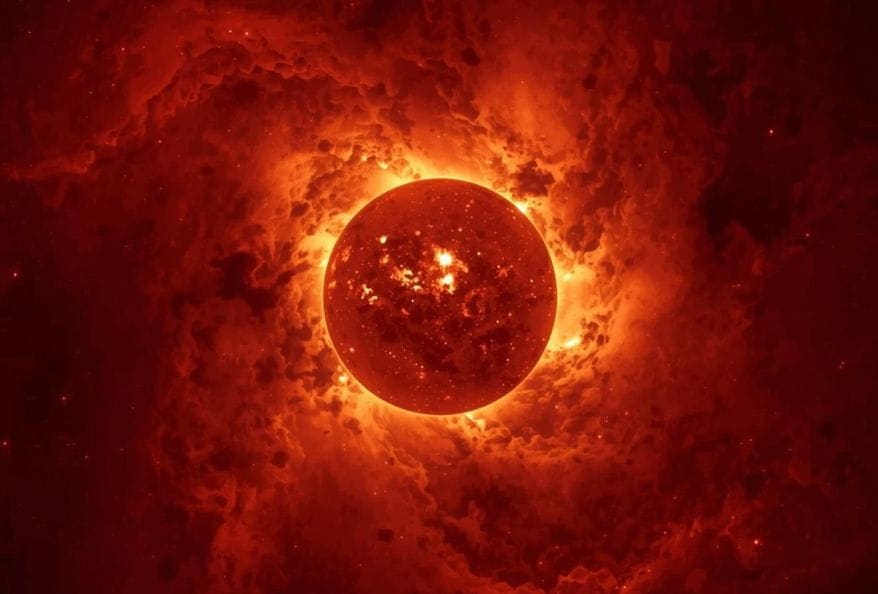
The Hidden Star Discovery made by the James Webb Space Telescope has stunned astronomers worldwide. Scientists finally located a massive star that exploded millions of years ago. Surprisingly, the star was completely invisible to older telescopes.
The explosion, named Supernova 2025pht, was first detected on June 29, 2025. However, researchers wanted to know what the star looked like before it exploded. As a result, they searched older space archives. Eventually, Webb’s infrared data revealed the hidden star clearly.
The Exploding Star Behind the Hidden Star Discovery
The supernova occurred in a nearby galaxy around 40 million years ago. Although the explosion happened long ago, its light only recently reached Earth. Automated sky surveys detected the bright flash immediately.
After that, astronomers examined archived images. Unlike other telescopes, Webb captured something extraordinary. It showed a single red supergiant star exactly where the explosion occurred.
Why the Star Was Invisible
The exploded star was a red supergiant covered in thick carbon-rich dust. Because of this heavy dust layer, visible-light telescopes like the Hubble Space Telescope could not detect it.
However, infrared instruments can see through dust clouds. Therefore, Webb’s advanced mid-infrared cameras revealed the star clearly. In fact, it turned out to be the dustiest red supergiant ever observed.
This finding solves a long-standing mystery. For years, astronomers wondered why many massive stars were missing from images before exploding. Now, scientists believe these stars are simply hidden beneath thick dust.
Carbon Burps Before the Explosion
Researchers were surprised by the dust composition. Instead of silicate-rich dust, models showed carbon-rich material. Consequently, scientists concluded that carbon from deep inside the star was released shortly before the explosion.
This process, similar to a “carbon burp,” pushed material outward. As a result, the star became heavily obscured just before its dramatic end.
Infrared observations were essential for this Hidden Star Discovery. Without Webb’s specialized instruments, this mystery would have remained unsolved.
Power of Infrared Technology
The James Webb Space Telescope was designed differently from previous observatories. While Hubble observes visible light, Webb detects infrared heat radiation. Because of this design, it can penetrate thick cosmic dust clouds.
This technological difference highlights how engineering drives discovery. Better instruments lead to better data. Furthermore, advanced image processing and computer modeling help scientists interpret what they see.
Hidden Star Discovery and STEM Careers
This breakthrough is not just exciting for astronomers. It also opens doors for STEM students. Data analysis, computer modeling, and aerospace engineering all played major roles in this discovery.
For example, engineers designed Webb’s infrared instruments. Meanwhile, computer scientists developed models to analyze the dust composition. Therefore, coding and mathematics are critical skills in modern astronomy.
Students in Grades 11 and 12 can consider careers in:
- Astrophysics
- Aerospace engineering
- Space data science
- Computer modeling
As space exploration expands, skilled professionals will be in high demand.
How Massive Stars End Their Lives
Life Cycle and Hidden Star Discovery
Massive stars begin in gas clouds. After millions of years, they expand into red supergiants. Eventually, their cores collapse. Consequently, a massive explosion called a supernova.
Unlike our Sun, which will fade quietly, massive stars end violently. However, these explosions are essential. They spread heavy elements across the universe. In turn, those elements form new stars, planets, and even life.
Looking Ahead
The Hidden Star Discovery proves that the universe still holds many secrets. Scientists now plan to search for more dusty red supergiants before they explode.
At present, Webb remains unmatched in infrared astronomy. Nevertheless, future telescopes will build upon its success. As technology improves, even more hidden cosmic mysteries will be revealed.
Additionally, to stay updated with the latest developments in STEM research, visit ENTECH Online.
References
- Kilpatrick, C. D., Suresh, A., Davis, K. W., Drout, M. R., Foley, R. J., Gagliano, A., Jacobson-Galán, W. V., Kaur, R., Taggart, K., & Vazquez, J. (2025). The Type II SN 2025pht in NGC 1637: A red supergiant with carbon-rich circumstellar dust as the first JWST detection of a supernova progenitor star. Astrophysical Journal Letters, 992(1), Article L10. https://doi.org/10.3847/2041-8213/ae04de
- NASA Goddard Space Flight Center. (2026, February 23). NASA’s Webb telescope locates former star that exploded as supernova. NASA Science. https://science.nasa.gov/missions/webb/nasas-webb-telescope-locates-former-star-that-exploded-as-supernova/
- Author
- Latest Posts

Kottauppari Venkat Raghava
I am a technology-driven IT graduate with a strong passion for science and innovation. I am fascinated by how innovations like artificial intelligence, robotics, and emerging technologies are shaping our world. I specialize in analyzing complex scientific and technological research and presenting it in a clear, accessible way. My goal is to make science and technology understandable and engaging for students, tech enthusiasts, and professionals alike. By breaking down advanced concepts into simple, insightful narratives, I strive to inspire curiosity, learning, and innovation, helping readers stay informed about the breakthroughs that are shaping the future.