A cost-effective ZnO catalyst with engineered defects enables efficient breakdown and closed-loop recycling of various polyester wastes into useful monomers under scalable conditions.
A Green Approach to Recycling of polyester with Zinc-Based Catalysis
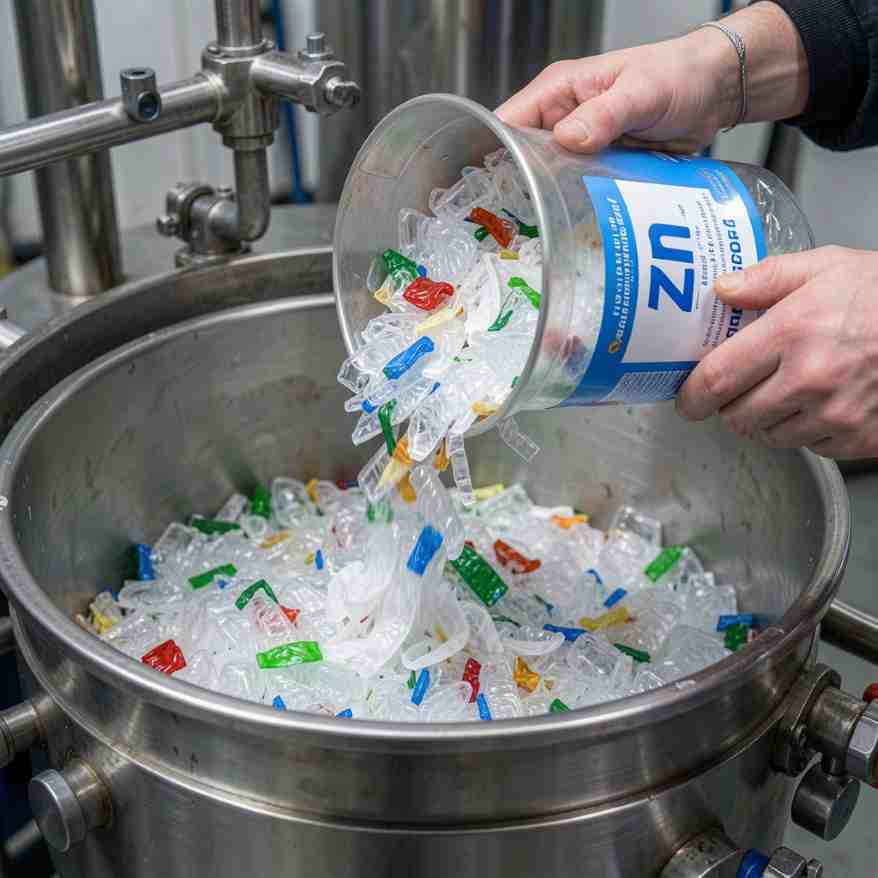
Recycling of polyester is becoming essential as plastic pollution continues to damage our planet every day. Oceans are overwhelmed with hazardous floating waste, and animals often consume toxic debris by mistake. A major shift is urgently needed. Scientists have now developed an innovative zinc catalyst that offers a promising solution. This catalyst efficiently breaks down durable plastics, converting waste into valuable resources. It can even process mixed materials like clothing and bottles with ease.
TL;DR ‘Recycling of Polyester’
A low-cost, coordinatively unsaturated ZnO catalyst enables efficient closed-loop recycling of diverse polyester wastes, including mixed plastics and textiles. This advancement connects biology, chemistry, and health sciences, encouraging students to pursue future opportunities in STEM careers.
Key Takeaways
- Scientists made an amazing zinc catalyst.
- It destroys solid polyester waste easily.
- It works perfectly on mixed plastics.
- The process is extremely cost-effective.
- It prevents massive environmental damage.
The Global Plastic Threat
People loved very durable plastics generated from recycling of polyester immensely every day. They make daily life highly convenient everywhere. As a result, heavy polyester waste piles up everywhere. This time, we must take massive fast action globally.
- Rivers carry tons of gross plastic trash.
- Animals ingest harmful invisible chemical pieces.
- Traditional recycling uses entirely too much energy.
- Old methods create terrible pollution issues.
Why Old Methods Fail
Standard recycling of polyester heavily falls completely short today. To point out, it sadly lacks vital scalability entirely. As a matter of fact, it hurts fragile ecosystems. Visit entechonline.com for better chemical engineering today.
- Normal recycling degrades useful plastic quality.
- Sorting mixed trash takes way too long.
- Current steps cost way too much money.
- They produce massive dirty carbon footprints.
Enter the Zinc Catalyst
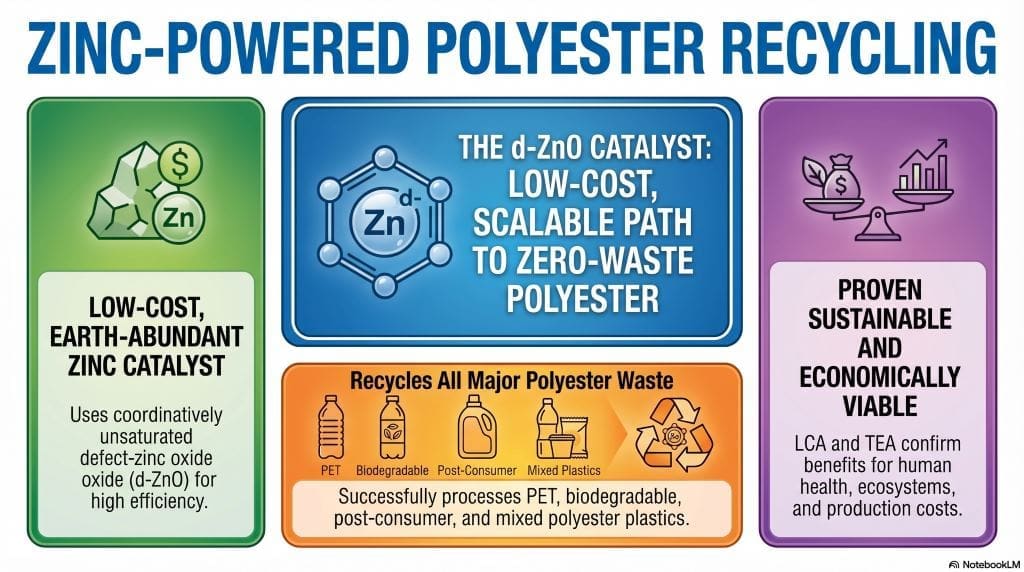
Bright hope proudly appears today. Smart scientists developed cool d-ZnO catalysts. In essence, this awesome material is highly earth-abundant. This special defect-zinc oxide genuinely works incredible wonders.
- The catalyst targets specific invisible oxygen molecules.
- It highly activates useful wet water molecules.
- It quickly generates strong tiny nucleophilic species.
- These species break the tough ester bonds.
Defective Zinc Magic
The brilliant science totally rocks today. Tiny defects beautifully boost the reactions. For the most part, it safely depolymerizes plastic waste by recycling of polyester . This is pure awesome heterogeneous catalysis in full action.
- It easily recycles modern biodegradable polyesters.
- It cleanly handles tricky post-consumer polyesters.
- It quickly processes complex dirty mixed textiles.
- It easily achieves true green closed-loop recycling.
Breaking Tough Chemical Bonds
What’s more, the new zinc works at low temperatures, it beautifully saves massive heating energy. We should avoid burning fossil fuels blindly today.
- The zinc defects activate the strong carbonyl groups.
- This activation makes ester bonds very weak.
- Water molecules then easily cleave the weak bonds.
- This completely degrades the solid plastic structure.
Fixing Mixed Clothing Trash
Old clothes cause major global trouble everywhere. Mixed textiles block normal recycling machines completely. To the end that, this cool catalyst easily helps. It smartly isolates the clean monomers in your lab.
- It stops dirty clothes from filling local landfills.
- It separates tricky cotton from polyester fibers easily.
- It heavily reduces terrible greenhouse gas emissions.
- It wonderfully supports the global circular economy.
The Power of Monomers
Pure chemicals emerge from the complex process. Plastics are giant complex solid polymer chains. Seeing that, the amazing catalyst breaks them into pieces. These separated chemical units form new materials perfectly today.
- The reaction isolates pure useful chemical monomers.
- It avoids creating harmful side products completely.
- Factories reuse these monomers for new bottles.
- This loop prevents extracting new raw fossil fuels.
Economic and Earth Benefits
In comparison to older approaches, traditional methods burn huge cash amounts daily, whereas this new zinc method significantly reduces costs. To put it another way, it is extremely inexpensive. For this reason, businesses highly value the combination of profitable science and strong economic viability.
- Engineers highly praise the techno-economic analysis results.
- It heavily lowers massive factory production costs.
- It vastly reduces raw resource consumption significantly.
- It greatly improves global human health overall.
Life Cycle Analysis
In light of recent developments, the Earth feels much better today, and math looks absolutely great. At the same time, life cycle assessments help limit toxic waste. As a result of this, it becomes essential to explore sustainable solutions thoroughly on entechonline.com right now..
- It expertly protects global ecosystem quality every day.
- It strictly limits bad factory carbon emissions.
- It smartly promotes essential healthy resource circularity.
- It happily builds a safer green future.
Career Path
Together with biology, chemistry solves real huge problems today. In this case, you can design extremely smart catalysts. In general, you can build advanced recycling. Keep your curious mind always active in high school.
- You can strictly study complex catalytic mechanisms.
- You can easily run a chemical plant safely.
- You can loudly fight bad plastic pollution everywhere.
- You can bravely protect our natural world.
Reference
- Cao, J., Liang, H., Chen, W., Li, X., & Fu, S. (2026). Sustainable recycling of polyester wastes using a coordinatively unsaturated Zn catalyst. Nature Communications. https://doi.org/10.1038/s41467-026-71862-6
- Author
- Latest Posts

I completed my Master of Science from the University of Allahabad in 2017 with a strong academic background in life sciences and chemistry. My specialization included Molecular Biology, Microbiology, Genetics, Plant Breeding, Phycology, Paleobotany, and Bioinformatics, along with Organic Chemistry, Inorganic Chemistry, and Physical Chemistry. This multidisciplinary training provided me with a comprehensive understanding of biological systems and analytical scientific approaches.
After completing my postgraduate studies, I gained valuable professional experience in both the education and social development sectors. I worked at A.M. Oxford Public School, where I was actively involved in guiding students toward academic excellence. In this role, I focused on creating an engaging learning environment, encouraging critical thinking, and nurturing students’ curiosity for scientific learning. My experience as an educator strengthened my communication, mentoring, and classroom management skills.
In addition to my teaching experience, I worked with Jeevan Jagriti Foundation, where I contributed to community-based initiatives aimed at improving educational access and awareness among underprivileged sections of society. Through this work, I participated in programs designed to support social development and promote the value of education in marginalized communities.
These professional experiences helped me develop strong interpersonal, leadership, and organizational skills while reinforcing my commitment to education and community service.