Smart pump control uses mathematical algorithms to help pumps find their most efficient operating point. As a result, industries can reduce electricity use and lower maintenance costs.
Smart Pump Control Saves Energy with AI-Style Math Methods
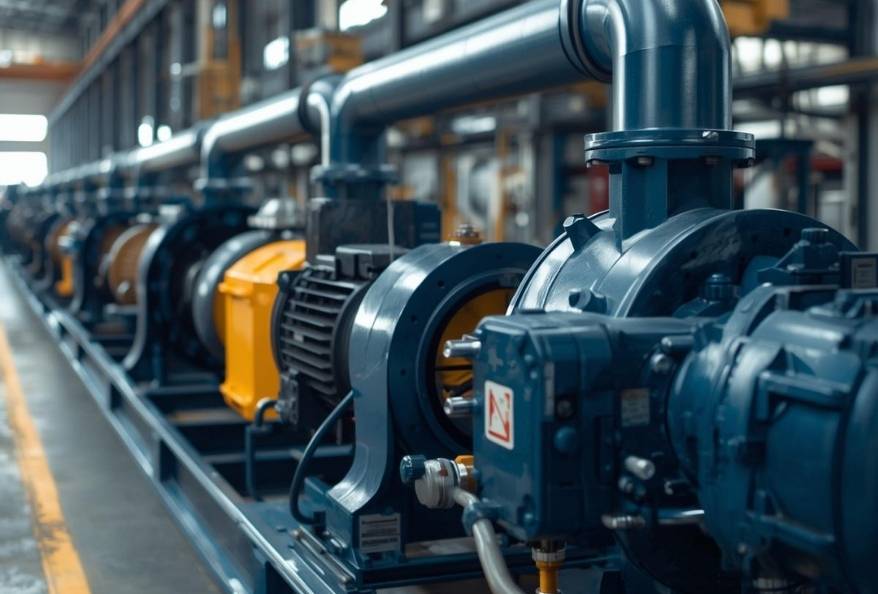
Smart pump control is transforming how modern pumping systems operate. Water pumps are essential in factories, buildings, and city infrastructure. These machines move liquids for cooling, manufacturing, and water supply systems. However, they consume a large share of global electricity.
One promising solution is smart pump control, which uses advanced algorithms instead of expensive sensors. At the present time, researchers are exploring methods that allow pumps to optimize their performance automatically.
Above all, this approach focuses on reducing power consumption while maintaining reliable operation. In many cases, pumps operate far from their ideal settings. Consequently, they waste energy and increase operational costs.
Smart control systems aim to solve this problem by continuously adjusting pump speed to achieve better efficiency.
The Best Efficiency Point in Smart Pump Control
Understanding the Best Efficiency Point
Every centrifugal pump has an operating condition known as the Best Efficiency Point (BEP). At this point, the pump moves the maximum fluid while using the least energy.
However, identifying the BEP is often difficult. Operators usually measure pressure, flow rate, or hydraulic head to determine this point.
These measurements require sensors such as pressure gauges and flow meters. Unfortunately, these devices can fail over time and require regular maintenance.
As well as increasing system complexity, sensor failures can interrupt operations. Therefore, engineers began exploring alternative solutions that rely less on hardware.
Extremum-Seeking Control in Smart Pump Control
A Model-Free Optimization Approach
One breakthrough approach is Extremum-Seeking Control (ESC). This technique allows pumps to locate their optimal efficiency point automatically.
Unlike traditional control systems, ESC does not require a detailed mathematical model of the pump. Instead, it relies on real-time measurements such as power consumption.
To illustrate, the system slightly changes the pump speed. After that, it observes how energy use changes. If power consumption decreases, the algorithm continues adjusting in that direction.
In other words, ESC gradually searches for the best operating condition.
How the Algorithm Works
The algorithm uses a small oscillation called a dither signal. This signal slightly varies the pump speed.As a result, the system can detect whether efficiency improves or worsens. The controller then updates the speed accordingly.
This process is similar to climbing a hill in the dark. You take small steps and observe whether you move upward or downward.Eventually, the system reaches the peak, which represents the most efficient operating point.
Experimental Results of Smart Pump Control
Researchers tested this control method using a simulated centrifugal pump system. At first, the pump started at a random operating speed.
Soon after, the ESC algorithm began adjusting the rotational speed automatically.
Within a short period, the pump reached its Best Efficiency Point. Afterward, the system maintained this efficient state during operation.
The results were significant. Energy consumption decreased while system performance remained stable.
To enumerate the benefits:
- Reduced electricity usage
- Lower maintenance requirements
- Improved equipment lifespan
- Reduced carbon emissions
Above all, the method required only power measurements instead of expensive sensor systems.
Industrial Impact of Smart Pump Control
Pumps are widely used in water treatment plants, chemical factories, and energy facilities. Consequently, improving pump efficiency can produce major global energy savings.
If millions of pumps operate closer to their Best Efficiency Points, electricity demand could drop significantly.
As well as reducing operational costs, industries could lower greenhouse gas emissions. Therefore, smart pump control plays an important role in sustainable engineering.
At the present time, automation technologies are transforming industrial systems. Smart algorithms are gradually replacing complex hardware solutions.
Future Opportunities in Smart Pump Control
Engineers working on smart pump control combine knowledge from several disciplines. These fields include mechanical engineering, control systems, and computer science.
Students interested in this area should focus on subjects such as:
- Calculus
- Physics
- Control theory
- Programming and data analysis
Provided that these skills are developed early, students can pursue careers in automation, robotics, or energy systems.
Many industries are now searching for engineers who can design intelligent machines.
The Future of Intelligent Energy Systems
Smart pump control demonstrates how mathematical algorithms can solve real engineering problems.
Instead of adding more sensors or hardware, engineers can use software to optimize machine performance.
As a result, industries can reduce energy waste while improving system reliability.
All things considered, smart control technologies will play a major role in future energy systems. As well as saving money, they will help reduce environmental impact worldwide.
Additionally, to stay updated with the latest developments in STEM research, visit ENTECH Online.
Reference
- Sukprasertchai, S., & Tiaple, Y. (2026). Model-Free BEP Pump Tracking Without Head Measurement Using Extremum-Seeking Control. Automation, 7(2), 46. https://doi.org/10.3390/automation7020046
- Author
- Latest Posts

Kottauppari Venkat Raghava
I am a technology-driven IT graduate with a strong passion for science and innovation. I am fascinated by how innovations like artificial intelligence, robotics, and emerging technologies are shaping our world. I specialize in analyzing complex scientific and technological research and presenting it in a clear, accessible way. My goal is to make science and technology understandable and engaging for students, tech enthusiasts, and professionals alike. By breaking down advanced concepts into simple, insightful narratives, I strive to inspire curiosity, learning, and innovation, helping readers stay informed about the breakthroughs that are shaping the future.