Solar Breakthrough: The “Spin-Flip” Trick That Could Supercharge Panels
‘Spin Flip Emitter’ in metal complexes can help solar cells leap beyond limits

Scientists in Japan just revealed a clever quantum move. It is called a spin-flip. It happens inside special metal complexes. Eventually, this flip can route energy more efficiently. Thus, it could push solar cells beyond old limits. That includes the famed Shockley–Queisser limit. The work comes from Kyushu University. And, their team connects spin physics to better sunlight harvesting. Surprisingly, the approach looks practical and elegant. It also hints at cheaper devices. Certainly, it is an exciting path for future solar tech.
TL;DR
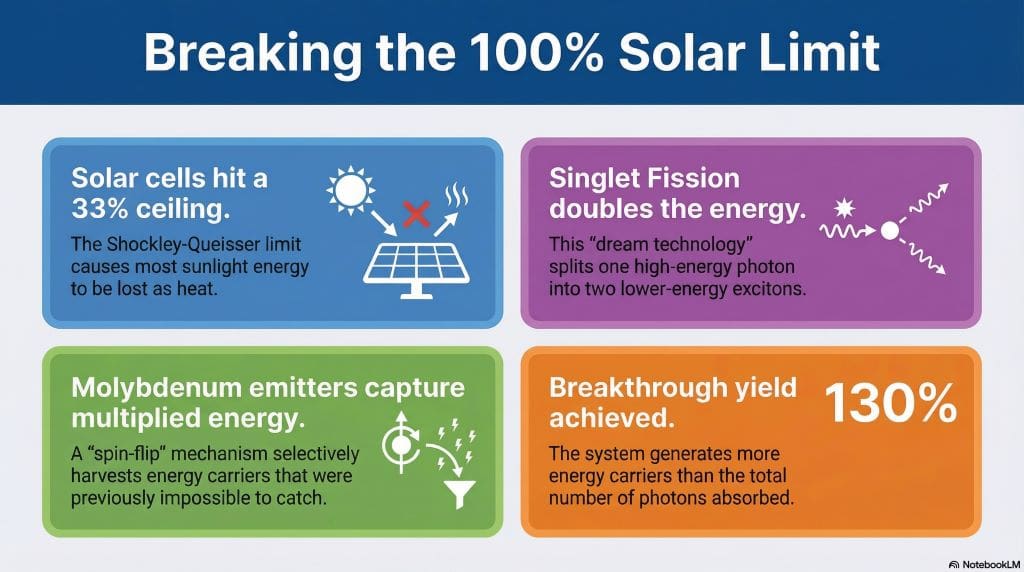
Researchers at Kyushu University and Johannes Gutenberg University Mainz used a molybdenum-based spin flip emitter to harness singlet fission, achieving 130% solar cell efficiency. As a result, this reduces energy loss and could revolutionize solar panels and LEDs .
Breakthrough in Solar Energy: Highlights
- Discovery by Leading Universities
- Researchers from Kyushu University and Johannes Gutenberg University Mainz collaborated.
- They focused on improving solar energy efficiency using advanced chemistry.
- Use of Molybdenum Metal Complex
- A molybdenum metal complex called a spin-flip emitter was used.
- This material plays a key role in capturing energy more effectively.
- Harnessing Singlet Fission
- The team utilized singlet fission, a process that splits one high-energy photon.
- This creates two lower-energy excitons, doubling the energy output.
- Breaking the 100% Efficiency Limit
- The researchers achieved a quantum yield of 130%, surpassing the usual 100% limit.
- This breakthrough reduces energy loss in solar cells.
- Applications in Future Technology
- The method could improve solar panels and LEDs.
- It offers potential for more efficient and sustainable renewable energy.
- Early-Stage Research with Big Potential
- While still in its early stages, this discovery opens doors for next-generation energy solutions.
- It highlights the importance of innovative chemistry in renewable energy.
This breakthrough demonstrates how science can push boundaries, making renewable energy more efficient and accessible for the future
Key takeaways of Spin Flip Emitter for Solar Cells
- Spin-flips open efficient energy routes. They extend excited lifetimes. They reduce losses from heat. This boosts potential cell performance. It makes better use of light. It advances quantum control ideas. It bridges chemistry and devices. It supports practical scaling. That is big for clean energy goals.
- Metal complexes enable precise tuning. Ligands shape the energy landscape. Abundant metals can be used. Thus, it eases cost and supply risks. It favors sustainable materials choices. It supports robust device designs. It merges lab insight with practice. Also, it opens new research directions. It could speed solar adoption.
- The approach targets old limits. It works inside known physics. It avoids peculiar, fragile methods. It fits printable manufacturing methods. It promises compatible interfaces. It aligns with stability needs. It is attractive for industry. Surely, it is inspiring for students. This is science meeting real world needs.
- Kyushu University reports strong evidence. They tracked ultrafast spin events. They showed longer excitations follow. They linked that to charge transfer. Losses then drop significantly. Device strategies become clearer. Moreover, next tests will validate prototypes. Surely, this is a path worth backing. Also, it deserves sustained research support.
- Students can act right now. Firstly, join labs at your school. Secondly, take courses across fields. Thirdly, learn spectroscopy basics early. Also, try coding for simulations. Build simple cells in class. Finally, seek internships in energy. Read widely and often. Follow university research news. Your work can matter sooner than.
How a spin makes sunlight work harder
Every photon brings energy and momentum. It also nudges electron spins. Spins can align or oppose. A spin-flip switches that alignment. As a result of this change opens new energy pathways. Those pathways reduce waste as heat. They also stretch excited-state lifetimes. Additionally, longer lifetimes improve charge separation. And, better separation means more current. So this tiny flip can amplify output. It could transform next-gen solar materials.
Why metal complexes matter now
Metal complexes act like molecular machines. In essence, their atoms guide electrons precisely. Ligands tune the energy landscape. Spins then choose a route. The right route keeps energy alive longer. In fact, it reduces instant losses from heat. So, electrons travel farther and cleaner. That helps devices do more work. It also supports stable, durable modules. This strategy favors abundant metals and smart designs too.
Beyond limits without peculiar tricks
Traditional cells lose energy as heat. Seeing that, scientists have tried many fixes. In fact, some are costly or fragile. However, the spin flip emitter method is different. Actually, it uses internal quantum control. Additionally, it avoids rare elements and extreme steps. Also, It suits printable, low-temperature methods. That helps scale production quickly. And it keeps costs within reach. It points toward reliable, efficient devices soon.
A quick primer on the “limit”
The Shockley–Queisser limit sets a cap. It bounds single-junction efficiency. Most light above the bandgap becomes heat. That wastes precious solar energy. But new routes can dodge that fate. Spin-flips can reroute excited states. They cut heat before it forms. So more energy turns to electricity. That nudges devices past old ceilings safely.
What the Kyushu team shows
The Kyushu group mapped these pathways. They used advanced spectroscopy methods. Also, they tracked ultrafast switching events. Finally, they saw spin states interchange quickly. Then they saw longer-lived excitations. Those states supported better charge transfer. That means fewer energy losses. It is strong evidence for this route. It bridges chemistry and device physics beautifully.
From lab insights to real devices
Mechanisms guide better engineering choices. Chemists can tune ligands precisely. They can aim for fast spin flips. They can build long-lived excitations. Engineers then craft better interfaces. They capture charges cleanly and fast. They reduce recombination and heat. That improves stability as well. With iterative design, performance rises. This is how science becomes technology practical.
Why this matters for students
This work links physics, chemistry, and devices. Thus, it shows STEM is interconnected. It also shows engineering is creative. To point out, we can redirect energy at will. As a result, we can turn waste into work. That mindset drives progress forward. You can join these efforts now. Many paths lead into this field. Explore materials, devices, or theory today.
Careers that can shape the sun
Materials scientists design light-harvesting compounds. Chemists build smart ligands. Physicists probe ultrafast events. In reality, engineers scale manufacturing lines. As well as, data scientists optimize architectures. Vis a vis policy experts deploy solutions wisely. After that, educators grow the talent pipeline. At last, entrepreneurs translate labs to markets. Each role pushes solar forward. Together they change our energy future.
Frequently Asked Questions, FAQs
What is a “spin flip emitter,” in simple terms?
An electron has a tiny magnetic property. That is its spin state. However, a spin-flip changes that state quickly. And, the change unlocks new energy routes. Those routes waste less as heat. Devices can harvest more energy then. Thus, the trick helps electrons move efficiently. Certainly, it is a small move with big impact.
How does spin flip emitter help solar cell efficiency?
Solar cells lose energy as heat. Spin-flips reroute excitations early. As a result, they lengthen useful lifetimes inside materials. Charges then separate more cleanly. Thus, less energy becomes heat waste. And, more becomes electrical current. So the overall efficiency rises. That can push past older limits. It is a smart quantum assist.
Are rare or toxic elements required for spin flip emitter?
This approach suits abundant metals. Ligands provide the fine tuning. That keeps costs more manageable. It also supports greener sourcing. Devices gain sustainable supply chains. Industry likes those advantages. They help with scaling production. They enable broad deployment worldwide. This matters for climate action urgently.
Could this spin flip emitter work outside lab conditions?
That is the next test phase. However, the mechanism looks solid. In fact, teams must integrate devices. At this point, interfaces need careful engineering. Stability testing will be crucial. Manufacturing steps must be practical. Printable methods are promising here. Partners can push pilots soon. Progress will need patient iteration. That is how real innovation lands.
Where can I learn more about spin flip emitter right now?
Start with the Kyushu University page. It explains the discovery clearly. It links to the research details. Then check your school resources. Ask teachers about research options. Join STEM clubs and competitions. Seek free online courses too. Follow lab pages on social media. Stay curious and persistent always. Start by reading the official summary source (Kyushu University, n.d.).
Reference
‘Spin-flip’ in metal complexes can help solar cells leap beyond limits | Research Results | KYUSHU UNIVERSITY. (n.d.). 九州大学(KYUSHU UNIVERSITY. https://www.kyushu-u.ac.jp/en/researches/view/377/
- Author
- Latest Posts
Charudatta Pathak was a student at St. Aloysius High School in Bhusawal, established in 1874, making it one of India’s oldest convent institutions. He earned his bachelor’s degree in mechanical engineering from SSVPS College of Engineering, Dhule in 1995, demonstrating exceptional academic achievement. Thereafter, he launched his career as a CNC programmer in a toolroom. He has utilized FANUC, Deckel, Maho, and Mikron controllers to operate 2-axis and 3-axis machines for the fabrication of jigs, fixtures, dies, and molds. He commenced his career as an academic in 1996, when he assumed the role of lecturer at SSVPS College of Engineering, Dhule. Additionally, he earned his post-graduate degree in CAD/CAM from L. D. College of Engineering, Ahmedabad, in 2000, and then acquired a Ph.D. from COEP in 2011 while concurrently engaged in teaching. Until 2023, he occupied many academic roles, including lecturer, assistant professor, professor, dean, principal, director, and vice chancellor at both public and private universities throughout India. From 2008 to 2010, he served as the project lead in the CAE department of a European multinational firm. During his 28-year professional tenure, he identified a need for dependable books targeted at students in grades 8 to 12, particularly for nascent career planning. He founded ENTECH Digital Magazine, a free monthly publication available on entechonline.com and magzter.com. Teens with a strong interest in Science, Technology, Engineering, and Mathematics (STEM) who aspire to pursue careers in these fields may find ENTECH Digital Magazine beneficial.