A new research paper reports the first direct evidence of a giant lava tube...
Venus Lava Tube Discovery Using Advanced Radar Technology
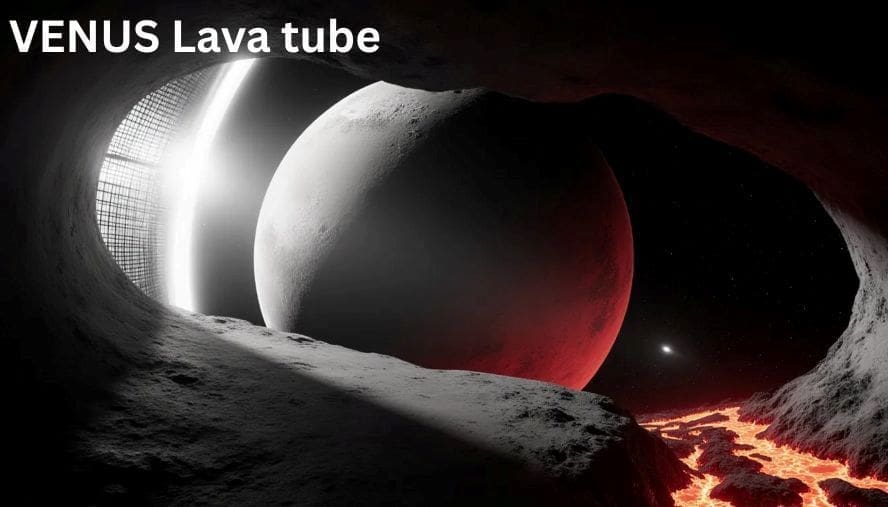
Venus, often called Earth’s sister planet, has long fascinated scientists. Its dense atmosphere hides many geological secrets. At the present time, a remarkable discovery sheds light on the planet’s volcanic past. A new research paper reports the first direct evidence of a giant lava tube on Venus; this Venus lava tube discovery represents a major discovery that can inspire teens interested in science, engineering, and space exploration.
The Venus Lava Tube Discovery: Uncovering Hidden Volcanic Tunnels
Why is that? Venus’s thick carbon dioxide atmosphere blocks most optical observations. Instead of sunlight, scientists use radar technology to “see” through the clouds. The Magellan spacecraft, which orbited Venus from 1990 to 1992, used radar to map the planet’s surface. However, until recently, no one had confirmed the presence of lava tubes using this technique.
How Did Researchers Reach to the Venus Lava Tube Discovery?
At first, the team focused on “skylights.” These are surface features where the roof of a lava tube collapses, creating an opening. Skylights serve as natural windows into the underground world of lava tubes.
Using data from the Synthetic Aperture Radar (SAR) on the Magellan spacecraft, the scientists applied a special imaging technique for subsurface tunnels. Their goal was to detect hidden lava tubes in the Nyx Mons region of Venus.
Their analyses revealed an impressive subsurface conduit measuring about 1 kilometer in diameter. The roof above it is at least 150 meters thick, and the hollow tube extends at least 300 meters underground. To put it another way, this lava tube is huge — much larger than many known on Earth.
Why Does The Venus Lava Tube Discovery Matter?
This finding is exciting for several reasons.
Firstly, it proves that Venus has complex volcanic systems similar to Earth’s. Understanding volcanoes on other planets helps researchers predict volcanic activity and its effects on planetary evolution.
Secondly, lava tubes can protect against harsh environments. Given Venus’ extreme heat and pressure, these tubes could offer clues about possible habitats for future exploration missions.
Finally, the techniques used for detection could be applied to other planets. Radar imaging is a powerful tool for studying places we cannot visit in person—yet.
Opportunities for Students Interested in STEM
The discovery of a massive lava tube on Venus is a masterclass in STEM integration. To uncover secrets beneath a thick, toxic atmosphere, scientists rely on radar technology (Physics/Engineering), topographical mapping (Math), and geological modeling (Science). For students, this breakthrough transforms “abstract” classroom concepts into a literal roadmap for exploring alien worlds. This discovery shows how science, technology, engineering, and math (STEM) work together. Students can take the case of planetary exploration to see the variety of career paths available.
How Science and Engineering Work Together
The search for these hidden tunnels relies heavily on advanced radar technology. Since Venus is perpetually shrouded in thick clouds, traditional cameras are useless; instead, radar uses radio waves to map surfaces through cloud cover. To make this possible, engineers must design and operate highly specialized instruments capable of penetrating the dense Venusian atmosphere.
After the data is collected, scientists then analyze the signals to interpret the geological features, specifically looking for the tell-tale signs of hollow structures. This endeavor is truly a massive team effort; consequently, geologists, physicists, mathematicians, and computer scientists all contribute their specific expertise to solve the puzzle.
Furthermore, this collaboration ensures that every bounce of a radio wave is accurately accounted for. For instance, while a physicist might model the wave’s behavior, a geologist identifies the resulting shapes as volcanic features. Ultimately, it is this synergy that makes the venus lava tube discovery possible.
Educational Resources and Career Paths
For students curious about STEM careers, exploring resources on Entech Online’s education page can be helpful. They offer guides on subjects like physics and engineering.
Additionally, check out Entech’s career guide to learn about job roles in space science and technology. These pages highlight required qualifications, job outlooks, and inspiring career stories.
Conclusion-Venus Lava Tube Discovery
All things considered, the radar-based venus lava tube discovery right beneath Venus’ surface is a scientific milestone. It expands our understanding of volcanic activity beyond Earth.
So long as technology advances, we can expect more discoveries about our solar system neighbors.
With this purpose in mind, today’s students could be tomorrow’s space explorers, engineers designing new instruments, or scientists interpreting alien worlds.
Additionally, to stay updated with the latest developments in STEM research, visit ENTECH Online. Basically, this is our digital magazine for science, technology, engineering, and mathematics. Also, at ENTECH Online, you’ll find a wealth of information.
References
Carrer, L., Diana, E., & Bruzzone, L. (2026). Radar-based observation of a lava tube on Venus. Nature Communications, 17, Article 1147. https://doi.org/10.1038/s41467-026-68643-6
- Author
- Latest Posts

A Master’s-qualified Zoologist with a focus on Limnology, I combine hands-on laboratory experience with a sophisticated background in science communication. My career is defined by an interdisciplinary approach to the life sciences, merging technical research skills with a proven ability to teach and engage diverse audiences. I am committed to lifelong learning and the creative dissemination of medical and biological research, ensuring scientific literacy and inspiration remain at the forefront of the field.