The James Webb Space Telescope has mapped Uranus’ upper atmosphere in stunning 3D detail, detecting cooling temperatures, auroral bands, and magnetic mysteries.
Webb Uranus Discovery Shocks Scientists Worldwide
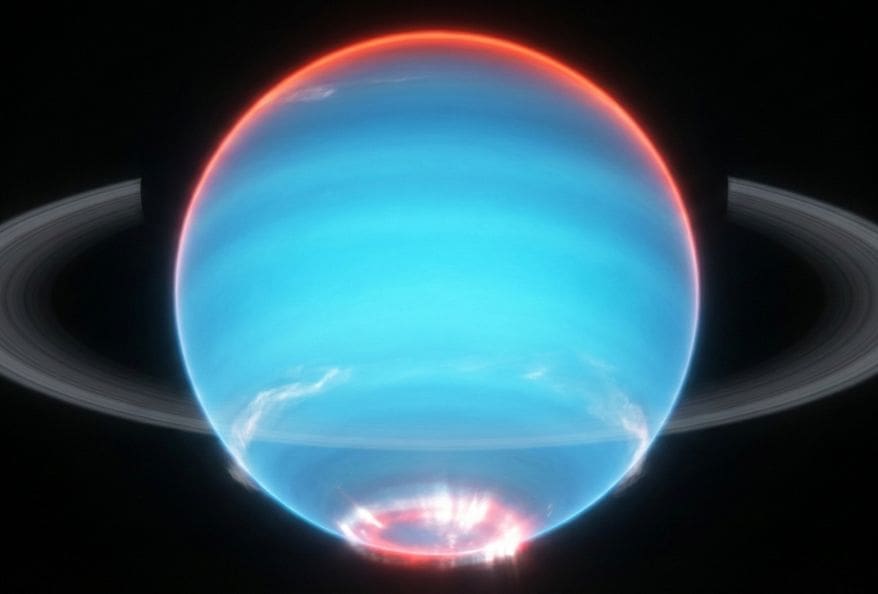
The Webb Uranus discovery is one of the most exciting astronomy breakthroughs in years. Using advanced infrared instruments, the James Webb Space Telescope not only mapped Uranus’ upper atmosphere in stunning 3D detail but also revealed cooling temperatures, glowing auroral bands, and surprising magnetic mysteries. As a result, this major discovery is helping scientists better understand the distant ice giant like never before.
Webb Uranus Discovery: Mapping the Ice Giant
For decades, Uranus was difficult to study. However, the Webb Uranus discovery has completely changed that situation. In particular, scientists used Webb’s advanced infrared instruments to map the planet’s ionosphere — a region stretching up to 5,000 kilometers above the clouds.
Because this upper layer is highly ionized, charged particles constantly interact with the planet’s magnetic field. Consequently, researchers were able to create, for the first time, a full three-dimensional map showing ion temperatures, densities, and energy movement.
Temperatures peak between 3,000 and 4,000 kilometers, while ion densities reach their maximum closer to 1,000 kilometers. Moreover, these variations reveal complex longitudinal differences across the planet. Overall, the data shows that Uranus’ atmosphere is far more dynamic than previously believed.
Webb Uranus Discovery Reveals a Bizarre Magnetic Field
One of the most surprising aspects of the Webb Uranus discovery involves Uranus’ strange magnetic field. Unlike Earth’s neatly aligned magnetic field, Uranus’ field is dramatically tilted and off-center. As a result, its atmospheric behavior is highly unusual.
Because of this unusual configuration:
- For example, auroras sweep across unexpected regions
- In addition, magnetic poles are not aligned with geographic poles
- Furthermore, energy flows unevenly through the upper atmosphere
Webb detected two bright auroral bands near the magnetic poles. Interestingly, between these bands, scientists observed a depleted region where both emission and density drop. Similarly, comparable features appear on Jupiter, suggesting magnetic field lines play a crucial role in shaping atmospheric behavior.
Cooling Trends in the Webb Uranus Discovery
Another major revelation from the Webb Uranus discovery is that the planet’s upper atmosphere has been cooling since the early 1990s. Previously, scientists suspected this trend; however, they lacked precise confirmation.
The average temperature is now about 426 Kelvin (around 150°C). Although that sounds hot, it is actually lower than previous spacecraft measurements. Therefore, this confirms a long-term cooling trend.
Thanks to Webb’s infrared sensitivity, researchers were able to measure heat flow with unprecedented precision. Consequently, scientists now have stronger evidence supporting decades of theoretical predictions.
How the Webb Uranus Discovery Helps Us Understand Exoplanets
Uranus is classified as an ice giant. Therefore, understanding it helps scientists interpret similar planets orbiting other stars. In fact, many exoplanets discovered so far are Uranus-sized worlds.
By studying:
- Vertical atmospheric structure
- Energy balance
- Magnetic interactions
Researchers can refine planetary models for distant exoplanets. Ultimately, these insights are especially important as we search for habitable worlds beyond our solar system. In other words, studying Uranus helps us understand planets far beyond it.
Engineering Behind the Discovery
This breakthrough would not have been possible without cutting-edge engineering. Specifically, the James Webb Space Telescope operates in deep space under extreme cold conditions. At the same time, its infrared instruments detect faint heat signatures from billions of kilometers away.
Engineers designed Webb to survive harsh space environments while delivering crystal-clear data.
Why the Webb Uranus Discovery Matters for Students
This discovery clearly shows how curiosity and innovation push humanity forward. For instance, if you are interested in astronomy, physics, or engineering, breakthroughs like this could shape your future career.
You could become:
- An astronomer analyzing planetary data
- An aerospace engineer designing future telescopes
- A planetary scientist studying ice giants
Eventually, space science continues to reveal new mysteries, and the next big discovery could come from students like you.
Final Thoughts on the Webb Uranus Discovery
In conclusion, the Webb Uranus discovery has transformed our understanding of this distant ice giant. Not only did scientists map its ionosphere in 3D, but they also confirmed a decades-long cooling trend and revealed complex auroral structures shaped by a bizarre magnetic field.
Although Uranus lies billions of kilometers away, Webb has brought it closer than ever before. Ultimately, the universe remains full of mysteries waiting to be explored.
Additionally, to stay updated with the latest developments in STEM research, visit ENTECH Online. Basically, this is our digital magazine for science, technology, engineering, and mathematics. Also, at ENTECH Online, you’ll find a wealth of information.
References
- Tiranti, P., et al. (2025). Webb maps the mysterious upper atmosphere of Uranus. Geophysical Research Letters. https://doi.org/10.1029/2025GL119304
- European Space Agency. (2026). Webb maps the mysterious upper atmosphere of Uranus. ESA/Webb. https://esawebb.org/news/weic2602/
- Author
- Latest Posts

Kottauppari Venkat Raghava
I am a technology-driven IT graduate with a strong passion for science and innovation. I am fascinated by how innovations like artificial intelligence, robotics, and emerging technologies are shaping our world. I specialize in analyzing complex scientific and technological research and presenting it in a clear, accessible way. My goal is to make science and technology understandable and engaging for students, tech enthusiasts, and professionals alike. By breaking down advanced concepts into simple, insightful narratives, I strive to inspire curiosity, learning, and innovation, helping readers stay informed about the breakthroughs that are shaping the future.