These tiny soil microbiome break down dead plants, recycle essential nutrients, and even fight off nasty plant diseases.
What Is the Soil Microbiome? Northwest Soil Health

Estimated reading time: 6 minutes
Agriculture in the Inland Pacific Northwest faces significant challenges, as farmers contend with dry summers, cold winters, and diverse growing conditions. Consequently, soils in the region can suffer. However, a new study highlights an important finding: soil microbiomes respond dynamically to these challenges. Understanding how they respond is vital because it may help farmers improve soil health.
To explore this, the study examines how different farming systems—including dryland and irrigated agriculture—affect microbial life. Most importantly, it links biological changes in the soil to soil function. In turn, this connection can help guide better land management. Ultimately, the findings suggest that these tiny organisms may play a crucial role in the future of sustainable farming in the region.
Key Takeaways
- The soil microbiome is the community of tiny organisms living underground.
- In the Inland Pacific Northwest, microbial diversity drops in tilled systems.
- Dryland farming creates distinct microbial communities compared to irrigated land.
- How the microbiome responds to stress determines soil health.
- Better management practices can improve microbial life.
- Healthy microbes lead to better nutrient cycling and crop yield
Defining the Soil Microbiome: Your Essential Guide
What is soil microbiome diversity?
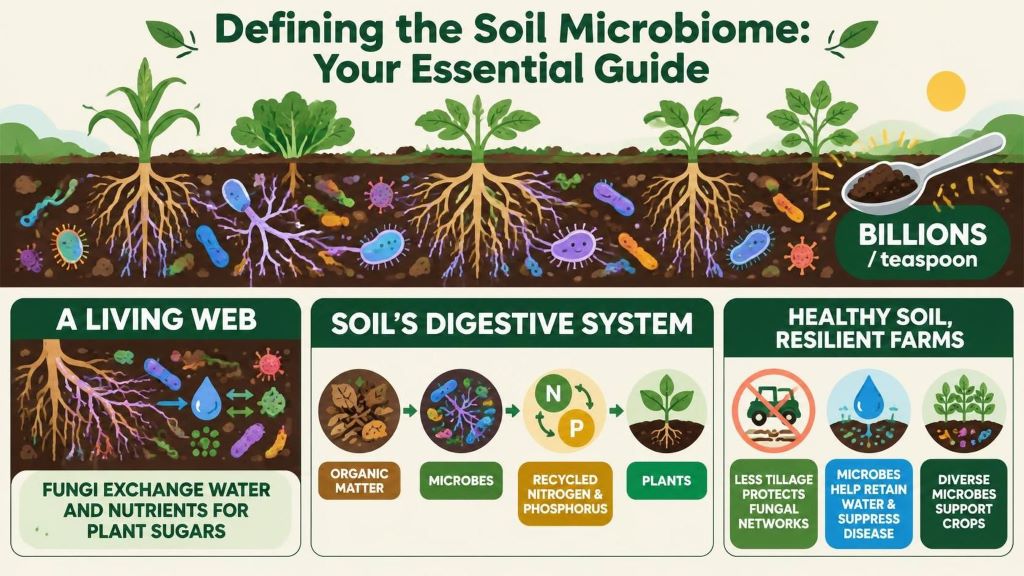
Simply put, soil is much more than dirt; it is a complex ecosystem. The soil microbiome includes all the microscopic life living underground, such as bacteria, fungi, protozoa, archaea, and viruses. Although these organisms are tiny, they are incredibly diverse. Moreover, they constantly interact with one another and with plant roots, forming a living web.
In fact, a single teaspoon of soil can contain billions of organisms. Together, they perform essential jobs: they break down organic matter and recycle nutrients such as nitrogen and phosphorus. As a result, plants can access the nutrients they need to grow. Without these microbes, plants would struggle to survive. In this way, the soil microbiome acts like the Earth’s digestive system.
The Role of Microbial Communities
Microbes live in complex communities and often form symbiotic relationships with plants. For example, mycorrhizal fungi attach to plant roots and help them absorb water and nutrients. In return, plants provide the fungi with sugars. This exchange supports crop health.
However, these microbial networks can be harmed by soil disturbance. For instance, tillage can break up fungal networks and disrupt the structures microbes create. Therefore, farmers can help protect these microscopic allies by minimizing disturbance.
A healthy microbiome can also suppress plant diseases and help soil retain water—an especially valuable benefit during dry spells. Consequently, managing for microbial diversity can strengthen a farm’s resilience. In effect, it offers a natural form of protection against climate extremes.
What Is the Soil Microbiome’s Function in Agriculture?
Soil organisms drive many essential processes. For example, some bacteria fix nitrogen from the air, while other microbes decompose crop residue. In doing so, they turn dead plant material into nutrients for future crops—a process known as nutrient cycling. In healthy soil, this cycle continues constantly.
However, when the microbiome becomes unbalanced, these functions can be disrupted. As a result, nutrients may become unavailable, plants may weaken, and pests and diseases may spread.
A study from the Inland Pacific Northwest highlights how farming practices can affect these soil functions. For instance, intensive tillage can speed up decomposition, releasing carbon into the air and disrupting soil structure. By contrast, no-till farming can help build soil carbon and support a more diverse microbial community. In turn, that community works continuously to support the farmer and the crop.
Soil Microbiome Response in the Inland Pacific Northwest
The Challenge of the Inland Pacific Northwest
This region poses unique agricultural challenges. For example, in areas such as the Palouse, farmers grow wheat, barley, and legumes under low-to-moderate rainfall. While some areas rely on irrigation, others depend entirely on rain. As a result, the region contains distinct agroecosystems.
To understand these differences, a recent study examined soils from various sites across dryland and irrigated farming systems. Researchers aimed to determine how the soil microbiome responds in each setting. The findings show that responses vary depending on the farming system. Although location and climate play a role, management practices may matter even more. In particular, the study suggests that specific farming choices strongly influence the health of soil biology.
Dryland vs. Irrigated Systems
Water availability can shape soil microbial communities in different ways. In dryland systems, microbes face water stress and must adapt to survive with less moisture. Accordingly, the study found distinct microbial communities in these areas. By contrast, irrigated systems can support different microbes, as added water allows more bacteria to thrive and may increase microbial biomass.
However, irrigation alone does not guarantee healthy soil. The research found that dryland systems can also support diverse microbial life, depending on how the land is managed. For example, overgrazing and excessive tillage can harm both dryland and irrigated soils. Conversely, when farmers maintain soil cover, microbes in dryland systems can flourish. This finding is especially important for the region because it suggests that farmers can improve soil health without using more water—by adopting better management practices.
The Impact of Tillage on Microbial Life
Tillage is another major factor because it disturbs the soil ecosystem. The study indicates that tillage can reduce microbial diversity and disrupt soil structure. In particular, it can break apart fungal hyphae networks and expose organic matter to oxygen. As a result, decomposition speeds up, and carbon stored in the soil can escape as carbon dioxide.
Consequently, the soil may lose some of the structure that holds it together, while microbes lose part of their habitat. To examine these effects, the study compared no-till systems with conventional tillage. No-till soils showed better biological health and retained more water and nutrients. Because this pattern appeared across the region, the findings suggest that reducing tillage is an important way to protect the soil microbiome from degradation.
Microbial Indicators of Soil Health
Scientists assess soil health by looking for biological indicators. In this study, researchers measured enzyme activity, which can indicate how active microbes are, as well as microbial biomass, which reflects the amount of microbial life in the soil. In general, greater biomass can be a sign of healthier soil.
Although microbial responses varied from site to site, the study found a clear pattern: systems with diverse crops had stronger biological indicators, while monoculture systems had weaker signals. For example, crop rotation can provide microbes with a wider range of food sources. In turn, this can support a more diverse community and help keep the soil ecosystem stable.
Frequently Asked Questions
What is soil microbiome?
It is the community of microscopic organisms living in soil, including bacteria, archaea, fungi, viruses, and protozoa. Together, these organisms support soil processes and, in turn, ecosystem stability.
Why does the soil microbiome matter for agriculture?
Microbes help cycle nutrients, thereby supporting soil functions that benefit crops. Moreover, the review connects microbial traits with function and considers how soil-health management can influence those traits.
How can farming practices affect soil microbial communities?
Practices such as crop diversification, residue retention, and legume incorporation can influence microbial biomass, community composition, and activity. The effects vary with local conditions and management.
Reference:
- Abanikannda, K. L., & Sullivan, T. S. (2026). Soil Microbiome Response Is Key to Improving Soil Health Across Multiple Agroecosystems in Inland Pacific Northwest. Sustainability, 18(7), 3518. https://www.mdpi.com/2071-1050/18/7/3518
- Author
- Latest Posts

I completed my Master of Science from the University of Allahabad in 2017 with a strong academic background in life sciences and chemistry. My specialization included Molecular Biology, Microbiology, Genetics, Plant Breeding, Phycology, Paleobotany, and Bioinformatics, along with Organic Chemistry, Inorganic Chemistry, and Physical Chemistry. This multidisciplinary training provided me with a comprehensive understanding of biological systems and analytical scientific approaches.
After completing my postgraduate studies, I gained valuable professional experience in both the education and social development sectors. I worked at A.M. Oxford Public School, where I was actively involved in guiding students toward academic excellence. In this role, I focused on creating an engaging learning environment, encouraging critical thinking, and nurturing students’ curiosity for scientific learning. My experience as an educator strengthened my communication, mentoring, and classroom management skills.
In addition to my teaching experience, I worked with Jeevan Jagriti Foundation, where I contributed to community-based initiatives aimed at improving educational access and awareness among underprivileged sections of society. Through this work, I participated in programs designed to support social development and promote the value of education in marginalized communities.
These professional experiences helped me develop strong interpersonal, leadership, and organizational skills while reinforcing my commitment to education and community service.