Ever Wondered Why Onions Make You Cry? Here's the Chemistry behind this Explained.
Crying Over Onions
Why Onions Make You Cry? Here’s the Chemistry behind this Explained.
You’re halfway through chopping an onion, and your eyes start burning. A minute later, you’re crying like you just watched the ending of a really good movie — except there’s no movie, just a vegetable. You blink, you tear up, you maybe curse a little. And then you wonder: why does this keep happening?
Turns out, that humble onion is running a surprisingly sophisticated chemical defence system. And once you understand it, you’ll never look at your cutting board the same way again.
The Onion’s Secret Weapon
Onions belong to the Allium family — the same botanical clan as garlic, leeks, and chives. Like many plants, onions have evolved chemical defences against being eaten by insects and animals. The irony, of course, is that humans find them delicious anyway. But the onion doesn’t give up without a fight.
Inside an intact onion cell, two key ingredients sit safely separated: amino acid sulfoxides (sulfur-containing compounds) and an enzyme called alliinase. Think of them as two reactive chemicals kept in different compartments of the same room. As long as the wall stands, nothing happens.
Then you pick up your knife.
The Chemistry of Why Onions make you cry
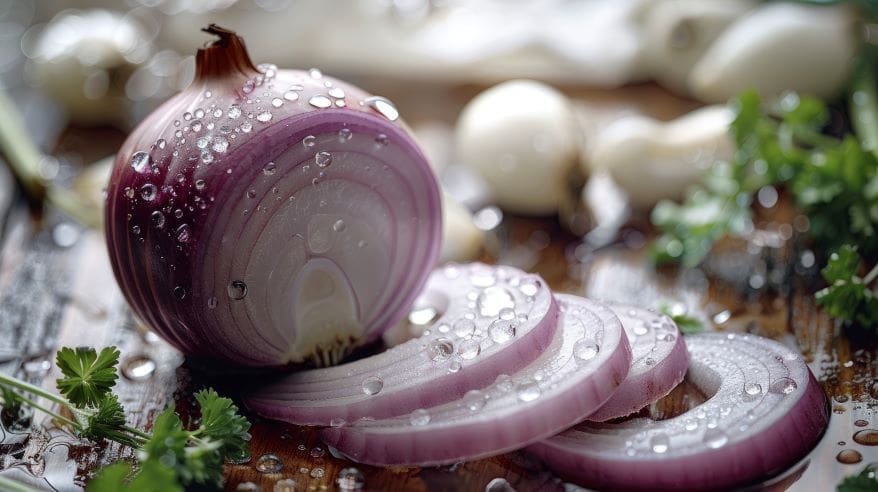
The moment your knife cuts through the onion’s cells, those compartments break open. The amino acid sulfoxides and alliinase mix together — and a rapid chemical reaction begins.
Alliinase acts as a catalyst, triggering a chain of reactions that converts the sulfur compounds into a cocktail of new molecules. One of these — syn-propanethial-S-oxide — is an unstable, volatile gas. It doesn’t wait around. It immediately rises from the cutting board and drifts upward.
Straight toward your eyes.
Why Your Eyes Are the Target
Your eyes are lined with a thin layer of moisture — the tear film. When syn-propanethial-S-oxide hits this moisture, it reacts with water to form a weak sulfuric acid. Not enough to cause damage, but more than enough to irritate the sensitive nerve endings in your cornea.
Your nervous system reads this as a threat. It triggers your lacrimal glands — the tear-producing glands just above each eye — to flush out the irritant as fast as possible. The result? An involuntary flood of tears, completely beyond your control. You’re not being dramatic. Your body’s damage-control system is simply doing its job.
This is why blinking faster doesn’t help much. The irritant is already in contact with your eye’s surface. The tears are the response, not the cause.
The Remarkable Moment
Here’s what makes this remarkable: the onion isn’t just releasing a random irritant. It has evolved a two-step biochemical trigger — separated reactants that only combine when the cell wall is physically breached. It’s a remarkably elegant system. In nature, this kind of “only activate on damage” chemistry is called a defence mechanism cascade, and it appears across dozens of plant and animal species.
The onion’s version just happens to be particularly effective against creatures with eyes and tear ducts — which is most of the animals that would want to eat it.
How to Beat the System
Understanding the chemistry reveals exactly why some hacks work — and why others are myths.
Cold temperatures slow the reaction. Chilling the onion in the fridge before cutting reduces the volatility of syn-propanethial-S-oxide, so less gas reaches your eyes. This one actually works.
A sharp knife matters. A dull blade crushes cells rather than cleanly cutting them, rupturing far more compartments than necessary and releasing more gas. A sharp knife means a cleaner cut, less gas, fewer tears.
Cutting near running water helps. The volatile gas dissolves readily in water, so water running nearby can intercept it before it reaches your face.
Holding bread in your mouth? Probably not doing much. Neither is the “open-mouth breathing” trick. The gas isn’t entering through your mouth — it’s irritating your eyes.
Goggles work perfectly. Because the science says they should. You’re not being ridiculous; you’re just applying chemistry.
STEM in Your Kitchen
Every time you chop an onion, you’re witnessing enzyme catalysis, volatile organic chemistry, and an evolutionary defence system — all in the time it takes to dice half a vegetable for dinner.
The kitchen, it turns out, is one of the most chemically active environments in your daily life. And the onion is just one example. Once you start looking for the hidden science in ordinary things, it’s very hard to stop.
Your eyes will still water, though. That part, unfortunately, chemistry cannot fix.
Additionally, to stay updated with the latest developments in STEM research, visit ENTECH Online.
Reference
- Silvaroli, J. A., Pleshinger, M. J., Banerjee, S., Kiser, P. D., & Golczak, M. (2017). Enzyme that makes you cry — crystal structure of lachrymatory factor synthase from Allium cepa. ACS Chemical Biology, 12(9), 2296–2304. https://pmc.ncbi.nlm.nih.gov/articles/PMC5693239/
- Royal Society of Chemistry. (2024). Propanethial-S-oxide: Magnificent molecules. RSC Education. https://edu.rsc.org/magnificent-molecules/propanethial-s-oxide/3010038.article
- Author
- Latest Posts

I am an inspirational writer and emerging science blogger with a deep-rooted passion for understanding and sharing the wonders of the world around us. My journey began with a Bachelor of Science in Chemistry from AKI’s Poona College of Arts, Commerce and Science, where I developed not only a strong foundation in scientific principles but also a mindset that values curiosity, observation, and critical thinking. Studying chemistry has taught me to approach problems with logic, to look beyond the obvious, and to see patterns where others might only see complexity. These experiences have shaped the way I perceive life and influence the way I express my thoughts, both scientifically and creatively.
I have always believed that knowledge is only as powerful as the way it is shared. This belief has guided me to create content that bridges the gap between science and everyday life. I aim to simplify complex scientific ideas so they become approachable, relatable, and engaging for everyone—whether someone has a formal background in science or is simply curious about the world. Science, in my view, is not confined to textbooks and laboratories; it is a way of thinking, understanding, and connecting with the world around us. By making science accessible, I hope to inspire curiosity, ignite learning, and encourage people to see the beauty and relevance of scientific discovery in their daily lives.
Alongside my love for science, I am deeply passionate about motivational writing. I believe words carry the power to transform perspectives, encourage self-reflection, and inspire action. By combining analytical thinking with creativity, I create content that is intellectually stimulating yet emotionally resonant. Whether I am breaking down a chemical concept, exploring a scientific phenomenon, or crafting motivational narratives, my goal is to communicate ideas in a way that is clear, meaningful, and impactful.
Through my work, I strive to empower my readers—not just by helping them understand the science around them, but by inspiring them to grow, learn, and realize their full potential. Every article, post, or story I write reflects my commitment to turning knowledge into inspiration. I want to spark curiosity, encourage self-improvement, and show that learning and personal growth are deeply connected. For me, writing is not just a craft; it is a way to touch minds, connect hearts, and make ideas come alive in a way that truly resonates.