The detector sensors made from ultrathin gallium selenide detect these pulses at room temperature, eliminating complicated cooling requirements.
Ultrafast UV-C Laser Pulses: The Future of Lighting-Speed Communication
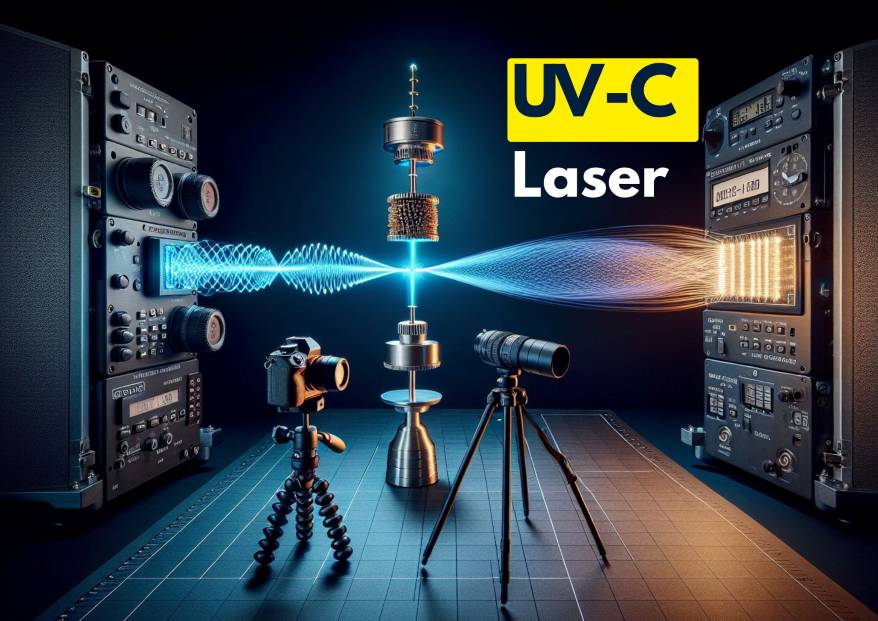
Ultraviolet light in the UV-C range has unique properties that scientists want to explore. These laser pulses operate between 100 and 280 nanometers and scatter strongly in the atmosphere. This property enables non-line-of-sight communication, meaning data can be sent even with obstacles blocking direct paths. This feature is crucial in crowded or obstructed environments.
Despite its potential, generating and detecting UV-C light pulses reliably has been difficult. However, a groundbreaking system now produces extremely short laser pulses lasting just femtoseconds (one quadrillionth of a second). This innovation combines a special UV-C lase pulser source with sensitive detectors made from atomically thin, two-dimensional semiconductors (2DSEM), such as gallium selenide (GaSe).
The Power of Femtosecond Pulses
These femtosecond UV-C laser pulses are generated by the new system through the utilization of nonlinear optical crystals. Through cascaded second-harmonic production, these crystals enable frequency doubling, which in turn causes a multiplicative effect on pulse effectiveness. Ultrafast signals that are appropriate for cutting-edge applications in the fields of imaging and telecommunications are produced by the flashes that are produced as a result.
Sensitive 2D Semiconductor Sensors
The detector sensors made from ultrathin gallium selenide detect these pulses at room temperature, eliminating complicated cooling requirements. Significantly, their response ranges from linear to super-linear photocurrent relative to laser pulse energy, enhancing detection accuracy over varied power levels. Such performance is a major step forward for practical UV-C photonics.
Pioneering Applications and Opportunities
Free-Space Communications Breakthrough
A communication configuration was established by the study team, in which the data that was encoded by the UV-C laser transmitter was accurately decoded by the 2D semiconductor sensor receiver. As a result of this result, there are intriguing opportunities for the rapid transmission of information without the requirement of clean sightlines. The use of this wireless technology could be beneficial to autonomous systems and robotics since it enables reliable data exchange even in difficult areas.
This work combines the generation of femtosecond UV-C laser pulses with their fast detection by 2D semiconductors, said Professor Amalia Patané, emphasizing its significance in photonics operating at tiny timescales over wide energy ranges.
Expanding Horizons in Imaging and Spectroscopy
The integration compatibility of these materials also points toward compact on-chip photonic circuits combining both sources and detectors. Such circuits can expand broadband imaging capabilities or enable ultrafast spectroscopy. Capturing events that occur in mere quadrillionths of a second. Scientists expect this edge will spark innovation across fields like biology, materials science, and environmental monitoring.
The Road Ahead: Efficiency and Accessibility Matter
The principal laser scientist for the project underlined that it was essential for the success of the system to maximize conversion efficiency using phase-matched nonlinear processes. In order to scale down the size of the gear while keeping its powerful output. High efficiency is essential for real-world deployments that take place outside of labs.
A researcher with a doctoral degree pointed out that the development of designs that are not only compact but also efficient and straightforward ensures that academics and industries that are looking for new tools based on UV photonics will have greater access to this technology.
This discovery marks the beginning of the broad usage of ultrafast UV-C laser pulses across a variety of different industries. From the transmission of data in a secure manner to the improvement of imaging techniques. These lasers provide novel answers to problems that have been around for a long time.
Additionally, to stay updated with the latest developments in STEM research, visit ENTECH Online. Basically, this is our digital magazine for science, technology, engineering, and mathematics. Further, at ENTECH Online, you’ll find a wealth of information.
Reference
Dewes, B. T., Klee, T., Cottam, N. D., Broughton, J. J., Shiffa, M., Cheng, T. S., Novikov, S. V., Makarovsky, O., Tisch, J. W. G., & Patané, A. (2025). Fast ultraviolet-C photonics: generating and sensing laser pulses on femtosecond timescales. Light Science & Applications, 14(1), 384. https://doi.org/10.1038/s41377-025-02042-2
- Author
- Latest Posts

I’m a web developer and science writer with a Master’s degree in Computer Applications (MCA) from Pune University.
I work in tech, building websites and staying updated with the latest developments. I also love writing about physics, chemistry, technology, robotics, mathematics, and breakthrough innovations. My passion is breaking down complex scientific topics into simple, easy-to-understand stories.
My goal is to help everyone stay informed about the exciting changes happening in science and technology. I believe understanding science shouldn’t be complicated—it should be accessible to all.