The conventional memristors are constructed out of rare-earth minerals, which are not only costly but also detrimental to the environment.
Sustainable Fungal Memristors: Eco-Friendly Computing with Shiitake Mushrooms
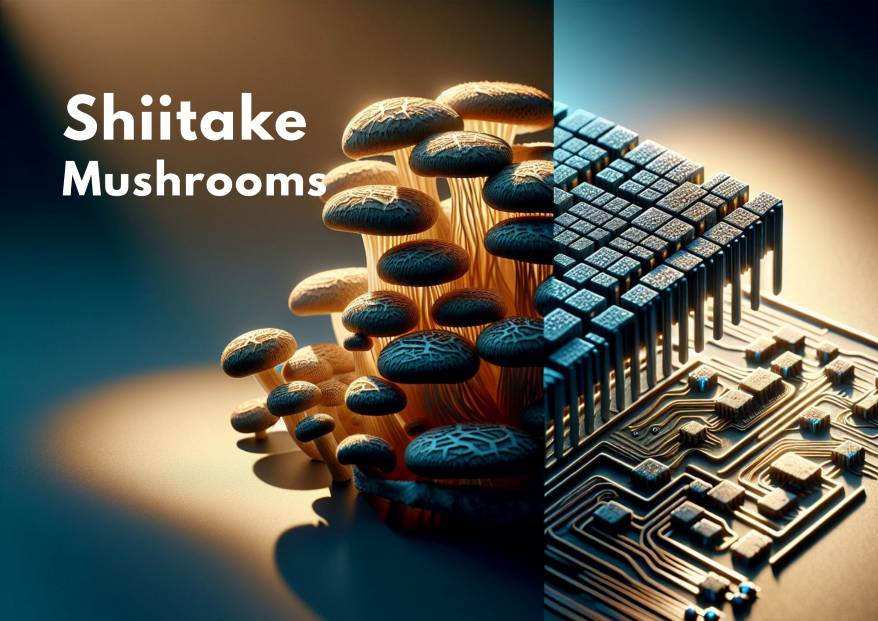
Memristors are special electronic devices that can remember electrical signals. This means they can store information like our brain’s neurons. They are extremely important for creating smarter, faster, and energy-saving computers. Because memristors combine memory and processing functions in one device, they reduce the time it takes to perform tasks. This property makes them ideal for applications in robotics, autonomous vehicles, and artificial intelligence.
The conventional memristors are constructed out of rare-earth minerals, which are not only costly but also detrimental to the environment. Their creation also necessitates the formation of intricate semiconductor factories. This restricts the degree to which these technologies may become environmentally benign and inexpensive. Therefore, experts have been searching for alternatives that are more environmentally friendly.
The Role of Memristors in Robotics and Autonomous Systems
It is necessary for robots and self-driving cars to have the ability to make decisions fast in order for them to provide both safety and efficiency. Memristors are of significant aid because they enable systems to learn from their previous experiences by altering their resistance in response to electrical input. This allows the systems to learn from their experiences. This ability is comparable to the way in which human brains learn knowledge by altering the connections between neurons when they are exposed to new information.
This learning skill enables machines to respond more quickly in demanding situations, such as avoiding barriers or appropriately following routes. This feature allows machines to learn and improve their performance.
The Challenge of Making Sustainable Electronics
The conventional approach to the production of memristors entails the exploitation of materials that, when discarded, contribute to the degradation of the environment. In addition, the manufacturing process for these devices typically requires a substantial amount of energy to be consumed.
In addition to delivering substantial computing power, an ecologically friendly solution using renewable resources significantly reduces the electronic waste that discarded devices produce.
How Shiitake Mushrooms Are Changing the Game
A group of researchers investigated Lentinula edodes, commonly known as shiitake mushrooms, as a potential material for environmentally friendly memristors. They chose this fungus because its networks, called mycelium, spontaneously transmit electrical signals just like neurons.
Devices that are based on mushrooms make use of organic biomass, which decomposes naturally and does not do any harm to ecosystems. Additionally, in comparison to conventional memristors, these fungal memristors have a lower energy consumption. This is due to the electrochemical features of fungi, which allow for less voltage operation.
The simplicity required to develop fungal electronics drives down production costs while reducing the electronic waste generated by discarded components. Additionally, shiitake mycelium resists radiation, suggesting that engineers could utilize it for space exploration electronics.
The Science Behind Fungal Adaptability
Mushrooms contain electrical pathways that offer more flexibility and replicate biological synapses better than the rigid artificial crystals used in modern memristors. Researchers now employ mushrooms to build these modern electronic components.This contributes to the development of artificial neural networks that are more effective and have the capacity to learn in a manner that is analogous to that of the human brain.
Because of this one-of-a-kind feature, it is possible that self-driving cars or robotics of the next generation may be able to work with greater intelligence while simultaneously consuming less energy.
Additionally, to stay updated with the latest developments in STEM research, visit ENTECH Online. Basically, this is our digital magazine for science, technology, engineering, and mathematics. Further, at ENTECH Online, you’ll find a wealth of information.
Reference
LaRocco, J., Tahmina, Q., Petreaca, R., Simonis, J., & Hill, J. (2025). Sustainable memristors from shiitake mycelium for high-frequency bioelectronics. PLoS ONE, 20(10), e0328965. https://doi.org/10.1371/journal.pone.0328965
- Author
- Latest Posts

I’m a web developer and science writer with a Master’s degree in Computer Applications (MCA) from Pune University.
I work in tech, building websites and staying updated with the latest developments. I also love writing about physics, chemistry, technology, robotics, mathematics, and breakthrough innovations. My passion is breaking down complex scientific topics into simple, easy-to-understand stories.
My goal is to help everyone stay informed about the exciting changes happening in science and technology. I believe understanding science shouldn’t be complicated—it should be accessible to all.