Urban heat island cooling applies AI and green infrastructure to cool cities, reduce heat stress, and support climate-resilient urban planning.
Urban Heat Island Cooling Using AI and Green Infrastructure
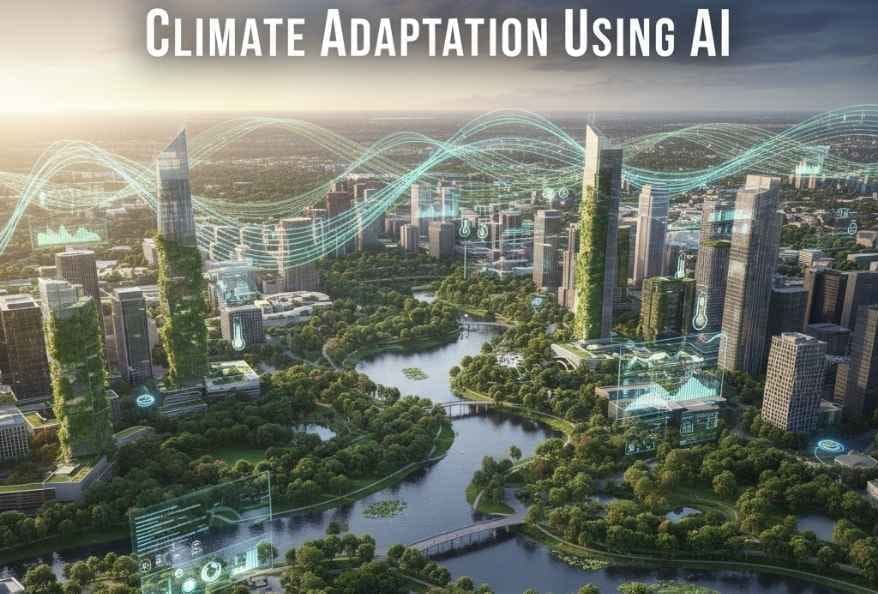
Urban heat island cooling is becoming essential as cities across the world experience rising temperatures. Urban areas trap heat due to concrete, asphalt, and dense infrastructure, causing them to remain warmer than surrounding rural regions. This phenomenon, known as the urban heat island effect, increases energy demand, threatens public health, and reduces overall urban comfort. To address this challenge, researchers and planners are increasingly combining artificial intelligence with green and blue infrastructure to design cooler, more resilient cities.
To address this challenge, researchers and planners are turning to urban heat island cooling strategies that combine natural solutions with advanced technologies such as artificial intelligence (AI).
Understanding Urban Heat Island Cooling in Cities
Urbanization replaces natural land with concrete, asphalt, and dense infrastructure. These materials store heat efficiently and prevent natural cooling. As cities expand, vegetation decreases, wind flow is restricted, and surface temperatures rise.
High urban temperatures increase the risk of heat stress, worsen air pollution, and raise electricity demand due to air conditioning use. In contrast, rural areas remain cooler because of open land, trees, and water bodies that naturally regulate temperature.
Effective urban heat island cooling is now a critical priority for city planners worldwide.
Role of Trees in Urban Heat Island Cooling
Blue-green infrastructure (BGI) refers to natural and semi-natural features such as parks, street trees, green roofs, rivers, lakes, and wetlands. These elements reduce heat by providing shade and promoting natural cooling processes like evaporation and transpiration.
Trees cool the surrounding air by releasing moisture through their leaves, while water bodies absorb heat and moderate temperature fluctuations. When integrated into urban environments, BGI can lower local temperatures by several degrees and significantly improve outdoor comfort.
However, the cooling impact of BGI varies depending on climate, city layout, vegetation type, and water availability. This makes planning complex and location-specific.
Why Traditional Planning Is Not Enough
Earlier urban planning methods relied heavily on manual analysis and generalized design rules. These approaches were slow, costly, and often failed to account for local environmental conditions.
As cities grow larger and climate risks intensify, planners need tools that can analyze vast amounts of environmental data quickly and accurately. This is where artificial intelligence plays a transformative role in urban heat island cooling.
How Artificial Intelligence Improves Urban Cooling
AI, particularly machine learning, can process large datasets from satellite imagery, weather stations, land-use maps, and sensor networks. These systems identify patterns in surface temperature, vegetation cover, humidity, and wind flow that are difficult for humans to detect.
By analyzing this data, AI models can predict how different blue-green infrastructure designs will affect urban temperatures. For example, they can estimate how much cooling a new park, tree corridor, or water body would provide in a specific neighborhood.
This allows planners to test multiple scenarios digitally before implementing them in the real world.
Smart Mapping and Simulation
One of the most powerful applications of AI in urban heat island cooling is spatial simulation. AI-powered maps visually highlight urban hot spots and cooler zones, making heat distribution easy to understand.
Planners can simulate changes such as adding trees, expanding green roofs, or introducing water features. The AI then predicts temperature reductions, energy savings, and long-term climate benefits. This approach saves time, reduces costs, and minimizes the risk of ineffective designs.
Benefits Beyond Temperature Reduction
Urban heat island cooling strategies offer more than just lower temperatures. Blue-green infrastructure improves air quality, reduces flood risk, supports biodiversity, and enhances mental well-being. AI-driven planning ensures these benefits are delivered efficiently and equitably across cities.
By targeting the most vulnerable areas, cities can protect at-risk populations during heatwaves and reduce health-related emergencies.
Future of Urban Heat Island Cooling and Smart Cities
As climate change accelerates, AI-supported urban planning will become essential. Cities of the future are likely to rely on machine learning models to guide infrastructure development, climate adaptation, and sustainability strategies.
Urban heat island cooling represents a shift toward smarter, nature-based solutions that work with the environment rather than against it. By combining technology with ecological design, cities can become more resilient, energy-efficient, and livable.
Opportunities for Students and Professionals
Fields such as AI, data science, environmental engineering, and urban technology are rapidly expanding. Universities and research institutions are increasingly offering programs focused on smart cities and climate resilience.
Students and young professionals can contribute by developing innovative tools, improving models, and designing greener urban spaces. Even small-scale interventions—such as planting trees or restoring water bodies—can make a meaningful difference when guided by data-driven planning.
The Path Forward for Urban Heat Island Cooling
Urban heat island cooling is no longer optional—it is a necessity for sustainable urban development. Blue-green infrastructure provides proven natural cooling, while artificial intelligence ensures these solutions are applied where they are most effective.
With continued research, innovation, and public engagement, cities can transform from heat traps into healthy, climate-resilient environments built for the future.
Additionally, to stay updated with the latest developments in STEM research, visit ENTECH Online. Basically, this is our digital magazine for science, technology, engineering, and mathematics. Further, at ENTECH Online, you’ll find a wealth of information.
References:
- Ma, X., Ye, J., Yang, F., Tang, S., & Jiang, Z. (2026). Machine Learning Application in Investigating Cooling Effect of Urban Blue–Green Infrastructure: A Systematic Review. Technologies, 14(2), 105. https://doi.org/10.3390/technologies14020105
- Zhu, Z., & Li, Y. (2023). Deep Learning for Urban Heat Island Mitigation: A Review. Applied Sciences, 13(4), 2145. https://doi.org/10.3390/app13042145
- Author
- Latest Posts

Kottauppari Venkat Raghava
I am a technology-driven IT graduate with a strong passion for science and innovation. I am fascinated by how innovations like artificial intelligence, robotics, and emerging technologies are shaping our world. I specialize in analyzing complex scientific and technological research and presenting it in a clear, accessible way. My goal is to make science and technology understandable and engaging for students, tech enthusiasts, and professionals alike. By breaking down advanced concepts into simple, insightful narratives, I strive to inspire curiosity, learning, and innovation, helping readers stay informed about the breakthroughs that are shaping the future.