A new study reveals how norovirus manipulates your gut microbiome. The ...
Scientists Discover How Norovirus Hijacks Gut Bacteria to Make You Sicker
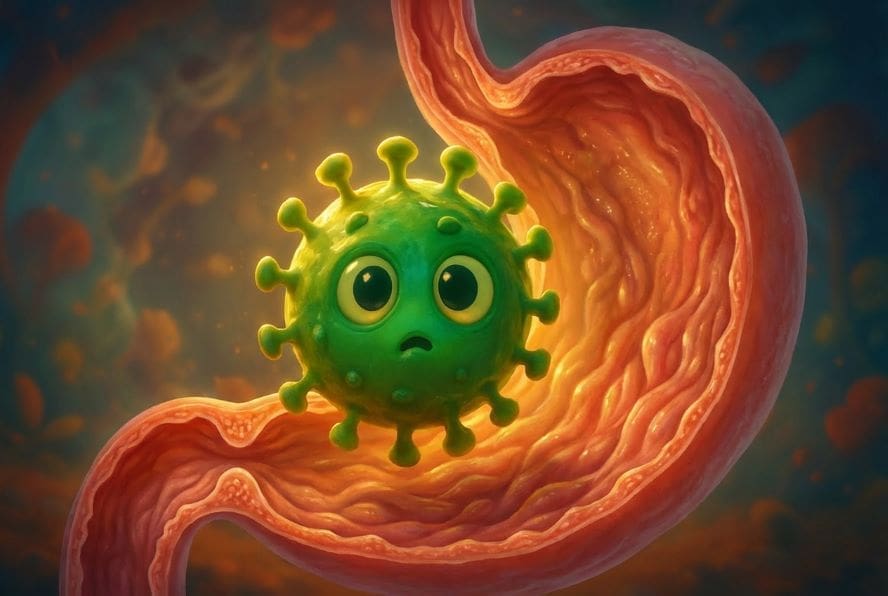
A new study reveals how norovirus hijacks gut bacteria. Have you ever had a stomach bug that knocked you out for days? Scientists just figured out something shocking about norovirus. This common virus doesn’t work alone. In fact, it teams up with bacteria in your gut.
The findings could change how we treat viral infections. Moreover, this research opens doors for STEM careers in microbiology and medicine.
What Makes This Discovery Important-How Norovirus Hijacks Gut Bacteria
Norovirus hijacks gut bacteria therefore, causing millions of infections every year. The virus spreads fast on cruise ships and in schools. It leads to severe vomiting and diarrhea. Above all, it can be life-threatening for young children.
Until now, scientists thought viruses acted independently. This research proves otherwise. The virus actually needs intestinal bacteria to thrive. As a result, treating the infection might require new approaches.
The research team used advanced imaging techniques. They tracked how the virus interacts with gut bacteria. To illustrate, they watched viral particles attach to bacterial cells. This partnership helps the virus infect human cells more effectively.
How the Virus-Bacteria Partnership Works
The study shows norovirus binds to specific bacterial surfaces. These bacteria produce special sugars called histo-blood group antigens. The virus uses these sugars as anchors.
At the same time, the bacteria benefit from this relationship. The viral infection creates conditions that help bacteria multiply. To put it differently, they form a mutually beneficial alliance.
This partnership happens in several stages. First, the virus enters the digestive system. Then, it seeks out compatible bacteria. After that, the virus attaches to bacterial surfaces. Finally, this complex infects human intestinal cells more efficiently.
The research team tested this virus-bacteria partnership in laboratory models. They compared infections with and without specific bacteria. As can be seen, the virus was less effective without bacterial help.
Career Opportunities in Microbiome Research
This discovery highlights exciting STEM career paths. Microbiome research is a rapidly growing field. In addition, it combines biology, chemistry, and computer science.
Students interested in this area of virus-bacteria partnership can pursue various directions. For example, they might become microbiologists or virologists. Others might focus on bioinformatics or pharmaceutical development. To enumerate, career options include research scientist, medical doctor, or biotech entrepreneur.
The field requires strong laboratory skills. As well as, professionals need critical thinking abilities. They must understand complex biological systems. Moreover, they should communicate findings effectively.
Exploring opportunities in biotechnology can help students understand these career paths better. The field offers competitive salaries and meaningful work.
Educational Pathways to Consider
Students curious about this research should take specific courses. Biology and chemistry classes provide essential foundations. At the same time, mathematics and computer science are increasingly important.
High school students can start preparing now. Join science clubs or research programs. Seek internships at local universities or hospitals. This time, focus on building laboratory experience.
College programs offer specialized tracks in microbiology. Many schools now have microbiome research centers. These facilities provide hands-on learning opportunities. In like manner, students gain exposure to cutting-edge techniques.
Graduate programs lead to advanced research positions. A master’s degree typically takes two years. A PhD requires four to six years. On the condition that students maintain focus, they can enter this field.
Real-World Applications of This Research of How Norovirus Hijacks Gut Bacteria
This discovery has practical implications. To say nothing of, it could lead to new treatments. Scientists might develop therapies targeting the virus-bacteria interaction.
One approach involves disrupting the partnership. Blocking bacterial attachment sites could prevent infection. Another strategy uses probiotic supplements to compete with harmful bacteria.
The pharmaceutical industry is taking notice. Companies are investing in microbiome-based therapies so as to understand the virus-bacteria partnership. As a matter of fact, this represents a billion-dollar market opportunity.
Understanding infectious disease research provides more context for these applications. The field continues expanding with new discoveries.
What This Means for Future Medicine
This research changes our understanding of viral infections. Sooner or later, doctors might prescribe combination therapies. These would target both viruses and bacteria simultaneously.
Personalized medicine could become more common. Doctors might analyze individual microbiomes before treatment. To this end, they could customize therapies for better outcomes.
The findings also affect public health strategies. Prevention programs might focus on maintaining healthy gut bacteria. In conclusion, this research represents a paradigm shift in virology.
Getting Started in This Field
Students should start exploring these topics of how norovirus hijacks gut bacteria. Read scientific articles and watch educational videos. At this point, focus on understanding basic concepts.
Connect with professionals in the field. Attend science fairs and conferences. Ask questions and seek mentorship opportunities. With this in mind, building networks early helps later.
Take advantage of online resources and courses. Many universities offer free educational materials. In this case, self-directed learning complements formal education.
All things considered, this research shows science keeps surprising us. The discovery proves how much we still don’t know. Most importantly, it demonstrates why STEM education matters for solving real-world problems.
Additionally, to stay updated with the latest developments in STEM research, visit ENTECH Online. Basically, this is our digital magazine for science, technology, engineering, and mathematics. Also, at ENTECH Online, you’ll find a wealth of information.
Reference
da Silva, A. C., Lapkin, J., Yin, Q., Muller, E., & Almeida, A. (2025). Meta-analysis of the uncultured gut microbiome across 11,115 global metagenomes reveals a new candidate biomarker of health. bioRxiv, 2025-09. https://doi.org/10.1016/j.chom.2026.01.013
- Author
- Latest Posts

I am a Master’s qualified in Science with focus on Zoology and Entomology and am a passionate, curiosity-driven science enthusiast aiming to transform complex scientific ideas in a manner that are easy to understand hence, educate, and inspire.
I have an experience of working on the projects in the field of Entomology which has provided me hands-on experience with various research techniques. Besides, I have also gained experience of lab work as well as developed communication skills during the course of my bachelors and masters.
With a strong foundation in life sciences and a growing interest in Medical and Biological research, I have cultivated a writing style that merges scientific facts with creativity.
My experience in teaching has also taught me to develop an understanding of what are the interests of people and how to communicate them effectively.
I am committed to lifelong learning, actively engaging in Interdisciplinary learning, so as to broaden my perspective.