3D Printing in Space empowers astronauts to build tools, habitats, and infrastructure beyond Earth, making long-term space exploration more practical and sustainable.
3D Printing in Space: Building Moon & Mars Bases
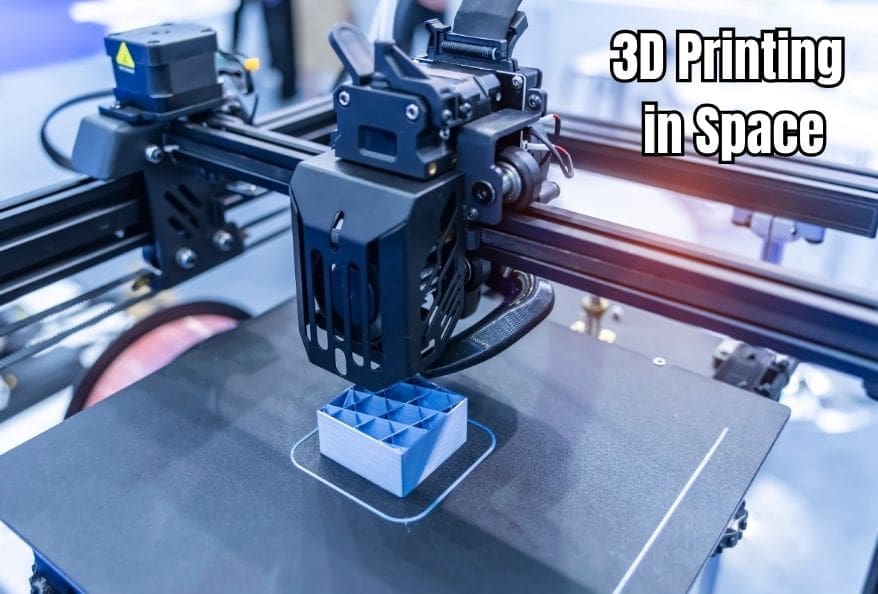
3D Printing in Space is transforming how humanity plans to build Moon bases and Mars colonies. Instead of launching every tool, bolt, and habitat module from Earth, astronauts and robots can manufacture what they need directly in orbit or on planetary surfaces. This revolutionary approach, known as additive manufacturing (AM), reduces costs, increases mission flexibility, and supports long-term space exploration.
As space agencies and private companies accelerate lunar and Martian missions, in-space manufacturing is becoming essential infrastructure rather than experimental technology.
Why 3D Printing in Space Matters
Launching materials into orbit is extremely expensive. Every kilogram sent aboard a rocket significantly increases mission cost. Traditionally, astronauts rely entirely on pre-supplied equipment. However, with 3D Printing in Space, missions can carry raw materials instead of finished products.
Key Advantages:
- Reduced Launch Costs: Raw feedstock weighs less than complete spare parts.
- On-Demand Manufacturing: Tools and components can be printed when needed.
- Recycling Capabilities: Plastic waste can be reused as printing material.
- Mission Independence: Crews become less dependent on Earth resupply.
For deep space missions lasting months or years, this autonomy is critical. If a wrench breaks on Mars, waiting months for replacement is not an option. Printing it locally ensures mission continuity and safety.
The Physics Challenge: Printing in Microgravity
3D printing on Earth relies heavily on gravity. Melted materials settle naturally, and layer bonding is predictable. In microgravity environments such as the International Space Station, those assumptions no longer apply.
In space:
- Buoyancy disappears.
- Surface tension dominates fluid behavior.
- Melt pools behave like floating droplets.
Molten metals do not flow downward. Instead, they form spherical shapes influenced by surface forces. Engineers must redesign printing processes to maintain structural integrity in these conditions.
Researchers test these behaviors using drop towers, parabolic flights, and orbital experiments aboard space stations. Understanding microgravity physics ensures that printed parts are strong enough for mission-critical applications.
Qualification and Safety Standards
On Earth, engineers test parts destructively—breaking them to measure strength and durability. In space, materials are limited, and waste must be minimized. Therefore, 3D Printing in Space requires new qualification strategies.
One solution is the digital twin concept. A digital twin is a virtual replica of the physical part. It simulates structural performance and predicts potential failure before use.
Additionally:
- Sensors monitor temperature and layer bonding in real time.
- AI systems detect defects during printing.
- Strict certification standards ensure astronaut safety.
Organizations like NASA are developing new manufacturing standards for space-based additive manufacturing. Safety is non-negotiable, especially when human lives depend on structural reliability.
Robotics and AI in Space Manufacturing
Astronauts have limited time and energy. That is why autonomous robotic systems will play a central role in building lunar and Martian habitats.
How Robotics Enhances 3D Printing in Space:
- Robots can construct habitats before humans arrive.
- AI corrects printing errors instantly.
- Systems operate continuously without fatigue.
- Hazardous environments become manageable.
A particularly exciting development is In-Situ Resource Utilization (ISRU). This approach uses local materials—such as lunar regolith (Moon dust)—as printing feedstock. Instead of transporting building materials from Earth, future missions could print structures using the Moon’s own surface material.
Private companies like SpaceX and Blue Origin are actively investing in technologies that support autonomous space infrastructure.
Metal Printing: The Next Frontier
Most current space-based printers use polymers. While useful for tools and small components, plastic is insufficient for load-bearing structures.
Future missions require printing:
- Titanium components
- Aluminum alloys
- High-strength steel
- Radiation-shielding materials
However, metal 3D printing consumes significant power. Spacecraft and lunar bases operate under strict energy constraints. Engineers are therefore designing energy-efficient laser and electron-beam systems optimized for vacuum conditions.
As power generation improves—especially through advanced solar arrays and compact reactors—metal additive manufacturing will become practical for constructing large habitats and spacecraft components.
Career Opportunities in 3D Printing in Space
The rise of space-based manufacturing creates diverse career paths beyond becoming an astronaut.
In-Demand Roles:
- Materials Scientist: Develop printable space-grade alloys.
- Robotics Engineer: Design autonomous construction systems.
- Aerospace Engineer: Integrate printers into spacecraft systems.
- AI Software Developer: Build real-time defect detection systems.
- Process Engineer: Optimize vacuum and microgravity printing methods.
Students interested in aerospace engineering, mechanical engineering, materials science, or computer science can contribute to the future of space colonization.
The Future of Space Construction
The long-term vision of 3D Printing in Space extends far beyond tools and habitats. In the coming decades, future possibilities may include orbital manufacturing factories, large space telescopes printed directly in orbit, deep-space spacecraft assembled in microgravity, and, ultimately, permanent Moon and Mars cities. Moreover, these advancements could significantly reduce mission costs and increase operational flexibility.
By addressing critical logistical challenges, additive manufacturing removes one of the biggest barriers to sustained human presence beyond Earth. As a result, long-duration exploration becomes more practical and economically viable. In other words, 3D printing is not just a convenience—it is a foundational technology for humanity’s expansion into space.
3D Printing in Space: Building Beyond Earth
3D Printing in Space is no longer science fiction; rather, it is becoming a core technology for Moon bases and Mars settlements. By lowering launch costs, enabling in-situ manufacturing, and integrating robotics and AI, it is transforming modern space exploration.
As research continues to progress, therefore, additive manufacturing will power the next phase of human expansion beyond Earth. Ultimately, as the space economy grows at a rapid pace, consequently, 3D Printing in Space stands at the very center of sustainable exploration and long-term colonization efforts.
Additionally, to stay updated with the latest developments in STEM research, visit ENTECH Online. Basically, this is our digital magazine for science, technology, engineering, and mathematics. Also, at ENTECH Online, you’ll find a wealth of information.
Reference
Dumitrescu, O., Prisăcariu, E. G., Roșu, R. A., & Cozzoni, E. (2026). Additive Manufacturing in Space: Process Physics, Qualification, and Future Directions. Technologies, 14(2), 121. https://doi.org/10.3390/technologies14020121
- Author
- Latest Posts

Kottauppari Venkat Raghava
I am a technology-driven IT graduate with a strong passion for science and innovation. I am fascinated by how innovations like artificial intelligence, robotics, and emerging technologies are shaping our world. I specialize in analyzing complex scientific and technological research and presenting it in a clear, accessible way. My goal is to make science and technology understandable and engaging for students, tech enthusiasts, and professionals alike. By breaking down advanced concepts into simple, insightful narratives, I strive to inspire curiosity, learning, and innovation, helping readers stay informed about the breakthroughs that are shaping the future.