Researchers used over 15,000 reef surveys. They looked at reefs in 41 countries. To enumerate, nearly 200 authors joined this work. They used satellites to track heat...
Ocean Warming Coral Loss: Third Global Bleaching Event
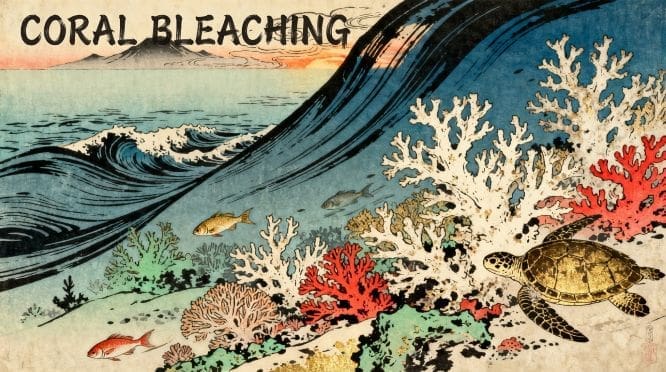
Climate change is moving fast. Our oceans are feeling the heat right now. A new research paper shows the 2014–2017 heatwave was brutal. It was the “Third Global Coral Bleaching Event” that is the ocean warming coral loss. Corals are tiny animals that build huge reefs. They live with tiny algae. These algae give them food and bright colors. As a matter of fact, ocean warming coral loss happens when heat makes this bond break. This has become the third global bleaching event. The algae leave the coral. This makes the coral turn white. This is called bleaching. At this point, the coral is starving. It can die if the water stays hot. Prior to this study, we did not know the full scale. At the present time, scientists have the clear data.
A Massive Global Data Project-Ocean Warming Coral Loss
Researchers used over 15,000 reef surveys. They looked at reefs in 41 countries. To enumerate, nearly 200 authors joined this work. They used satellites to track heat. They also used underwater checks. In this case of the third global bleaching event, the numbers are very scary. Half of all coral reefs suffered significant bleaching. What’s more, 15% of reefs saw high mortality. This means many corals died for good. In detail, the damage was worse than ever before. All in all, this event was a global disaster. At any rate, it shows how fast our world is changing. So far, this third global bleaching event is the most severe event recorded. Seeing that the heat was so high, it was historic.
The Role of Marine Engineering in Ocean Warming Coral Loss
How do we track this ocean warming coral loss from space? That is to say, we use marine engineering to understand the scale of this third global bleaching event of ocean warming coral loss. Engineers build the sensors and satellites that measure ocean temperatures with high precision. To point out, this career is vital for the planet. So that we can protect nature, we need data. With this in mind, students can look at STEM jobs. Marine biology and data science are great fields. You can help save biodiversity with these skills. After that, you might find ways to cool the reefs. To be sure, we need fresh minds in these roles. At the same time, the clock is ticking for the ocean.
Why Coral Reefs Matter: Preventing Ocean Warming Coral Loss
Coral reefs are not just pretty. In fact, they protect our shores by blocking big waves and preventing erosion. However, as we face increasing third global bleaching event of ocean warming coral loss, these natural barriers are at risk. All things considered, they feed millions of people too. So long as the reefs are healthy, the ocean thrives. In short, they are the rainforests of the sea. Analogous to a city, they provide homes for fish. Summing up, if reefs die, the ecosystem crashes. As a result, we lose food and jobs. To put it another way, it is a human crisis. Prior to now, we underestimated the loss. In light of this study, we must act fast. With attention to the climate, we can make changes.
Opportunities in Environmental Science: Tackling Ocean Warming Coral Loss
Provided that you like science, this is a big chance. To illustrate, you can study oceanography to understand how water moves and how currents help predict the heat driving ocean warming coral loss. In reality, you can also work in policy. To that end, science helps make new laws. At length, you could work for groups like the Smithsonian. As an illustration, this team worked across many borders. Together with global partners, they found the truth. So as to help, you could learn GIS mapping. This time, the world needs more environmental experts. To list, you could be a biologist or a coder.
The Future of Our Blue Planet
At this instant, a fourth event is starting of the ocean warming coral loss. While it may be true that things look grim regarding ocean warming coral loss, there is hope. To repeat, science gives us the map. In essence, we know where the heat is. By all means, we can target those areas. Sooner or later, we must lower carbon levels. With this intention, many companies are going green. While this may be true, we need more innovation. To sum up, the 2014–2017 event was a wake-up call. Balanced against the past, the future is harder. By and large, we must protect the ocean now. To put it differently, our survival depends on it.
Taking the Next Step in STEM
Are you ready to join the fight to tackle this third global bleaching event of ocean warming coral loss? Take the case of these 200 researchers. They started as curious students like you. To rephrase it, you can make a huge impact. At this time, you can explore STEM careers to start. By comparison, you have better tools than the past. With the result that, your generation can solve this. As I have noted, the data is clear. As can be seen, the reefs are in danger due to the ocean warming coral loss. To say nothing of the fish, we need the reefs. All in all, science is our best tool. With this purpose in mind, keep learning and asking questions. Explore science topics to find your path today.
Additionally, to stay updated with the latest developments in STEM research, visit ENTECH Online. Basically, this is our digital magazine for science, technology, engineering, and mathematics. Also, at ENTECH Online, you’ll find a wealth of information.
References
Eakin, C. M., Heron, S. F., Connolly, S. R., et al. (2026). Severe and widespread coral reef damage during the 2014-2017 Global Coral Bleaching Event. Nature Communications, 17(1), 1318. https://doi.org/10.1038/s41467-025-67506-w
- Author
- Latest Posts

A Master’s-qualified Zoologist with a focus on Limnology, I combine hands-on laboratory experience with a sophisticated background in science communication. My career is defined by an interdisciplinary approach to the life sciences, merging technical research skills with a proven ability to teach and engage diverse audiences. I am committed to lifelong learning and the creative dissemination of medical and biological research, ensuring scientific literacy and inspiration remain at the forefront of the field.