Hydrogel composites made from pineapple crowns and avocado peels enable simultaneous heavy metal removal from aqueous solutions.
Eco-Friendly Hydrogels from Fruit Waste for Heavy Metal Removal
Fruit waste often seems completely useless, with pineapple crowns and avocado peels discarded every day, leading to growing piles of organic waste. At the same time, industrial activities contaminate water sources, where toxic metals like lead and copper threaten aquatic ecosystems. Addressing both challenges, scientists sought an innovative and sustainable solution for heavy metal removal. Traditionally, costly filtration systems were the primary method for treating such pollution. However, researchers have now introduced a novel approach by converting fruit waste into efficient bio-based hydrogels. These eco-friendly materials act as powerful filters, enabling rapid and effective heavy metal removal from contaminated water.
Heavy Metal Removal: TL;DR
Fruit waste–based hydrogel composites (pineapple crown and avocado peel) were developed as low-cost, eco-friendly adsorbents for simultaneous heavy metal removal from aqueous solutions. This innovation bridges biology, chemistry, and health sciences, motivating students to explore and pursue future careers in STEM fields
Key Takeaways
- Scientists burned fruit waste into porous biochar.
- They mixed biochar with a hydrogel polymer.
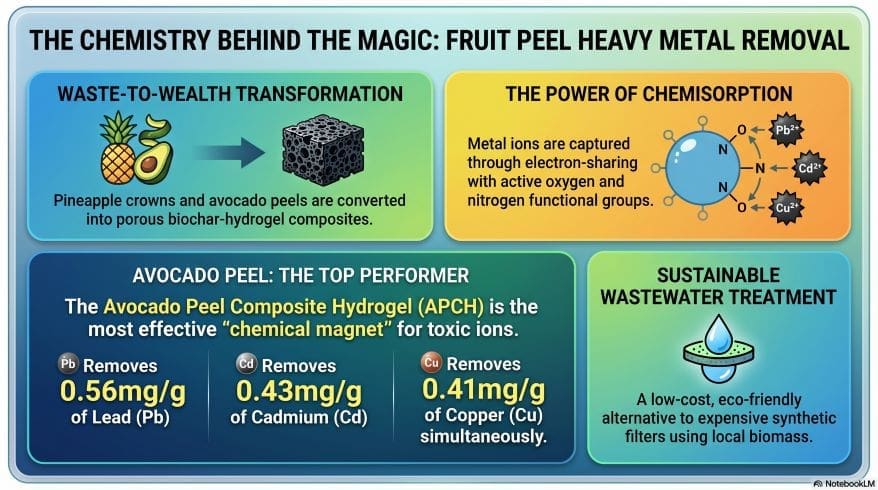
- Avocado peels absorbed metals best.
- The process removes lead, cadmium, and copper.
- It provides a cheap, sustainable solution..
How Does It Work?
The science behind this is fascinating. Students learn about polymers in chemistry class. Hydrogels behave like giant sponges. They trap heavy metals within their unique structure..
- Biochar provides a huge surface area.
- Heat makes the fruit waste extremely porous.
- Chemical groups act like tiny metal magnets.
- Oxygen and nitrogen molecules grab the toxins.
In light of this, testing showed amazing results. Avocado peel filters worked better than pineapple. In fact, they soaked up more lead. The porous structure made this absorption possible.
Why Avocado Peels Win
All in all, avocados have a special makeup. Avocado biochar contains denser, finer micro-pores. As a matter of fact, these trap metals well. This creates an ideal system for pollutants.
- Avocados have dense lignocellulosic networks.
- Their hydrogels expose more active binding sites.
- They maintain strong mechanical stability in water.
- They bind lead, cadmium, and copper simultaneously.
With this in mind, let us compare performances. Pineapple crowns definitely helped clean the water. Then again, avocado peels held onto more toxins. This waste proved incredibly efficient overall.
The Chemistry Behind the Magic
The synthesis process is fascinating. Scientists dry and crush the fruit waste. After that, they bake it at high heat. This pyrolysis process creates highly porous biochar.
- The heat reaches 500 degrees Celsius exactly.
- Nitrogen gas flows continuously during the baking.
- Chemicals activate the biochar surface effectively.
- Polyacrylamide forms the flexible hydrogel structure.
The ingredients are mixed together. In similar fashion, a crosslinker is added carefully. Summing up, the mixture forms a solid gel. This hybrid survives water agitation well.
Testing the Bio-Filters
Lab tests are rigorous. Scientists put the gels into contaminated water. After that, they shook the mixtures for hours. The testing phase proved the concept completely.
- The water contained lead, cadmium, and copper.
- The solution pH stayed between 4 and 6.
- Machines shook the samples at 125 revolutions.
- The experiment lasted for 300 minutes total.
The gels soaked up metals. As can be seen, equilibrium happened eventually. In short, the metals bonded to the gel. This chemical bonding is called adsorption kinetics.
Measuring the Success of Heavy Metal Removal
All things considered, the data looked very promising. Avocado gels grabbed 0.56 milligrams of lead. By comparison, pineapple gels absorbed much less. These exact measurements prove the avocado superiority.
- Cadmium absorption reached 0.43 milligrams per gram.
- Copper absorption hit 0.41 milligrams per gram.
- Pineapple crowns maxed out at 0.23 milligrams.
- The avocado pores stayed open much better.
For the most part, structure determines the success. In effect, avocado biochar disperses better inside gels. Together with polyacrylamide, it forms strong bonds. This unique synergy maximizes the metal removal.
Real-World Applications of Heavy Metal Removal
To point out, this is real environmental engineering. You can read more on sustainable engineering. In reality, students can replicate this eventually. You just need basic lab equipment and curiosity.
- This combines chemistry, physics, and ecology perfectly.
- It uses free radical polymerization techniques.
- Students can study adsorption kinetics models.
- This inspires green technology career paths.
In conclusion, nature offers brilliant engineering solutions. We must stop ignoring basic agricultural waste. To that end, green chemistry holds the key. This exciting field needs more young scientists.
Global Impact
By all means, clean water is a right. In general, toxic water hurts vulnerable communities most. As has been noted, bio-filters clean water affordably. Such global innovations save many human lives.
- This stops secondary sludge production.
- It uses extremely low energy overall.
- Local materials keep production costs down.
- The process promotes a circular economy.
With this purpose in mind, innovation must continue. To be sure, future tests will scale up. Engineers will test actual industrial wastewater soon. We need sustainable solutions for future generations.
Additionally, to stay updated with the latest developments in STEM research, visit ENTECH Online.
Reference
- Wardani, S., Husni, H., Sulaiman, M. I., Desvita, H., & Hadi, A. (2026). Simultaneous removal of heavy metals from aqueous solutions by pineapple crown and avocado peel hydrogel composites. Global Journal of Environmental Science and Management, 12(2), 473-496. https://doi.org/10.22034/gjesm.2026.02.01
- Author
- Latest Posts
I completed my Master of Science from the University of Allahabad in 2017 with a strong academic background in life sciences and chemistry. My specialization included Molecular Biology, Microbiology, Genetics, Plant Breeding, Phycology, Paleobotany, and Bioinformatics, along with Organic Chemistry, Inorganic Chemistry, and Physical Chemistry. This multidisciplinary training provided me with a comprehensive understanding of biological systems and analytical scientific approaches.
After completing my postgraduate studies, I gained valuable professional experience in both the education and social development sectors. I worked at A.M. Oxford Public School, where I was actively involved in guiding students toward academic excellence. In this role, I focused on creating an engaging learning environment, encouraging critical thinking, and nurturing students’ curiosity for scientific learning. My experience as an educator strengthened my communication, mentoring, and classroom management skills.
In addition to my teaching experience, I worked with Jeevan Jagriti Foundation, where I contributed to community-based initiatives aimed at improving educational access and awareness among underprivileged sections of society. Through this work, I participated in programs designed to support social development and promote the value of education in marginalized communities.
These professional experiences helped me develop strong interpersonal, leadership, and organizational skills while reinforcing my commitment to education and community service.