Learn how the ancient primate fossil Colorado discovery reveals our earliest ancestors after the dinosaurs.
Ancient primate fossil Colorado: Tiny teeth tell a big story
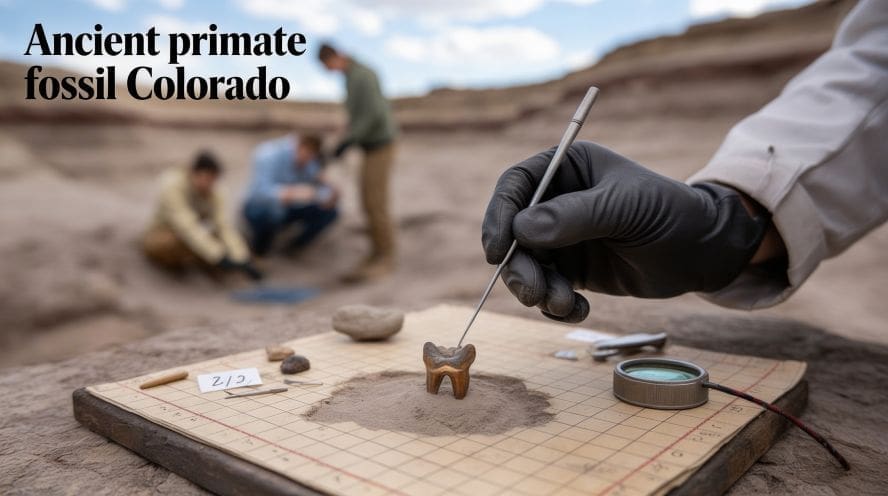
Ancient primate fossil Colorado discoveries are currently reshaping what we know about our past. Scientists recently found a major piece of the human evolution puzzle in the dirt. They identified fossil teeth in the Denver Basin that belong to Purgatorius. This animal is a very early relative of all primates, including humans. At the present time, we know it lived right after the dinosaurs died. As a result, this tiny creature is a key to our origins.
A Big Find in the Ancient Primate Fossil Colorado
The team found these fossils at a site called Corral Bluffs. At first, they looked for small clues in the heavy sediment. They used a method called screen-washing to find them with attention to detail. This process involves washing buckets of dirt through very fine screens. To explain, it helps catch the ancient primate fossil Colorado teeth that eyes often miss. After that, volunteers spend hours picking through the remaining grains carefully.
These teeth are approximately 65.5 million years old in reality. This date is just after the mass extinction event that killed T. rex. Prior to this, experts only found Purgatorius in much more northern areas. They found them in Montana as well as Saskatchewan in Canada. Now, we know they lived much further south than anyone expected. This ancient primate fossil Colorado find fills a huge geographic gap for researchers.
Mapping the Ancient Primate Fossil Colorado Tree
The Corral Bluffs site in Colorado is a scientific goldmine for everyone. It preserves an entire ecosystem from the Paleocene era after the blast. This is when mammals began to rule the world as a whole. They took over the empty spaces left by the large dinosaurs.
The Purgatorius find proves that early primates were true survivors. They thrived while the world was still recovering from fire and ash. This ancient primate fossil Colorado find gives us a new perspective. In light of this, we must keep searching for more clues. There are many more species yet to be found in the basin. Each tooth helps us understand the evolution of the brain.
Why This Ancient Primate Fossil Colorado Matters
Purgatorius was not a monkey or an ape by any means. Instead, it was a plesiadapiform, which is an archaic type of primate. These are the earliest known relatives of primates on the family tree. They were likely small and lived in trees to stay safe. To illustrate, they looked a bit like modern squirrels or tiny tree shrews. At the same time, they were starting to adapt to a new world.
Paleontologists believe these animals moved south very quickly after the impact. The new fossils show a unique mix of features in the enamel. As a result, they might belong to an entirely new species. This ancient primate fossil Colorado suggests that primates diversified almost immediately. It happened within the first million years after the extinction of the dinosaurs. We are seeing a burst of life in the fossil record.
Your Future with the Ancient Primate Fossil Colorado
Are you interested in Earth history and the mystery of life? You might enjoy digging for a dream as a professional fossil hunter. Paleontology is a great STEM career for curious students. It combines biology, geology, and fieldwork in the great outdoors. You could be the one to find the next major skeleton.
You can study how life recovered after global disasters in the past. This research helps us understand our own origins and future survival. All things considered, it is an exciting time for science and technology. Many lucrative careers wait for grade 11 and 12 students like you. To point out, many of these roles use advanced computer modeling.
What Does a Paleontologist Do?
To list, here are some typical tasks for this career:
- Searching for fossils in the field during the summer months.
- Cleaning specimens in a laboratory using very small tools.
- Using 3D scanning to see inside rocks without breaking them.
- Writing research papers about new finds for journals like JVP.
You need strong critical thinking skills to be successful in this field. What’s more, you must be patient while searching through tons of dirt. Finding a single ancient primate fossil Colorado tooth can take weeks of hard work. However, the reward is incredible when you find something new. You get to hold a piece of history in your hands. As a result, you become a pioneer in human evolution.
Conclusion
To sum up, these tiny teeth tell a huge story. They show how our oldest relatives began their journey. Studying the ancient primate fossil Colorado helps us map our ancestors. Perhaps you will be the one to find the next link. Start your STEM journey today. The past is waiting for you to find it.
Additionally, to stay updated with the latest developments in STEM research, visit ENTECH Online.
Reference:
- Chester, S. G., Crowell, J. W., Krause, D. W., & Lyson, T. R. (2025). Southernmost occurrence of Purgatorius sheds light on the biogeographic history and diversification of the earliest primate relatives. Journal of Vertebrate Paleontology, e2614024. https://doi.org/10.1080/02724634.2026.2614024
- Author
- Latest Posts

A Master’s-qualified Zoologist with a focus on Limnology, I combine hands-on laboratory experience with a sophisticated background in science communication. My career is defined by an interdisciplinary approach to the life sciences, merging technical research skills with a proven ability to teach and engage diverse audiences. I am committed to lifelong learning and the creative dissemination of medical and biological research, ensuring scientific literacy and inspiration remain at the forefront of the field.