Explore the augmented reality definition and learn how this technology transforms your experience with the real world.
Ultimate Guide to Augmented Reality: Merging Digital and Physical Worlds

Estimated reading time: 7 minutes
Augmented reality stands as one of the most transformative technologies of our time. In essence, augmented reality merges digital information with the real world. You interact with both physical and virtual elements simultaneously. The result creates an entirely new way to experience reality. This comprehensive guide explores everything you need to know about augmented reality. We will examine its definition, real-world applications, and future potential.
Understanding the Augmented Reality Definition
To begin our journey, we must establish a clear augmented reality definition. Augmented Reality (AR) is a technology that superimposes digital information onto the real world. Unlike virtual reality, it does not replace your surroundings. Instead, it adds layers of images, sounds, or data to your existing environment. Generally most people experience AR through smartphones or tablets.
To explain, the technology uses sensors and cameras to track the physical space. After that, it places 3D assets or text into that space in real-time. As a result, the user sees a combined version of reality. All in all, AR bridges the gap between the virtual and physical domains. To put it differently, it enhances what you see rather than hiding it.
How Augmented Reality Works
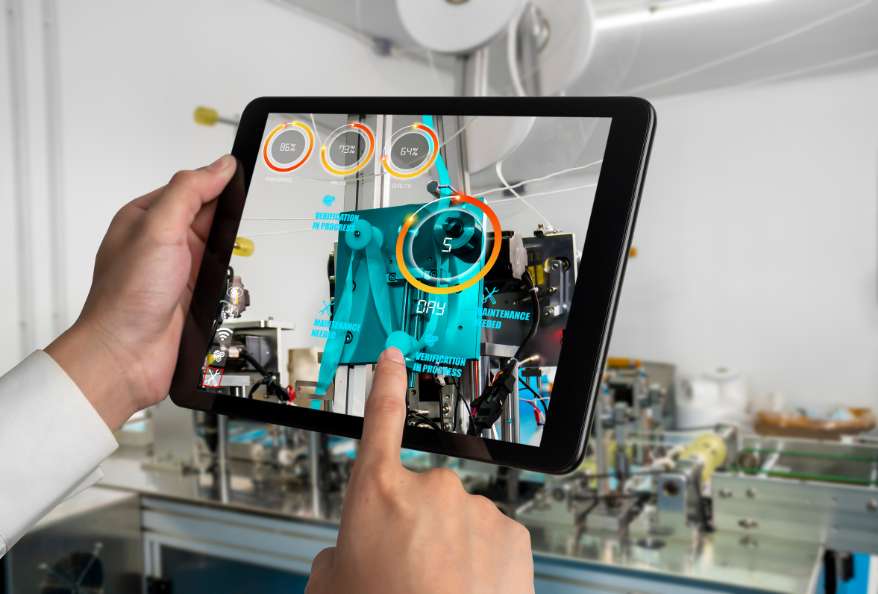
Augmented Reality relies on several key components to function correctly. Firstly, the device needs a camera to capture the world. Prior to displaying an image, the software must identify points of interest. At the same time, sensors like accelerometers and gyroscopes track the device’s position.
Similarly, the processor handles millions of calculations per second. By comparison, older devices struggled with this intense workload. But the modern hardware allows for seamless interaction. To illustrate, when you move your phone, the digital object stays in place. This time, the software ensures the virtual object aligns with the physical floor or table.
Types of AR Technology
- Marker-based AR: This type uses a specific visual trigger like a QR code.
- Markerless AR: It relies on GPS or compasses to provide location-based data.
- Projection-based AR: It shines light directly onto physical surfaces.
- Superimposition AR: This replaces the original view of an object with a new image.
Real-World Examples of Augmented Reality
Retail and Shopping
The retail industry has embraced augmented reality extensively. To illustrate this point, major fashion brands now offer virtual try-on experiences. Customers can see how clothing items look on their bodies even before purchasing. Cosmetics brands provide similar applications for testing makeup products. Customers can view lipstick colors or eyeshadow shades on their own faces using augmented reality.
Furniture retailers have pioneered augmented reality applications as well. For example, IKEA’s app allows users to place virtual furniture in their homes. Customers visualize how specific pieces fit within their spaces. This reduces return rates significantly, and lets people make more confident purchase decisions.
Gaming and Entertainment
Gaming represents another dominant sector for augmented reality implementation. Classic case of Pokémon GO, which became a cultural phenomenon with AR. Players caught virtual creatures in their actual neighborhoods, explored cities while having fun in a virtual cartoon world.
At this point, gaming developers continue creating innovative augmented reality experiences. On the other hand, snapchat filters demonstrate augmented reality capabilities to casual users. These filters overlay digital masks onto faces in real time. Users find these playful applications entertaining and shareable. Sooner or later, such mainstream exposure normalizes AR.
Education and Training
Educational institutions have begun implementing augmented reality tools. To put it another way, students interact with complex concepts through visual demonstrations. For example, a biology student can explore 3D organs, medicine students can even practice surgical procedures using AR simulations. These training environments present realistic scenarios without risk.
Industrial training programs also leverage augmented reality. Technicians view step-by-step repair instructions overlaid on equipment, and assembly workers can follow AR guides to build complex products accurately. This reduces errors and accelerates training timelines considerably.
Healthcare and Medicine
As an illustration of augmented reality’s medical potential, surgeons now use this technology during operations. Augmented reality displays critical patient information during procedures. Surgeons visualize internal structures through imaging data. This enhanced visibility improves surgical precision. Recovery times often decrease as a result.
Additionally, doctors use augmented reality for diagnostic purposes. Medical professionals visualize tumor locations before treatment planning, helping them understand anatomical relationships more clearly through AR.
The Benefits of Using Augmented Reality
All things considered, augmented reality offers unique advantages over traditional media. To start, it provides an immersive experience without the need for bulky headsets or other costly equipment. So long as you have a smartphone, you can access AR. Another key point is the interactive nature of the content. In contrast to a flat video, users can move around an AR object.
As a result, information retention increases significantly. With this intention, teachers use AR to explain complex science concepts. In essence, it makes learning feel like an adventure and also increases efficiency.
Career Opportunities in the Augmented Reality Space
Provided that you are interested in technology, augmented reality offers a thriving career path. To enumerate, there are many roles available for creatives and engineers. At this time, the demand for AR developers is at an all-time high.
Similarly, 3D artists are vital to the industry. After all, every AR experience needs high-quality models. To put it another way, if you can design digital art, you have a place here. In addition, companies need UX designers specifically for spatial computing.
Some common roles you can explore include:
- AR Software Engineer
- 3D Interaction Designer
- Computer Vision Researcher
- Technical Product Manager
- Creative Content Producer
Future Scope of Augmented Reality
All in all, the future of AR looks incredibly bright. In due time, we will likely move away from handheld phones. Instead, we may wear lightweight AR glasses. So that we can see notifications directly in our sight. To point out, big tech companies are investing billions of dollars. At this instant, they are building the infrastructure for a spatial web.
In fact, AR may transform how we commute. Analogous to a GPS, your car windshield might show navigation arrows. Sooner or later, every industry will adopt some form of this tech. With the result that, our world will become more data-rich and interactive. In other words, the digital and physical worlds will merge completely.
Challenges Facing Augmented Reality
While it may be true that AR is impressive, it faces hurdles. At length, battery life remains a major concern. Seeing that AR uses cameras and high brightness, it drains power quickly. In either case, hardware must become more efficient. Another key point is the privacy of data. With this in mind, users worry about cameras recording their private spaces. At the same time, the field of view in glasses is often limited.
User Adoption and Comfort Issues
To point out another challenge, some users experience discomfort with augmented reality. Extended use can cause eye strain and headaches. The technology requires users to hold devices at specific angles, which creates physical fatigue. Ergonomic solutions need further development.
Additionally, cultural acceptance varies significantly across regions. Some populations embrace augmented reality enthusiastically, while others remain skeptical. Privacy concerns deter adoption in certain communities. Building trust requires transparent communication about data practices.
Impact and Implications of Augmented Reality
Business and Economic Implications
Augmented reality generates substantial economic opportunities. Markets for AR products and services grow rapidly. Industries from retail to healthcare invest heavily in this technology. Employment in related domains expands accordingly, enabling strong job security and competitive compensations.
Social and Cultural Impacts
Augmented reality will reshape human interaction patterns. Communities may experience social changes as this technology becomes ubiquitous. Working relationships could transform through remote collaboration with AR. Educational methods will evolve to incorporate AR tools.
Augmented Reality Definition: Conclusion
Summing up, the augmented reality definition describes a world where digital and physical realities coexist. As a matter of fact, AR is changing how we work, play, and learn. Although this may be true, we are still in the early stages.
AR is not just a trend, rather it is a fundamental shift.
In reality, the potential for innovation in augmented reality is limitless. With that in mind, we encourage you to start exploring AR. So long as you stay curious, you can find a place in this evolving field.
Additionally, to stay updated with the latest developments in STEM research, visit ENTECH Online. Basically, this is our digital magazine for science, technology, engineering, and mathematics. Further, at ENTECH Online, you’ll find a wealth of information.
References:
- Kamińska, D., Zwoliński, G., Laska-Leśniewicz, A., Raposo, R., Vairinhos, M., Pereira, E., Urem, F., Hinić, M. L., Haamer, R. E., & Anbarjafari, G. (2023). Augmented Reality: Current and new trends in education. Electronics, 12(16), 3531. https://doi.org/10.3390/electronics12163531
- Author
- Latest Posts

Manas Lahare is a web developer, digital content specialist, and technical writer with a passion for breaking down complex technological and mathematical concepts. He holds a Master of Computer Applications (MCA) from Sinhgad Institute of Management and Computer Application (SIMCA), graduating in 2024.
With core technical expertise in WordPress development, PHP, HTML/CSS, and Search Engine Optimization (SEO), Manas combines hands-on web architecture skills with structured research. As a prolific author for ENTECH Magazine, he covers a wide array of cutting-edge STEM and IT topics—ranging from data security innovations like homomorphic encryption and passwordless authentication to core emerging tech like Industry 4.0, Augmented Reality (AR), always-on connectivity, and abstract mathematical topology.
Through his writing, Manas aims to make intricate digital systems, modern cybersecurity standards, and foundational computer science topics accessible and engaging for students, developers, and tech enthusiasts.