Solar panels on rooftops already power many homes. They turn sunlight into electricity that runs lights and appliances. Perovskite materials could make panels cheaper and more powerful. Tiny defects inside the crystals limit how well…
Solar panels on rooftops already power many homes. They turn sunlight into electricity that runs lights and appliances. Perovskite materials could make panels cheaper and more powerful. Tiny defects inside the crystals limit how well they work. Perovskite solar cell defect reduction is still a big challenge for researchers. Researchers at Princeton found a simple chemical mix that reduces those defects. Electrons hold energy from sunlight much longer. This change could raise power output by about one percent. Students in a materials lab once grew small crystals and saw how grain boundaries trapped charges. The new approach targets those same boundaries.
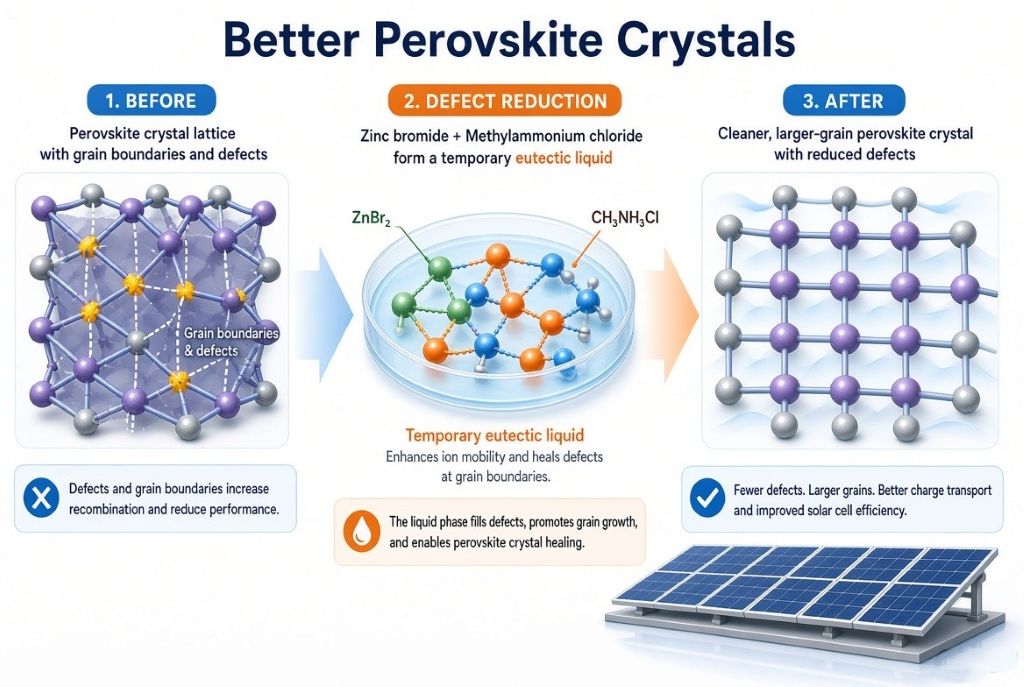
Princeton researchers used a simple chemical mix to grow perovskite crystals with fewer defects.
Perovskite Solar Cell Defects and Challenges
Perovskite solar cells use lab-made crystals that capture light well. The crystals form from liquid solutions that can be printed into thin films. Printing and layering create tiny defects at grain boundaries. Those defects trap electrons and release their energy as heat instead of electricity. The longer electrons keep the energy from sunlight, the more power the cell can make. Current films lose energy quickly because of these flaws.
Tandem cells that stack perovskite on silicon already produce more power than silicon alone. Defects still limit further gains. Researchers have tried many additives to improve crystal quality. Most approaches add complexity or cost. A simpler fix during the early growth stage would help scale the technology.
How the Team Achieved Perovskite Solar Cell Defect Reduction
The Princeton-led team added zinc bromide and methylammonium chloride early in fabrication. The two chemicals form a volatile eutectic mixture. The mixture melts at a lower temperature than either chemical alone. During heating, the temporary liquid surrounds the growing crystals. Crystals rearrange into a more ordered structure with fewer defects. The methylammonium chloride later evaporates. Zinc stays at the grain boundaries and helps passivate remaining flaws. Electrons in the treated films retain energy for up to 300 microseconds. That time is ten times longer than in untreated perovskites. The result points to roughly one percent higher power output in cutting-edge cells. The approach works across different perovskite compositions tested by the group.
Why Cleaner Crystals Matter for Solar Technology
Longer energy retention means more electricity from the same amount of sunlight. The gain of about one percent is meaningful when panels cover large areas. Tandem designs already boost output by about forty percent over single-junction silicon. Reducing defects makes those tandems more reliable and efficient. The method also supports larger modules because grain-boundary problems grow with device size. Companies that print perovskite films can adopt the additive without major process changes. Rising demand from data centers and electric vehicles increases the need for lower-cost solar power. Cleaner crystals help close the gap between lab results and commercial panels. Students who study materials science often measure carrier lifetimes in class projects. Seeing how a simple salt mixture extends those lifetimes makes the defect problem concrete.
Careers in Perovskite Solar Cell Development
Materials science, chemical engineering, and physics programs cover crystal growth and defect analysis. Undergraduate research frequently involves preparing thin films and measuring their optical properties. Internships at solar companies or national labs give experience with printing processes and device testing. Python skills for data analysis of carrier lifetime measurements are useful early on. Later roles include optimizing additives, scaling module production, or testing long-term stability. University groups and startups hire people who can connect lab chemistry with practical manufacturing. Early projects might involve growing perovskite films or characterizing grain boundaries with simple microscopy. The Princeton work shows that careful attention to crystallization chemistry can unlock performance gains without alternative equipment.
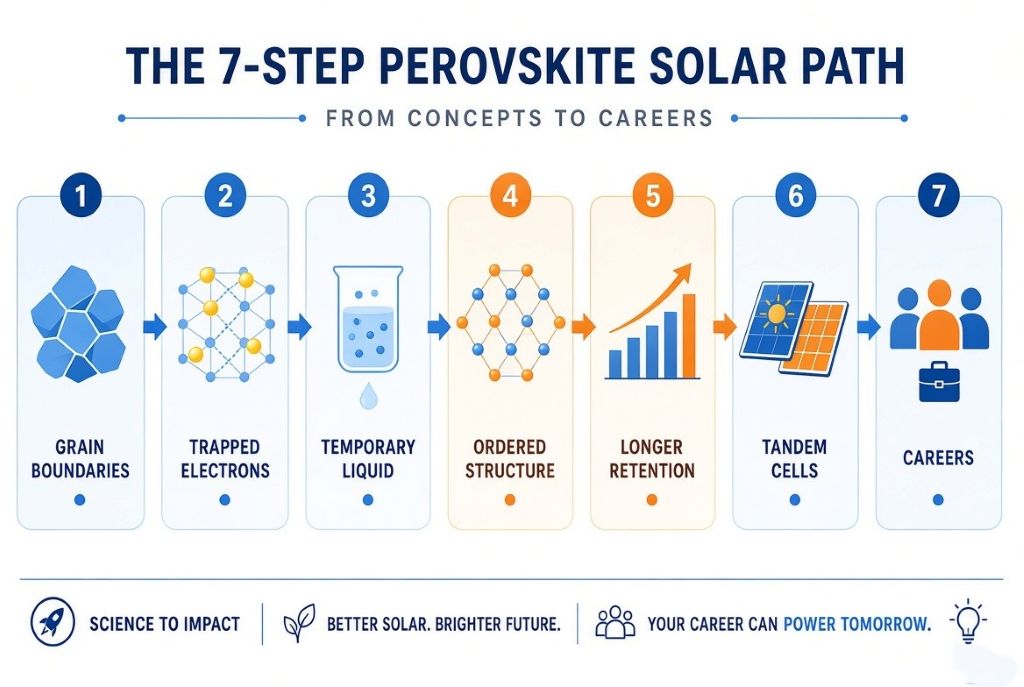
A visual summary of how a temporary liquid mixture reduces grain-boundary defects and connects to solar materials careers.
How This News Article Was Compiled
The article draws only from the official Princeton Electrical and Computer Engineering news page. Technical details, researcher names, and results come directly from that university announcement. Career notes reflect standard educational pathways in materials science and solar technology.
Deven Nandapurkar is a Software Engineer, Project Lead; working at the strategic intersection of software engineering, productivity science, and emerging technologies. Driven by a core philosophy of "building things worth building," he leads cross-functional teams and drives end-to-end technical strategy—from early-stage conceptualization through production-grade deployment.
A Computer Engineering graduate from Pune University, Deven brings a sharp systems-thinking approach to technical leadership, honed by years of managing high-stakes engineering projects and leading teams to top placements in national and international hackathons, including the NASA Space Apps Challenge and the Peerlist GenAI Hackathon.
Deven explores how human cognition and emerging technology converge. He regularly writes about cognitive performance optimization, attention management, AI integration, and the evolving dynamics of the modern workforce - offering actionable frameworks for professionals seeking to maximize their productivity and thrive alongside intelligent systems.
Shreyas Kulkarni is a Chartered Electrical Engineer and renewable energy pioneer with over eight years of hands-on experience in the clean energy sector. He is the Co-Founder of UNICUS Energy, a leading provider of solar energy solutions in India, where he drives technical execution, system architecture, and clean tech deployment.
As an author for ENTECH Magazine, Shreyas focuses on making solar technology practical and understandable for students, engineers, and homeowners. His contributions include detailed guides on the inner workings of rooftop solar systems and deep dives into modern hardware advancements, such as lightweight solar panels and flexible photovoltaic materials.