Scientists analyzed Europa’s seafloor to measure tectonic strength. Fractures and seawater-altered rocks make movement more likely.
Exploring Europa’s Seafloor: Could It Host Habitable Environments?
Estimated reading time: 3 minutes
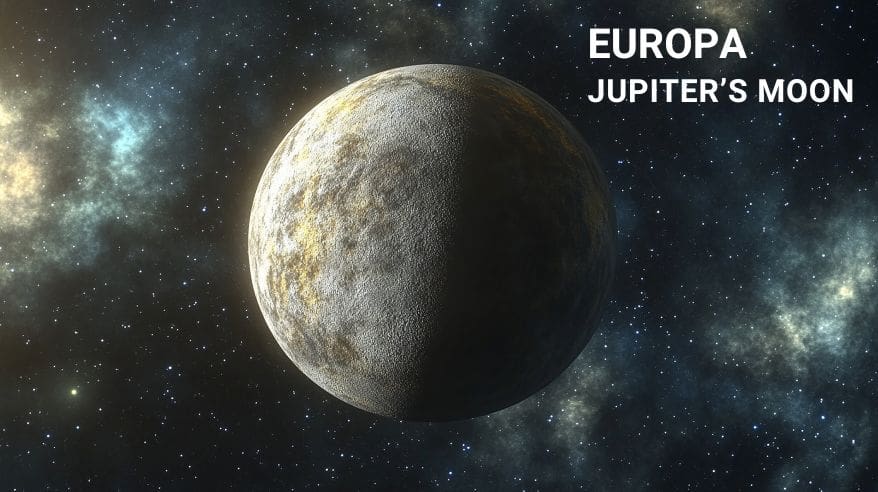
Europa, one of Jupiter’s largest moons, has drawn significant attention for its potential to support life beneath its icy surface. Scientists recently studied the moon’s rocky seafloor to estimate its **tectonic strength** and geological activity. They found that the brittle strength of Europa’s silicate interior depends mainly on pre-existing fractures within its rocks. These fractures act as weaknesses where movement can occur.
To explore how Europa’s seafloor behaves under stress, researchers looked at parameters that make the ocean floor relatively weak. For example, rocks altered by chemical reactions with seawater or earlier heating phases may slip more easily than unaltered rocks.
Role of Fractures in Europa’s Rocky Interior
The study assumes a network of constant pore spaces throughout the brittle rock layer beneath Europa’s ocean. These pores likely remain connected to the ocean above and help regulate fluid pressure in the rock. This assumption offers a conservative estimate, suggesting faulting triggered by fluid pressure is less likely. However, this setup highlights possible mechanisms for geological activity on this remote seafloor.
Europa’s Seafloor : The Impact of Tides and Stresses on Fault Formation
Tidal forces from Jupiter create an 84-hour diurnal tidal cycle affecting Europa’s ice shell and underlying rocky crust. However, calculations show that these tidal stresses only reach about 54 kPa—far below what is necessary to cause faults at depths of 100 or 1000 meters beneath the seafloor.
Even if repeated loading over millions of years weakens these rocks by around 75%, current tidal forces are still insufficient to trigger fault slips deep underground. Thus, active faulting due directly to tides seems unlikely today.
Could Global Cooling Lead to Faulting?
The interior cooling could cause Europa’s rocky core to contract over time. This contraction would produce thrust faults as the crust compresses. But models suggest a radial contraction of about one kilometer is necessary before such faults form—much more than Earth’s Moon but less than Mars or Mercury. Whether such faults formed in Europe‘s past remains unknown.
Even if thrust faults developed long ago from cooling contraction, their current activity is doubtful, said lead researcher Dr. J.D.S., emphasizing caution in assuming ongoing tectonic movements on Europa.
Microfractures: The Hidden Pathways for Fluids?
If large-scale faults do not slip often or stay open for long periods, smaller microfractures might maintain fluid movement in the rocky interior. On Earth, microfractures form along mineral grain boundaries due to thermal stresses and allow seawater penetration despite low permeability.
In Europa’s case, thermal cracking could add local stresses that help trigger small-scale slip up to depths around 2.5–3 km under hydrostatic conditions with pore water pressure present. Without pore water pressure reducing rock strength, thermal cracking barely affects fracturing depth at all.
The Search for Habitable Subsurface Niches
The study shows that while direct tectonic fault-slip currently appears limited on Europa’s seafloor, microfracture networks might sustain **water-rock interactions** crucial for habitability zones underneath the ice shell. Moreover, mineral precipitation near faults can seal cracks quickly unless sustained tectonic activity keeps them open.
This nuanced understanding aids astrobiologists exploring where life could exist beyond Earth within icy ocean worlds like Europa—the focus remains sharp on finding environments where chemistry supports biology.
Additionally, to stay updated with the latest developments in STEM research, visit ENTECH Online. Basically, this is our digital magazine for science, technology, engineering, and mathematics. Also, at ENTECH Online, you’ll find a wealth of information.
Reference
Byrne, P. K., Dawson, H. G., Klimczak, C., Regensburger, P., V., Crane, K. T., Catalano, J. G., Elder, C. M., Foley, B. J., German, C. R., Green, A. P., Hemingway, D. J., Mohit, M. D., Panning, M. P., Randolph-Flagg, N., Barbara, S. L., Skemer, P., Vance, S. D., & Wiens, D. A. (2026). Little to no active faulting likely at Europa’s seafloor today. Nature. https://doi.org/10.1038/s41467-025-67151-3
- Author
- Latest Posts

Ashwini Kshirsagar holds a graduate degree in Chemistry and a postgraduate degree in Environmental Science from Shivaji University, Kolhapur. With a strong foundation in scientific principles and a creative flair, she blends her expertise in environmental science with skills in technical writing, graphic design, and video editing. Proficient in Adobe software, Ashwini excels at transforming complex scientific concepts into clear, engaging, and visually compelling content. Her unique ability to merge science and storytelling allows her to create impactful communication materials that are both informative and accessible to a wide audience.