By comparing sea squirts, lampreys, and frogs, researchers discovered that vertebrates evolved a way in order to...
The Genetic “Secret Sauce” That Made Humans Possible
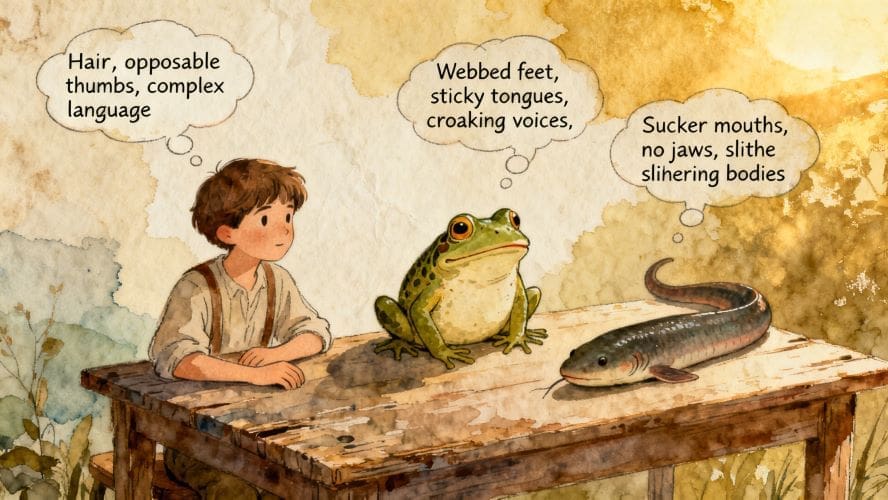
Scientists have discovered the genetic “secret sauce” that makes humans different form other organisms on the planet. Scientists used to wonder why vertebrates (like us) are so much more complex than simple worms, even though we both have about the same number of genes. This study found that the “secret sauce” isn’t having more genes, but having genes that can do more jobs.
By comparing sea squirts, lampreys, and frogs, researchers discovered that vertebrates evolved a way in order to make many different versions of a protein from a single gene. They found this specifically in the “master switch” genes that control how an embryo grows, effectively giving vertebrates a much larger and more flexible toolkit to build complex bodies and brains.
Torres-Aguila, Nuria P., Marika Salonna, Sebastian M. Shimeld, Stefan Hoppler, and David EK Ferrier published the paper under the title, “Long-read sequencing reveals increased isoform diversity in key transcription factor effectors of intercellular signalling at the invertebrate-vertebrate transition.” in January 2026.
ENTECH STEM Magazine has included this research in its list of Top 10 STEM Discoveries and Innovations of January 2026.
Potential Benefits-The Genetic “Secret Sauce” That Made Humans Possible
While a study on “isoform diversity in invertebrates” and the genetic secret sauce that made humans possible might sound like it’s only for people in lab coats, the findings actually have several practical “day-to-day” impacts.
1. More Precise Cancer Treatments
The pathways discussed in the paper on the genetic “secret sauce” that made humans possible (Wnt, Hedgehog, and BMP) are the same ones that often “go rogue” in cancer.
- The Benefit: Presently, many drugs shut down an entire gene to stop a tumor. This causes massive side effects because that gene might be doing “good” work elsewhere.
- Practical Flip: If we know which specific isoform (version) of the gene is causing the cancer, doctors can use “isoform-specific” drugs. This would mean hitting the tumor hard while leaving your healthy cells alone—drastically reducing the side effects of chemotherapy.
2. Advances in Regenerative Medicine
These genes are the “architects” that build a body from scratch.
- The Benefit: By understanding the specific versions of proteins that vertebrates (like us) use to grow complex organs, scientists can better figure out how to “re-grow” tissues.
- Practical Flip: This research on the genetic secret sauce of that made humans, could lead to better treatments for spinal cord injuries or organ failure by “turning on” the specific protein versions needed for repair that our bodies normally shut off after birth.
3. Faster, More Accurate Medical Diagnoses
The study o the discovery of the genetic secret sauce that made humans possible, used Long-Read Sequencing, a tech that is moving from research labs into neighborhood hospitals.
- The Benefit: Traditional DNA tests often miss “structural” changes in genes.
- Practical Flip: As this technology becomes standard, a single blood test could tell you exactly which protein versions your body is making. This leads to faster diagnosis for rare genetic diseases that “short-read” tests currently miss.
4. Understanding the “Human Blueprint”
- The Benefit: This study on the genetic secret sauce helps explain why humans are so complex despite having a relatively small number of genes.
- Practical Flip: It shifts our focus from “how many genes do you have?” to “how is your body splicing them?” This helps scientists understand why two people with the same “bad gene” might have totally different health outcomes—one gets sick, and the other doesn’t—because they are using different isoforms.
Educational and Career Opportunities
Bioinformatics Scientist
You would build the software and algorithms that find these “master switches” in the genetic code.
Genomics Researcher (Biotech/Pharma)
Working for companies like Illumina or Oxford Nanopore to develop better sequencing technologies or drug targets based on isoform diversity.
Clinical Geneticist
Helping patients by identifying which specific protein isoforms are causing their rare diseases or cancers.
Conservation Geneticist
Using these evolutionary insights to protect endangered species by understanding their genetic “fitness” and adaptability.
Additionally, to stay updated with the latest developments in STEM research, visit ENTECH Online. Basically, this is our digital magazine for science, technology, engineering, and mathematics. Also, at ENTECH Online, you’ll find a wealth of information.
Reference
Torres-Aguila, N.P., Salonna, M., Shimeld, S.M. et al. Long-read sequencing reveals increased isoform diversity in key transcription factor effectors of intercellular signalling at the invertebrate-vertebrate transition. BMC Biol 24, 28 (2026). https://doi.org/10.1186/s12915-026-02522-w
- Author
- Latest Posts

I am a Master’s qualified in Science with focus on Zoology and Entomology and am a passionate, curiosity-driven science enthusiast aiming to transform complex scientific ideas in a manner that are easy to understand hence, educate, and inspire.
I have an experience of working on the projects in the field of Entomology which has provided me hands-on experience with various research techniques. Besides, I have also gained experience of lab work as well as developed communication skills during the course of my bachelors and masters.
With a strong foundation in life sciences and a growing interest in Medical and Biological research, I have cultivated a writing style that merges scientific facts with creativity.
My experience in teaching has also taught me to develop an understanding of what are the interests of people and how to communicate them effectively.
I am committed to lifelong learning, actively engaging in Interdisciplinary learning, so as to broaden my perspective.