High energy space neutrinos have recently sparked a major buzz in the scientific community...
High Energy Space Neutrinos: Are Tiny Black Holes the Culprit?
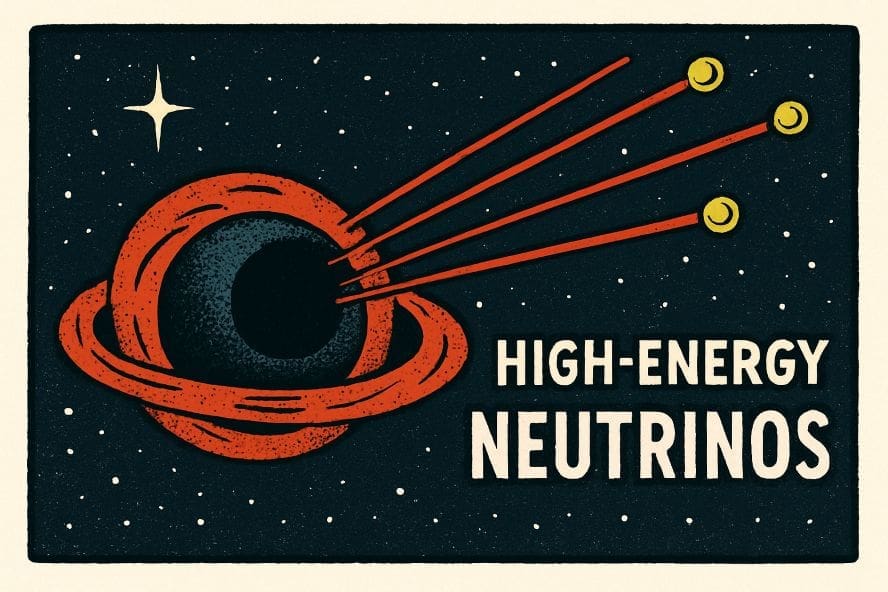
High energy space neutrinos have recently sparked a major buzz in the scientific community. To put it another way, we might have just found a new way to explain the most energetic particles ever seen. Scientists using the KM3NeT and IceCube detectors have spotted high energy space neutrinos that defy current logic. These “ghost particles” carry massive amounts of energy. As a result, researchers are looking beyond standard stars for an answer. A new paper suggests that Primordial Black Holes (PBHs) could be the source.
Tiny Black Holes from the Dawn of Time
What exactly are Primordial Black Holes? Unlike the huge black holes at the centers of galaxies, these formed just after the Big Bang. At that time, the universe was incredibly dense. Some regions collapsed under their own weight. This created tiny, ancient black holes. Prior to this study, many thought these small objects would have evaporated by now. However, this new research introduces a twist. To explain, these black holes might carry a special “dark charge.”
This charge comes from a dark sector of physics. It acts like a shield. It slows down the way the black hole loses mass through Hawking radiation. Because of this, these tiny objects can survive for billions of years. At the present time, they might even make up all the dark matter in our universe. To put it another way, these quasiextremal objects stay stable while other black holes vanish. With this in mind, they linger as invisible anchors throughout space. Summing up, their unique dark charge prevents a quick death. As a result, they remain as ancient remnants from the very beginning of time.
The Mystery of High Energy Space Neutrinos
The IceCube observatory in Antarctica has found five neutrinos with energies over 1 PeV (peta-electronvolt). That is a lot of power! All of a sudden, the KM3NeT experiment in the Mediterranean spotted one even stronger at 200 PeV. There are no known stars or galaxies that can easily make these. As a matter of fact, traditional black hole models don’t quite fit the data from both detectors at once.
The researchers, led by Michael J. Baker, found a solution. They used the idea of quasiextremal black holes. These are black holes that are almost perfectly balanced by their charge. So long as they stay in this state, they emit particles in a very specific way. This explains why we see high energy space neutrinos but fewer at lower levels.
Learn more about the different branches of science and engineering at ENTECH!
A Career in the Stars: Why This Matters for You
If you are in grade 11 or 12, this news is more than just cool trivia. It shows how physics and engineering work together. To illustrate, building a detector like IceCube requires thousands of sensors buried under two kilometers of ice. This is a massive feat of engineering career choices and logistics. To detect high energy space neutrinos, engineers must design hardware that works in the deep sea or the South Pole.
To list, here are some STEM paths related to this discovery:
- Astrophysics: Study how the universe began and how black holes evolve.
- Particle Physics: Discover how high energy space neutrinos interact with atoms.
- Data Science: Analyze the massive streams of data coming from underwater and underground sensors.
- Mechanical Engineering: Design the housings for sensors that must survive extreme pressure and cold.
Conclusion
All things considered, this theory solves three problems at once. First, it explains the weird signals of high energy space neutrinos. Second, it accounts for dark matter. Third, it tells us why we didn’t see a huge flash of light before the neutrinos arrived. The black holes transition so fast at the end that the light and particles happen almost together.
In conclusion, the universe is much weirder than we thought. Whether you want to be a researcher or an engineer, there is plenty left to find. To rephrase it, the next big discovery involving high energy space neutrinos could be yours!
Additionally, to stay updated with the latest developments in STEM research, visit ENTECH Online. Basically, this is our digital magazine for science, technology, engineering, and mathematics. Also, at ENTECH Online, you’ll find a wealth of information.
References
Baker, M. J., Juan, J. I., Symons, A., & Thamm, A. (2026). Explaining the PeV Neutrino Fluxes at KM3NeT and IceCube with Quasiextremal Primordial Black Holes. Physical Review Letters, 136(6), 061002. DOI: 10.1103/r793-p7ct
- Author
- Latest Posts

A Master’s-qualified Zoologist with a focus on Limnology, I combine hands-on laboratory experience with a sophisticated background in science communication. My career is defined by an interdisciplinary approach to the life sciences, merging technical research skills with a proven ability to teach and engage diverse audiences. I am committed to lifelong learning and the creative dissemination of medical and biological research, ensuring scientific literacy and inspiration remain at the forefront of the field.