Compare 5 commercial towel suppliers for hotels, salons, gyms, and spas, including pricing, shipping, and product range. Find the right fit for your business.
Discover how towels are manufactured and reach you, with career insights for young people exploring the textile industry.
Think about the last towel you used. Maybe it was a beach towel, a gym towel after practice, or the one you used after your shower. Soft, dry, just there when you need it. You probably never stopped to ask where it came from. But that towel started as a cotton plant growing in a field, and it passed through dozens of hands before it landed in your house. Every thread in it has a story that starts long before you ever folded it up.
How Towels Are Manufactured from Yarn
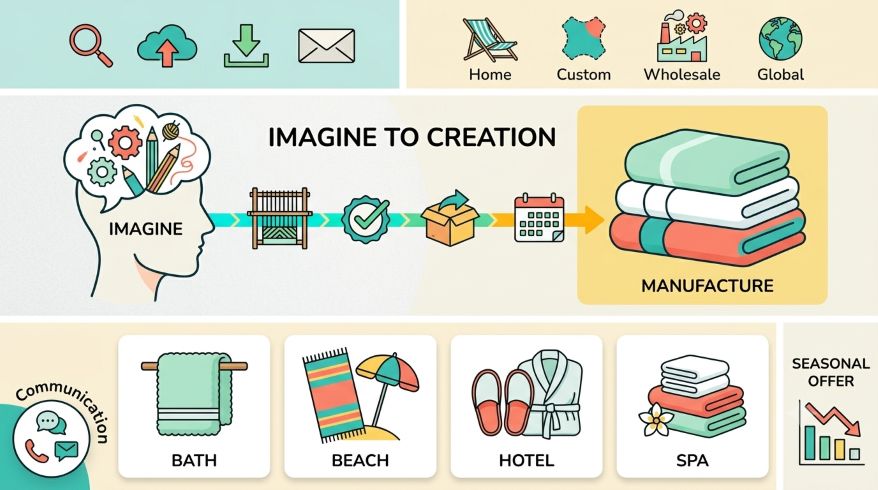
Fig. 1: The full towel manufacturing journey, from raw cotton to the store shelf.
Making a towel looks simple from the outside, but it is a long chain of small, careful steps. The whole process usually breaks into a handful of stages: growing and cleaning the cotton, spinning it into yarn, weaving that yarn into fabric with little loops, and then bleaching, dyeing, and finishing the cloth before it gets cut and sewn. Each step matters. Skip one, and the towel feels rough, dries slowly, or falls apart after a few washes.
From cotton plant to clean yarn
Almost every towel starts the same way, with cotton. Farmers grow cotton in warm places where the plants get plenty of sun and water. When cotton bolls open, workers pick the fluffy white fibers, remove the seeds, and press the cotton into large bales. Those bales can weigh around 227 kilograms (about 500 pounds) each. A towel factory might buy whole bales of raw cotton, or it might buy yarn that another mill already spun for it.
Next comes cleaning. Raw cotton arrives full of dirt, bits of leaf, and tangled short fibers. Machines open the bales and beat the cotton so the junk falls out. Next, machines card the fibers by passing them over large cylinders covered with fine wire teeth. The teeth straighten the fibers so they all point the same direction. For softer as well as stronger towels, machines comb the fibers to remove short, rough pieces and keep the longer, smoother ones. These longer fibers make stronger yarn and more durable towels.
After carding and combing, the fibers are gently twisted into a loose rope called a sliver, then spun into yarn. Spinning is where the cotton really becomes thread. A machine pulls the fibers out thin and twists them together so they grip each other into one continuous strand. How tight that twist is matters a lot. Looser twists make yarn that feels softer and soaks up more water. Tighter twists make yarn that is tougher but a little less fluffy. A towel’s feel is decided here, before it is even woven.
Weaving the loops that do the work
The yarn is now ready for the loom, and this is the step that makes a towel a towel. Flat fabric would just push water around. A towel needs loops, and those loops are what catch and hold the water.
Here is how it works. A towel is woven from two sets of yarn called “warp” and “weft.” The warp threads run the long way down the towel and are stretched tight on a big beam. The weft threads run side to side and get passed under and over the warp. On a towel loom, there are actually two warps working at once. One warp, the ground warp, is held tight and builds the body of the towel. The other warp, the pile warp, is fed in a little loose. When the weft gets pressed down, that slack in the pile warp pops up into little loops — and that is your terry cloth, the soft looped surface you dry off with.
Those loops do the whole job of a towel. They make the surface fluffy, and they give the towel lots of little pockets to hold water. A towel with taller, denser loops will generally soak up more water, while a towel with shorter loops dries faster. Weavers can adjust the height and tightness of the loops on the loom, which is why some towels feel thick and plush and others feel thin and quick to dry. It all comes down to how much yarn goes into each loop and how tall those loops stand.
Modern mills run fast. A single loom can fire a shuttle across the warp hundreds of times a minute. In one small factory, a single loom can turn out 250 dozen bath towels in a week, and a big mill might run 50 looms at once.
Bleaching, dyeing, and finishing
Fresh off the loom, the towel is a pale, unfinished gray cloth called “grey goods.” It is soft enough, but it is not white, and it is not ready for a shelf. So it heads to the wet-processing room.
First, manufacturers scour the fabric to remove natural waxes and leftover starch. Then, they bleach it with hydrogen peroxide to turn the beige cotton white. Even colored towels need this step so the dye spreads evenly. For white towels, manufacturers may also add brighteners to keep them looking crisp.
If manufacturers want a colored towel, they dip it into large vats of dye. For cotton, mills usually use reactive dyes, because those dyes bond to the fibers and do not wash out easily. After the towel comes out of the vat, heavy rollers press the color deep into the cloth, and steam sets it so it stays put through years of laundry. Nobody wants a beach towel that turns your swimsuit pink.
The final step is finishing. Manufacturers wash and soften the towel, then tumble it to fluff up the loops. They cut it to size, hem the edges, and add a label. Inspectors check for weaving errors and other flaws. Towels with minor defects are sold as seconds. From cotton seed to store shelf, the process can take several weeks.
Most people never think of a towel factory as a place to build a career, but the textile industry runs on real skills that are not going anywhere. Somebody has to run the weaving machines, check the dye vats, test the fabric, plan the shipping, and sell the finished product. Those are jobs you can learn on the job, and they pay well as you get good at them. If the science of it grabs you, researchers now measure exactly how a towel’s loops affect its absorbency and softness, using standard tests that any textile lab can run. That kind of knowledge turns into work, and it also helps the industry itself, because companies do better when the people joining them already understand the product end to end.
From the Factory Floor to the Store Shelf
A towel does not jump from the loom straight into your bathroom. It travels through a whole chain of people and companies first, and knowing that chain is the fastest way to find your place in this industry. The mill weaves, bleaches, dyes, and finishes the towel. From there it moves to a wholesaler or distributor, a company that buys towels in huge batches and resells them to businesses instead of individuals. Then it reaches the people who actually put towels into your hands: a hotel that stacks them in guest rooms, a gym that fills its locker room, a salon that wraps one around your shoulders, or a store that hangs them on a shelf.
Roles Across Towel Supply Chain
Each link in that chain runs on different jobs. Mills need machine operators, quality inspectors, dye technicians, and engineers who keep the looms running. Distributors need buyers who understand fabric quality, warehouse staff who track inventory, and logistics planners who move products on time. Hotels, gyms, and salons need purchasing managers who know the difference between a budget towel and a premium one. And behind all of it sit designers, salespeople, marketers, and supply-chain analysts who make sure the right towel ends up in the right place at the right price.
How to Start a Career in the Textile Industry
For a teenager wondering where to start, that is good news. You can enter this field at almost any point, with almost any starting skill. If you like working with your hands, machine operation and maintenance are in steady demand and you can train on the job. If you are more into data and planning, supply-chain and logistics roles need people who can track stock and solve problems. And, if you like the idea of talking to buyers and understanding what they need, sales and purchasing reward curiosity about the product itself. You can read more about these entry points in our guide to industrial textile careers on entechonline.com, and check our textile sourcing explainer to see how fabric moves from mill to market.
How Towels Are Manufactured: Why it matters?
Every job in this industry starts with understanding where a towel comes from. When you know how manufacturers weave the loops and what makes cotton softer, you can make better decisions. That is exactly why the next section matters. Before a towel reaches a customer, someone has to source it, and the companies below are who businesses call when they need towels in bulk. Understanding them closes the loop from yarn all the way to store shelf.
Stocking a hotel, salon, gym, or spa with the right towels sounds simple until a shipment arrives with inconsistent quality or a vendor can’t handle your volume. The commercial towel suppliers to consider range from broad-catalog wholesalers to niche specialists, and the differences between them matter more than most buyers expect before their first bulk order.
Where to Find Towel Suppliers for Your Business
Most commercial buyers land on a supplier through one of three paths: a Google search for bulk towels in their industry, a referral from another owner in the same vertical, or a trade-show encounter that never quite converts until they need to reorder fast. None of those paths guarantees a good fit.
The better approach is comparing suppliers against your actual requirements before you place anything. Consider order minimums, quality consistency across repeated purchases, shipping speed to your region, and whether the supplier’s catalog matches your use case — economy stock for back-of-house is a different product than a guest-facing luxury bath towel. The five options below cover most of what’s available to U.S. commercial buyers right now.
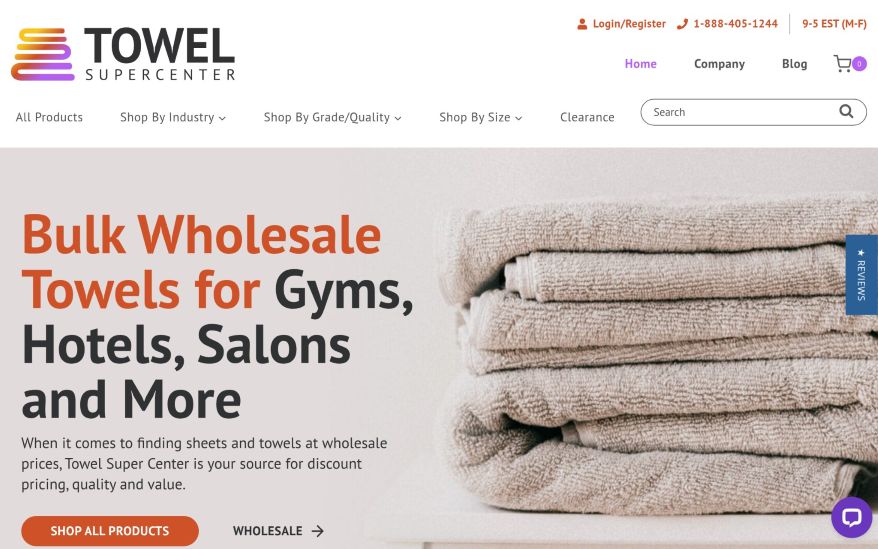
An Atlanta-based wholesale towel and linen retailer operating since 2012 that sells five distinct quality grades across eight named commercial industries, with same-day shipping for orders placed before 3:00 pm EST.
Product range: Economy, Premium, Premium Plus, Bleach-Resistant, and an 86/14 cotton blend quality tiers; dedicated product lines for hotels, salons, gyms, restaurants, car washes, spas, golf clubs, and pet groomers, each with GSM and fabric guidance specific to that setting. Overstock, irregulars, and reclaimed mixed-white towels are also available starting at $19.95 per box.
Who it fits: Buyers across eight named commercial industries who need to match a quality grade to a specific use case rather than settle for one fixed option; retail-listed items run roughly $3.25 to $63.99 per item, with bulk wholesale pricing quoted by phone at 1-888-405-1244. BBB A+ accredited since 2013.
Fulfillment: Same-day shipping on weekday orders placed before 3:00 pm EST; 2 to 3 business days to the East Coast and Midwest, 4 to 5 to the West Coast.
2. Oasis Towels
A Beverly Hills-based wholesale towel manufacturer, founded around 2011, that serves 25,000 customers across the U.S., Australia, and Canada with a focus on custom and personalized towel production.
Product range: Beach towels, bath towels, kids towels, Turkish and organic towels, and microfiber options — plus a custom manufacturing line where buyers specify color, pattern, and fabric. Corporate offices operate in Australia, Canada, and the UAE in addition to the U.S. headquarters.
Who it fits: Businesses that need branded or design-specific towels rather than off-the-shelf white stock; the low minimum order quantities make it accessible for smaller operations.
Fulfillment: The company describes large in-house manufacturing capacity, though specific headcount details aren’t publicly confirmed.
Considerations: Specific pricing is not published online; buyers need to contact the company directly for quotes.
3. American Soft Linen
An online wholesale and retail company established in June 2016 in West Haven, Connecticut, specializing in premium Turkish cotton bath towels and bedding for hospitality, spa, gym, and retail buyers.
Product range: Bath and beach towels, duvet covers, bed sheets, and linens — all manufactured and distributed in-house from raw material through final product. Products are tested against more than 1,000 harmful substances with certification #21.HUS.80380 issued by Hohenstein.
Who it fits: Hospitality buyers, property managers, and spas that need certified premium Turkish cotton in bulk; both individual consumers and wholesale accounts are served. A 30-day money-back guarantee, free shipping on orders over $100, and secure online payment processing are included.
Fulfillment: Orders ship from West Haven, Connecticut, with free shipping available on orders over $100.
Considerations: Team size is small (11 to 50 employees), and public pricing details are limited; buyers placing large orders should confirm availability and lead times directly.
4. Towels N More
A Phoenix, Arizona-based direct importer and distributor of wholesale towels and hospital-grade linens for hotels, medical facilities, gyms, salons, and commercial laundry operations.
Product range: Bath towels, hand towels, washcloths, bath mats, bar mops, bed sheets, pillowcases, draw sheets, and both economy and premium luxury towel lines. The company imports directly from overseas manufacturers, removing middleman cost from bulk pricing.
Who it fits: Buyers in healthcare, hospitality, and fitness who need hospital-grade linen standards or who are sourcing for large multi-location operations.
Fulfillment: Same-day or next-day delivery within one business day; free shipping on bulk orders over $5,000.
Considerations: No published founding year or team size information is available; buyers with specific lead-time requirements should confirm delivery windows before committing.
5. Just Salon Towels
A Duluth, Georgia-based supplier with 30-plus years in business under FOMI MARKETING INC., focused exclusively on bleach-proof, ring-spun cotton towels for salons, spas, and barbershops.
Product range: Colored salon towels in Burgundy, Black, Charcoal, Purple, Dark Brown, Hunter Green, and Navy Blue; makeup remover towels; spa robes; and massage table sheets — all sold in bulk. Every item is made from 100% ring-spun cotton yarn, which produces a softer, more durable towel that holds up to repeated bleaching.
Who it fits: Salons and barbershops that can’t use standard white towels due to bleach and dye contact — and that need a specific color to match their interior.
Fulfillment: Next-day shipping, hassle-free returns, free shipping on orders over $99, and volume pricing that scales down per unit as order size increases.
Considerations: The catalog is narrow by design; buyers who also need bath towels, bed linens, or non-salon products will need a second supplier.
What Separates Quality Towel Suppliers
Not every commercial towel supplier on the 2026 shortlist is competing on the same terms. Some win on customization, others on lead times, price floors, or material certification. Knowing which of those factors matters most to your operation cuts the candidate list down fast.
What really separates suppliers — both on paper and in practice — is whether quality holds up across reorders. A towel that looks fine on the first shipment but frays after three commercial washes will cost you more in the long run than a slightly pricier option rated for 200 cycles. Always request a sample before committing to a full case order. Most suppliers accommodate it. It’s the single most useful thing a new buyer can do before signing off on a contract.
Don’t ignore shipping origin relative to your own location. A supplier based on the opposite coast adds 2 to 3 business days to every reorder, and that gap compounds fast when you’re replacing stock under deadline pressure. It’s an easy thing to check upfront, but buyers regularly skip it, and only notice the problem when the first deadline slips.
Certification matters selectively. Most commercial buyers don’t need third-party textile testing, but healthcare facilities, high-end spas, and operations with specific chemical-exposure concerns should look for documented quality testing — not just a marketing claim.
Bottom Line: commercial towel suppliers
Choosing among commercial towel suppliers really comes down to matching each supplier’s actual strengths to what your operation needs most. Custom and branded work points toward Oasis Towels. Salon and barbershop buyers dealing with bleach exposure will find Just Salon Towels built specifically for that. Healthcare and large hospitality operations sourcing at scale have a direct-import option in Towels N More. Buyers wanting certified Turkish cotton backed by third-party quality testing should look at American Soft Linen. And operations needing multiple quality tiers — economy for the back of house, premium for guest-facing areas — within a single catalog with fast fulfillment will find that structure in a multi-grade wholesaler. Compare shipping windows, sample before you commit, and confirm bulk pricing by phone rather than assuming the listed retail price is what you’ll actually pay.
If you have read this far, you already know more about a towel than most adults ever will. That is not a small thing. It is the start of a skill, and skills are what turn into careers. The textile and supply-chain world is full of people who started exactly like this — curious about an everyday object, then smart enough to ask how it really works.
Start Small and Learn by Observing
Here is the advice I would give any teenager who wants to explore this field. Start small and hands-on. Notice the towels around you and ask which one feels better, dries faster, or lasts longer, then try to figure out why. Compare a cheap towel to a thick one at a store and look at the loops up close. That habit of looking closer is the same skill a quality inspector uses every day on the factory floor.
Choose Subjects That Match Your Interests
Next, make school work for the path you are interested in. If you like the making side, look into textiles, materials, or mechanical and industrial engineering. If you like the moving-and-planning side, pay attention to math, business, and logistics. Moreover, if you like the selling side, take a class or join a club where you can practice talking to people and understanding what they need. None of these are locked behind a single degree. Many of the best jobs in this industry are learned on the job, and the people who rise are the ones who show up curious and willing to learn.
Get Practical Experience in the Textile Industry
Then get in the door. Look for an internship, a part-time job, or even a summer position at a linen supplier, a warehouse, a hotel, a gym, or a distributor. You do not need to start at the top. You need to start somewhere, and every step teaches you the next one. Talk to people who already do the work and ask them how they got there. People in trades and industry are often glad to share, especially with someone young who actually asks.
Understand Why Textile and Supply-Chain Careers Matter
Finally, remember why this matters beyond a paycheck. The things we use every day — towels, sheets, clothes — do not make themselves. The people who build and move them keep everyday life running. An industry that understands this is one worth joining, and an industry that attracts young people who already understand it can grow the right way, for everyone.
So the next time you reach for a towel, you will know the story in your hands. And if you want, you can become part of the next chapter of it. For more on building a career in industrial textiles and supply chains, explore the careers section here on entechonline.com.
References:
Cotton spinning, weaving, bleaching, and finishing steps (from bale to “gray goods” to finished fabric) come from The Story of Cotton, an educational resource published by the National Cotton Council at Cotton.org: https://www.cotton.org/pubs/cottoncounts/story/spun-and-woven.cfm.
How a towel’s weave and thread density shape its absorbency, softness, and shrinkage is covered in the peer-reviewed open-access study “Evaluation of performance properties in woven Terry towel by multi response optimization” (Jamshaid, H., Mishra, R. K., Ahmad, N., et al., Scientific Reports 15, 32856, 2025): https://www.nature.com/articles/s41598-025-18328-9. The supplier descriptions in the second half are drawn from the original draft article.
Part of the entechonline.com industry and careers series. Written to help teens understand industrial textiles and plan early careers, and to help the industry grow by attracting people who already know the product.
Note: The article includes external links to third-party services; readers should independently evaluate any referenced platforms before engaging.
I am an inspirational writer and emerging science blogger with a deep-rooted passion for understanding and sharing the wonders of the world around us. My journey began with a Bachelor of Science in Chemistry from AKI’s Poona College of Arts, Commerce and Science, where I developed not only a strong foundation in scientific principles but also a mindset that values curiosity, observation, and critical thinking. Studying chemistry has taught me to approach problems with logic, to look beyond the obvious, and to see patterns where others might only see complexity. These experiences have shaped the way I perceive life and influence the way I express my thoughts, both scientifically and creatively.
I have always believed that knowledge is only as powerful as the way it is shared. This belief has guided me to create content that bridges the gap between science and everyday life. I aim to simplify complex scientific ideas so they become approachable, relatable, and engaging for everyone—whether someone has a formal background in science or is simply curious about the world. Science, in my view, is not confined to textbooks and laboratories; it is a way of thinking, understanding, and connecting with the world around us. By making science accessible, I hope to inspire curiosity, ignite learning, and encourage people to see the beauty and relevance of scientific discovery in their daily lives.
Alongside my love for science, I am deeply passionate about motivational writing. I believe words carry the power to transform perspectives, encourage self-reflection, and inspire action. By combining analytical thinking with creativity, I create content that is intellectually stimulating yet emotionally resonant. Whether I am breaking down a chemical concept, exploring a scientific phenomenon, or crafting motivational narratives, my goal is to communicate ideas in a way that is clear, meaningful, and impactful.
Through my work, I strive to empower my readers - not just by helping them understand the science around them, but by inspiring them to grow, learn, and realize their full potential. Every article, post, or story I write reflects my commitment to turning knowledge into inspiration. I want to spark curiosity, encourage self-improvement, and show that learning and personal growth are deeply connected. For me, writing is not just a craft; it is a way to touch minds, connect hearts, and make ideas come alive in a way that truly resonates.