his world isn't as distant as it seems. Welcome to the intriguing universe of the Internet of Things (IoT).
What is the Internet of Things IoT and How Does It Work
Estimated reading time: 9 minutes
The Internet of Things connects physical objects to the digital world, creating a seamless exchange of data. Actually, these objects, embedded with sensors and software, communicate through the internet to perform tasks and share insights. For example, smart lighting systems adjust brightness based on environmental conditions, conserving energy. With over 15 billion connected devices globally, this number is expected to nearly double by 2030. In fact, IoT enables devices to interact, making life smarter and more efficient.
How Does the Internet of Things Work?
Key Components of IoT
Sensors and IoT Devices
Sensors and IoT devices form the foundation of the Internet of Things. These devices collect data from their surroundings, such as temperature, motion, or light levels. For example, a smart thermostat uses sensors to monitor room temperature and adjust heating or cooling systems. Indeed, with over 75 billion connected devices expected by 2025, these components are essential for gathering information.
Connectivity Technologies
Connectivity enables IoT devices to communicate with each other and the cloud. Technologies like Wi-Fi, Bluetooth, and cellular networks transfer data seamlessly. This communication happens without human intervention, ensuring efficiency. For instance, a smart refrigerator can notify your smartphone when groceries run low, thanks to reliable connectivity.
Data Processing and Analytics
Once data is collected, it needs processing to generate insights. This step often occurs at the network’s edge or in the cloud. Real-time analytics identify patterns and trends, helping IoT technology make decisions. For example, traffic sensors analyze vehicle flow to optimize signal timings, reducing congestion.
User Interfaces
User interfaces allow you to interact with IoT devices. These interfaces can include mobile apps, voice assistants, or dashboards. They make it easy to control and monitor your devices. For instance, you can use a smartphone app to adjust your home’s lighting or check security cameras.
The IoT Ecosystem
Data Collection and Transmission
The IoT ecosystem begins with data collection by sensors. This data is then transmitted to processing systems through secure networks. The process ensures that connected devices share information efficiently, creating a seamless flow of communication.
Cloud Computing and Storage
Cloud computing plays a vital role in the IoT ecosystem. It stores vast amounts of data generated by billions of devices. By 2025, this data is expected to reach 79.4 zettabytes. The cloud also provides the computational power needed to analyze and manage this information.
Automation and Decision-Making
Automation is a key feature of the IoT ecosystem. Once data is analyzed, IoT technology can make decisions without human input. For example, smart irrigation systems in agriculture adjust water levels based on soil moisture, conserving resources and improving efficiency.
“The science of today is the technology of tomorrow.” – Edward Teller. The Internet of Things exemplifies this by transforming how devices interact and make decisions.
Benefits of IoT
The Internet of Things (IoT) has revolutionized how you interact with technology, offering numerous benefits for individuals and businesses. By connecting physical objects to the digital world, IoT enhances convenience, efficiency, and decision-making.
Benefits for Individuals
Convenience and Automation
IoT simplifies your daily life by automating routine tasks. Smart home devices, such as thermostats and lighting systems, adjust settings based on your preferences. For instance, a smart thermostat can learn your schedule and maintain an ideal temperature without manual input. This automation saves time and ensures comfort. Municipalities also use IoT-enabled smart lighting to improve energy efficiency, showcasing how connected technology benefits communities.
Health and Fitness Tracking
Wearable IoT devices like fitness trackers and smartwatches help you monitor your health. These applications track metrics such as heart rate, steps, and sleep patterns, empowering you to make informed lifestyle choices. Hospitals also rely on IoT for remote patient monitoring, enabling timely interventions and improving healthcare outcomes.
Energy Efficiency in Smart Homes
IoT applications in smart homes reduce energy consumption and lower costs. You can control temperature, lighting, and appliances remotely, ensuring optimal energy use. According to research, IoT technology in homes and offices leads to significant energy savings, contributing to environmental sustainability. For example, smart lighting systems adjust brightness based on occupancy, minimizing waste.
Benefits for Businesses
Operational Efficiency
IoT transforms business operations by optimizing processes and reducing waste. Connected devices monitor equipment performance in real time, ensuring smooth operations. Companies using IoT monitoring systems report a 5-15% reduction in energy consumption annually. This efficiency not only saves resources but also enhances sustainability.
Predictive Maintenance
IoT enables predictive maintenance by analyzing data from sensors embedded in machinery. This approach identifies potential issues before they escalate, reducing downtime and repair costs. For example, industrial IoT applications optimize machine operations, boosting energy efficiency and extending equipment lifespan.
Customer Insights and Personalization
IoT collects valuable data about customer behavior, helping businesses tailor their offerings. By analyzing this data, companies can create personalized experiences that meet individual needs. A study by Accenture highlights that the Industrial IoT could add $14.2 trillion to the global economy by 2030, emphasizing its transformative potential.
“Technology is best when it brings people together.” – Matt Mullenweg. The Internet of Things exemplifies this by connecting devices and improving lives.
Challenges and Security Concerns in IoT
The rapid growth of IoT has brought immense benefits, but it also introduces significant challenges. Security risks, privacy concerns, and technical issues are some of the hurdles you may face when using IoT devices.
Security Risks
Data Breaches
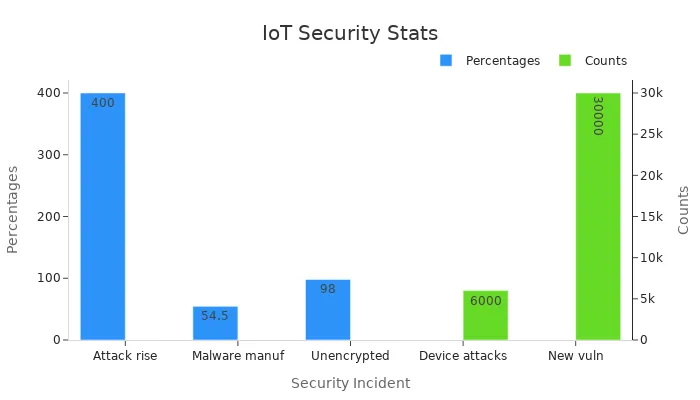
Data breaches remain one of the most critical threats in the IoT landscape. Cybercriminals exploit vulnerabilities in IoT devices to access sensitive information. For example, 98% of IoT device traffic remains unencrypted, making it an easy target for hackers. The table below highlights alarming statistics about security risks:
| Statistic | Description |
|---|---|
| 400% | Year-over-year increase in IoT cyberattacks, indicating a significant rise in security risks. |
| 54.5% | Percentage of IoT malware incidents occurring in the manufacturing industry. |
| 6,000 | Average number of connected device attacks experienced by the manufacturing sector each week. |
| 30,000 | Number of new vulnerabilities disclosed in the past year, reflecting the growing threat landscape. |
Vulnerabilities in IoT Devices
Many IoT devices lack robust security measures. Manufacturers often prioritize functionality over protection, leaving these devices exposed to attacks. Weak passwords, outdated software, and unpatched vulnerabilities create entry points for hackers. This negligence can lead to unauthorized access and compromised systems.
“Technology is a useful servant but a dangerous master.” – Christian Lous Lange. Without proper security, IoT can become a liability.
Privacy Concerns
Data Collection and Usage
The vast amount of data collected by IoT devices raises concerns about how it is used. Many IoT applications gather sensitive information, such as your location, health metrics, and personal preferences. Therefore, ensuring this data is handled ethically and complies with regulations like GDPR is crucial. However, verifying how closed-source devices store and access this data remains a challenge.
| Aspect | Findings |
|---|---|
| Privacy as a Quality Characteristic | Recognized as influencing decisions in various IoT application domains. |
| Regulatory Compliance | Essential for meeting requirements like GDPR and addressing ethical concerns. |
| Trade-offs in Development | Privacy prioritized over other quality characteristics due to sensitivity of data collected. |
| Challenges in Verification | Difficulty in verifying data collection, storage, and access in closed-source devices. |
Transparency Issues
Transparency is another major concern. Also, many IoT devices operate as black boxes, leaving you unaware of how your data is processed or shared. Therefore, this lack of clarity can erode trust and deter users from adopting IoT technology.
Technical Challenges
Device Interoperability
Interoperability issues arise when IoT devices from different manufacturers fail to communicate seamlessly. Hence, this lack of standardization complicates integration and limits the potential of IoT ecosystems. For example, a smart thermostat may not work with a security system from another brand, reducing overall efficiency.
Scalability and Network Congestion
As the number of IoT devices grows, managing network traffic becomes increasingly complex. Scalability challenges emerge when networks struggle to handle the sheer volume of data generated by billions of connected devices. Also, this congestion can lead to slower response times and reduced performance.
“The Internet of Things is not a concept; it is a network, the true technology-enabled network of all networks.” – Edewede Oriwoh. Overcoming these challenges will unlock the full potential of IoT.
The Future of IoT
Emerging Trends in IoT
5G Connectivity
The future of IoT is closely tied to the expansion of 5G connectivity. Indeed, this technology offers higher bandwidth, lower latency, and the ability to support a massive number of connected devices. In fact, these features make 5G essential for applications like remote healthcare, where real-time data transmission is critical. For instance, 5G enables remote patient monitoring, allowing doctors to track vital signs and provide timely interventions. In manufacturing, 5G-connected sensors improve process control and product quality by delivering real-time insights.
The future also includes the integration of 5G in retail. Basically, smart-shopping assistants analyze customer behavior and inventory in real time, offering personalized recommendations. According to projections, the combination of 5G and AI could contribute $17.9 trillion to the global GDP by 2035. As Nikola Tesla once said, “The present is theirs; the future, for which I really worked, is mine.” 5G embodies this sentiment by shaping the future of connectivity.
AI and Machine Learning Integration
Artificial intelligence (AI) and machine learning (ML) are transforming IoT by enabling smarter decision-making. These technologies analyze vast amounts of data collected by IoT devices, identifying patterns and trends that humans might miss. For example, AI-powered IoT systems in smart cities optimize traffic flow and enhance public safety. In healthcare, AI improves diagnostic accuracy by analyzing data from wearable devices.
The convergence of AI and IoT also benefits businesses. Real-time analytics help companies develop personalized strategies, improving customer satisfaction. This integration represents a significant step toward a more intelligent and connected future.
Innovations in IoT
Smart Cities
Smart cities represent one of the most exciting innovations in IoT. These urban areas use IoT technologies to improve services, reduce waste, and enhance the quality of life. For example, Los Angeles employs smart traffic management systems to reduce congestion. Sensors and cameras provide real-time updates, allowing traffic lights to adjust dynamically. Similarly, smart parking systems notify drivers of available spots, saving time and fuel.
Other applications include utilities management, where smart meters monitor energy and water usage. Generally, waste management systems use sensors to optimize collection schedules, reducing unnecessary trips. Additionally, these innovations demonstrate how IoT can create more efficient and sustainable cities.
IoT in Space Exploration
The future of IoT extends beyond Earth. Space exploration increasingly relies on IoT technologies for data collection and communication. For instance, satellites equipped with IoT devices monitor environmental changes and provide critical data for disaster management. These systems also support scientific research by collecting data from remote locations.
In addition, IoT plays a role in space missions. Sensors monitor spacecraft conditions, ensuring the safety of astronauts. As humanity ventures further into space, IoT will continue to be a vital tool for exploration and discovery.
Potential Impact of IoT
Transforming Industries
IoT is revolutionizing industries by improving efficiency and safety. Specifically, in manufacturing, IoT applications provide real-time data on production processes, reducing defects and downtime. Wearable devices monitor workers’ health, preventing injuries and enhancing productivity. According to studies, IoT improvements in manufacturing could generate over $470 billion annually by 2025.
Enhancing Quality of Life
The future of IoT promises to enhance your quality of life. Particularly, smart city initiatives improve urban living by optimizing traffic, energy use, and public safety. In healthcare, wearable devices enable continuous monitoring, leading to better health outcomes. The pandemic accelerated the adoption of IoT, driving innovation in various sectors. As urbanization increases, smart city projects will play a crucial role in meeting the needs of a growing population.
“The best way to predict the future is to invent it.” – Alan Kay. With IoT, you are witnessing the invention of a smarter, more connected world.
The internet of things connects physical objects to the digital world, enabling seamless communication and automation. It simplifies daily life, enhances business efficiency, and provides real-time insights. However, challenges like scalability, interoperability, and security gaps require attention. For example, ensuring robust communication protocols and managing bandwidth are critical for IoT success. Despite these hurdles, the future looks promising. By 2025, IoT connections are projected to reach 27 billion, driving innovation across industries. As Bill Gates said, “The advance of technology is based on making it fit in so that you don’t really even notice it.” IoT exemplifies this vision, creating a smarter, connected world.
Reference:
- Routray, S. K. (2021). Deployment of narrowband internet of things. Research Anthology on Developing and Optimizing 5G Networks and the Impact on Society, 859-875. https://doi.org/10.4018/978-1-7998-7708-0.ch036
- Author
- Latest Posts

Charudatta Pathak was a student at St. Aloysius High School in Bhusawal, established in 1874, making it one of India’s oldest convent institutions. He earned his bachelor’s degree in mechanical engineering from SSVPS College of Engineering, Dhule in 1995, demonstrating exceptional academic achievement. Thereafter, he launched his career as a CNC programmer in a toolroom. He has utilized FANUC, Deckel, Maho, and Mikron controllers to operate 2-axis and 3-axis machines for the fabrication of jigs, fixtures, dies, and molds. He commenced his career as an academic in 1996, when he assumed the role of lecturer at SSVPS College of Engineering, Dhule. Additionally, he earned his post-graduate degree in CAD/CAM from L. D. College of Engineering, Ahmedabad, in 2000, and then acquired a Ph.D. from COEP in 2011 while concurrently engaged in teaching. Until 2023, he occupied many academic roles, including lecturer, assistant professor, professor, dean, principal, director, and vice chancellor at both public and private universities throughout India. From 2008 to 2010, he served as the project lead in the CAE department of a European multinational firm. During his 28-year professional tenure, he identified a need for dependable books targeted at students in grades 8 to 12, particularly for nascent career planning. He founded ENTECH Digital Magazine, a free monthly publication available on entechonline.com and magzter.com. Teens with a strong interest in Science, Technology, Engineering, and Mathematics (STEM) who aspire to pursue careers in these fields may find ENTECH Digital Magazine beneficial.