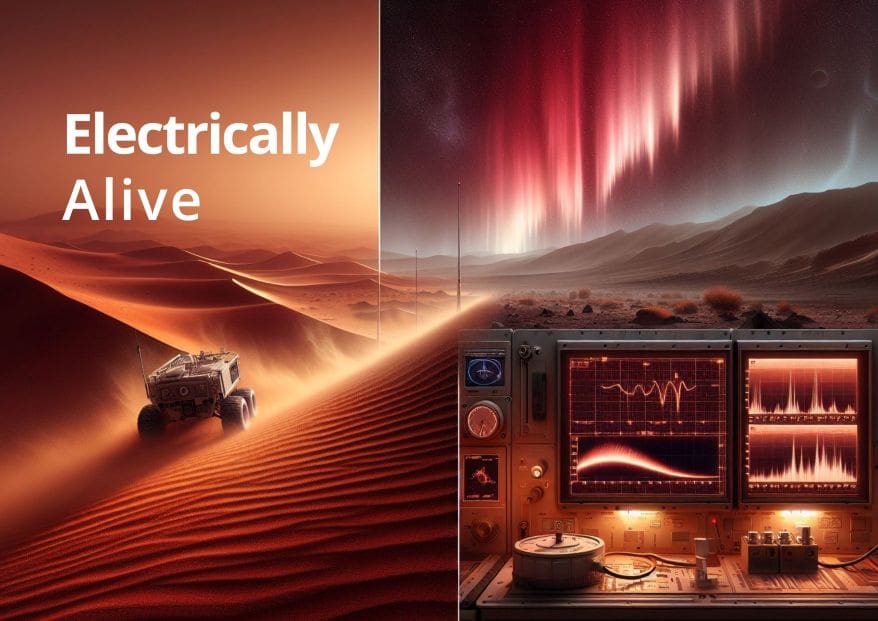
The Martian surface is covered with fine dust that moves often. When dust storms grains collide and rub together, they generate static electricity. This process causes electrostatic discharges (ESDs), which are electric sparks in the thin Martian atmosphere.
Mars Is Electrically Alive: How Dust Storms Shape the Red Planet
Estimated reading time: 4 minutes
Mars looks like a quiet, empty, and red planet, but it is much more electrically active than people think. New scientific studies show that dust storms and dust devils constantly change Mars’ surface and atmosphere through powerful electric processes. This article explains how electric discharges generated by dust influence the planet’s chemistry.
Mysterious Electrical Discharges on Mars’ Surface
How Dust Storms Creates Electricity on Mars
The Martian surface is covered with fine dust that moves often. When dust storms grains collide and rub together, they generate static electricity. This process causes electrostatic discharges (ESDs), which are electric sparks in the thin Martian atmosphere. Because the atmosphere has low pressure, these sparks happen more often than they would on Earth.
The Effects of Electrical Sparks on Mars’ Atmosphere
Rapid chemical reactions are brought about by the sparks. These reactions produce changes in the minerals and gases that are close to the surface. The scientific community is of the opinion that these activities result in the production of significant chemicals such as perchlorates, carbonates, and volatile chlorine compounds.
This means dust storms do not just move dirt; they change how Mars’ environment works at a basic level.
A Closer Look in Special Laboratories
The research team led by planetary scientist Alian Wang created special chambers called PEACh and SCHILGAR to copy Martian conditions in the lab. These chambers let scientists see what chemicals form when dust moves electrically.
This team identified key chemicals breaking down or forming via electrochemical reactions during dust storms activity under hot, dry Martian conditions. These experiments matched real results from NASA’s rovers closely.
The Role of Dust in Shaping Martian Chemistry Globally
The Global Chlorine Cycle on Mars
Dust-driven electrical discharges significantly affect the chlorine cycle on Mars. Many surface areas hold chloride deposits from ancient salty water. Wang’s team found that as electrical discharges happen frequently during dust storms, they fuel continuous chemical changes involving chlorine atoms.
This helps explain why NASA’s Curiosity rover finds unusual chlorine isotope patterns.
Using Isotopes to Understand Chemical Changes
The investigation of the isotope ratios of chlorine, oxygen, and carbon was a significant instrument that was utilized by researchers. Isotopes function similarly to chemical fingerprints, because they reveal which processes had the most significant impact on the elements. As a result of the action of electric dust, the results showed that there was a significant depletion of heavy isotopes.
This points to ongoing electrochemical reactions altering both surface minerals and atmospheric gases globally over time especially during Mars’ last few million years, known as the Amazonian period.
A Model Explains How Dust Links Surface with Atmospheric Chemistry
A new global model shows how electric discharges lift certain chemicals off dust particles into the atmosphere, helping them spread around and then fall back onto different places. Over time these cycles build new mineral layers, deepening our understanding of Mars’ dynamic chemistry today.
Mars Research Expands Our View of Solar System Chemistry
Beyond Mars: Similar Phenomena Elsewhere?
This discovery about dust storm induced electricity may apply to other worlds too! Planets such as Venus or moons like Titan could have similar electrical processes affecting their chemistry due to atmospheric or surface movements involving particles or lightning around their environments.
The Importance of Future Space Missions
Tackling these electrical effects helps scientists prepare better instruments to measure local chemistry not only on Mars but also beyond it. Understanding electrochemistry is vital for planning exploration strategies focusing on where life-supporting elements might be found or how environmental hazards form.
Additionally, to stay updated with the latest developments in STEM research, visit ENTECH Online. Basically, this is our digital magazine for science, technology, engineering, and mathematics. Further, at ENTECH Online, you’ll find a wealth of information.
Reference
Sturchio, N. C., Yan, H., Wang, A., Jackson, W. A., Bao, H., Yan, C. Y., Heraty, L. J., Wei, Y., Qu, Q. H., & Olsen, K. S. (2025). Isotope effects (Cl, O, C) of heterogeneous electrochemistry induced by Martian dust activities. Earth and Planetary Science Letters, 676, 119784. https://doi.org/10.1016/j.epsl.2025.119784
- Author
- Latest Posts

I’m a web developer and science writer with a Master’s degree in Computer Applications (MCA) from Pune University.
I work in tech, building websites and staying updated with the latest developments. I also love writing about physics, chemistry, technology, robotics, mathematics, and breakthrough innovations. My passion is breaking down complex scientific topics into simple, easy-to-understand stories.
My goal is to help everyone stay informed about the exciting changes happening in science and technology. I believe understanding science shouldn’t be complicated—it should be accessible to all.