Planck’s discovery not only gave birth to quantum theory but also unlocked new innovations that transformed everything.
Physics and Technology Before and After 1900
Estimated reading time: 8 minutes
Max Planck 1900 Quantum Hypothesis: Abstract
The year 1900 marks a pivotal moment in physics and technology, with Max Planck’s quantum hypothesis initiating the modern era of science. As we celebrate the International Year of Quantum (IYQ) 2025, this article revisits the state of physics and technology before and after 1900, highlights the revolutionary breakthroughs introduced by quantum theory, and examines the profound transformations in technology and human life that followed. The article underscores how the foundations laid in 1900 continue to inspire advances in quantum science and its applications today.
Introduction to Max Planck 1900 Quantum Hypothesis
In 1900, Max Planck announced that energy can be quantized, a revelation that reshaped our understanding of the physical world and set the stage for a scientific revolution. Although humankind had existed for millions of years, progress had been gradual—rooted in agrarian societies, limited technologies, and a relatively stable pace of life. Planck’s discovery marked a sudden turning point: it not only gave birth to quantum theory but also unlocked a cascade of innovations that transformed how we live, work, and communicate. The modern technologies that define our world—from electronics and lasers to medical imaging and quantum computing—trace their origins to this profound discovery. The dramatic change in humanity’s lifestyle and technological landscape can be traced back to this singular insight into the quantized nature of energy.
Also Read: Planck’s Quantum Theory: Is matter a wave?
Major Discoveries After Planck’s Quantum Theory
| Discoveries | Description |
| Einstein’s Photoelectric Effect (1905) | Light energy is quantized as photons. |
| Bohr’s Atomic Model (1913) | Electron orbits explained atomic spectra. |
| de Broglie Hypothesis (1924) | Particles exhibit wave-like properties. |
| Schrödinger Equation (1926) | Wave mechanics describes quantum systems. |
| Heisenberg’s Uncertainty Principle (1927) | Limits precision of measurements. |
| Dirac Equation (1928) | Unified quantum mechanics and special relativity. |
| Quantum Field Theory | Provided the framework for quantum electrodynamics (QED) and the Standard Model. |
Changes in Technology
These discoveries where followed by the changes in technology. Some are
| Technology / Discovery | Impact or Applications |
| Semiconductors and Transistors | Enabled modern electronics and computers. |
| Lasers | Applications in medicine, communication, and industry. |
| Nuclear Energy | Led to nuclear power and medical imaging. |
| Quantum Electronics and Optics | Includes LEDs, photodetectors, fiber-optic communication. |
| Magnetic Resonance Imaging (MRI) | Revolutionized diagnostics. |
| Quantum Computing | Exploits superposition and entanglement. |
Impact
These discoveries and new technology development changed the life style of people. Let us have a look at it
| Status Before 1900 | Status After 1900 |
| Life largely agrarian | Urbanization increased |
| Limited transportation mainly animal driven | Modern transportation including air traffic |
| Lighting and energy: candles and oil lamps | Widespread electricity with new types of light sources |
| Healthcare: limited knowledge | Improved healthcare |
| Communication: letters | Telephones, mobiles, internet |
| Education: limited literacy | Universal education |
| Daily life: manual labor | Mechanized and computerised work |
| Social mobility: Limited | Greater opportunities |
While the transformations of the last century may seem routine to us today, they trace back to a single, groundbreaking insight—Max Planck’s realization in 1900 that energy is quantized. The majority of people reading this article were born more than a hundred years after this discovery, and may take for granted the scientific foundations that shaped our modern world. To truly appreciate the changes—it is essential to understand the science that set these changes in motion. The following sections provide a brief yet meaningful description of the discoveries and the people behind it.
State of Physics in 1900
By 1900, classical physics seemed nearly complete, with Newtonian mechanics, Maxwell’s electromagnetism, and thermodynamics certainly providing a coherent description of the natural world.
At the turn of the century, physics appeared largely finished, yet subtle inconsistencies—“clouds on the horizon”—were emerging. Key aspects were:
1. A sense of triumph and completion: Classical mechanics explained planetary motion, projectiles, and machinery.
2. Electromagnetism: Maxwell unified electricity, magnetism, and light in the 1860s. Hertz experimentally verified EM waves.
3. Thermodynamics and Statistical Mechanics: Well-developed theories explained heat, engines, and gases.
Many leading physicists, including Lord Kelvin, believed physics was essentially complete. Kelvin famously remarked in 1900 that there were only “two small clouds on the horizon,” foreshadowing the revolutionary challenges that lay ahead.
Also Read: Understanding Probability and Statistics: A Beginner’s Guide
Lord Kelvin

Lord Kelvin (William Thomson), was a British mathematical physicist and engineer, renowned for his work in thermodynamics, electricity, and the absolute temperature scale (Kelvin scale).
In 1900, during a lecture at the Royal Institution, he described the ‘two small clouds‘ on the horizon of physics:
- The failure to detect the ether wind in the Michelson–Morley experiment.
- The unexplained behavior of black-body radiation, which could not be accounted for by classical physics.
Non-existence of Ether and the Development of Relativity
In the late 19th century, physicists postulated that light required a medium, called the ether, to propagate. The 1887 Michelson–Morley experiment attempted to detect Earth’s motion through this ether but found no effect: the speed of light remained constant in all directions. This result challenged classical theories of light and motion, eventually leading to Einstein’s development of special relativity.
The Black-Body Radiation Problem Before 1900
Black-body radiation was another critical puzzle of the late 19th century. A black body is an idealized object that perfectly absorbs and emits radiation at all wavelengths.

The Sun, an excellent approximation of a black body, emits radiation across the entire electromagnetic spectrum: radio, microwave, infrared, visible, ultraviolet, X-ray, and gamma rays.
A black body give a intensity variation like the one given above. It gives all kind of radiations.
Intensity rises, peaks in the visible range, then falls. Kirchhoff therefore established that the spectrum depends only on temperature, motivating experimental and theoretical investigation.
Significance of Radiation Distribution for Life on Earth
The distribution of solar radiation has profound implications for life.
Harmful high-energy radiation is relatively weak, protecting biological molecules. Moreover, the visible peak aligns with Earth’s atmospheric transparency, optimizing conditions for photosynthesis and vision.
From a physical perspective, the shape of the blackbody spectrum is surely critical for life as we know it. The Sun, approximated as a 5800 K blackbody, emits most of its energy in the visible range, which Earth’s atmosphere can certainly transmit efficiently. If the spectrum were flat—emitting equal energy at all wavelengths instead of peaking in the visible—it would drastically change the energy balance of the planet. Much more high-energy ultraviolet and X-ray radiation would bombard Earth, damaging organic molecules and destabilizing atmospheres, while less energy would fall within the visible range needed for photosynthesis.
The variation in intensity with wavelength—peaking in the visible and tapering off toward both higher and lower frequencies—creates the stable energy conditions that allow Earth to maintain liquid water, moderate climates, and sustainable ecosystems. Without this characteristic distribution, complex chemistry and biological evolution as we know them would be impossible. In short, the non-flat nature of blackbody radiation is a cornerstone of the physical conditions that permit life to exist in our universe. So we must study about it.
Early Experimental Studies
- 1860s–1880s: Physicists built cavity radiators as approximate black bodies.
- 1895–1899: Otto Lummer and Ernst Pringsheim performed high-precision measurements.
- 1899: Heinrich Rubens and Ferdinand Kurlbaum extended measurements to far-infrared wavelengths. Scientists tried to find theoretical models to give explanation for this intensity variations.
Early Theoretical Models
- Wien’s Displacement Law (1893): Described spectral peak shift but not full distribution.
- Wien’s Radiation Law (1896): Matched short wavelengths but failed at longer ones.
- Rayleigh–Jeans Law (1899–1900): Predicted infinite energy at short wavelengths (ultraviolet catastrophe). All the models failed to explain the complete graph. Why we actually need to find an explanation?
Max Planck
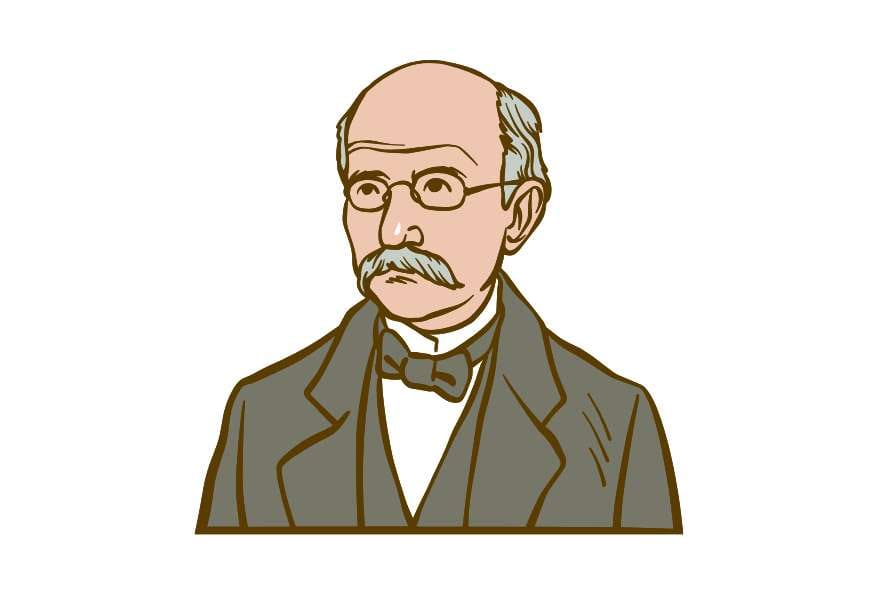
Max Planck (1858–1947) was born in Kiel, Germany, into a family of academics. He studied in Munich and Berlin. By the late 19th century, blackbody radiation measurements failed to match classical predictions, producing the ultraviolet catastrophe.
In 1900, Max Planck proposed that energy could be emitted or absorbed only in discrete packets, or quanta,
with energy E = hν,
where h is Planck’s constant
and ν is the frequency.
Ludwig Boltzmann

Ludwig Boltzmann (1844–1906) formulated the relation S = k ln W, linking entropy to microscopic states. Here S is the entropy, K is the Boltzmann constant and W is the number of microstates.
He suffered harsh criticism and depression, and tragically took his own life in 1906. Boltzmann’s ideas profoundly influenced Planck and quantum theory development.
Planck’s Quantum Theory
Planck did not set out to overthrow classical physics; rather he aimed to resolve the black-body radiation problem. He assumed that oscillators in black-body walls could only exchange energy in discrete amounts, called quanta: E = hν, where h is called Planck’s constant and ν is the frequency of radiations. On October 19, 1900, Planck presented the complete formula for radiations matching experimental data, and on December 14, he provided a physical interpretation. By combining Boltzmann’s statistical ideas with quantization, Planck resolved the ultraviolet catastrophe and certainly laid the foundation for quantum mechanics.
Max Planck 1900 Quantum Hypothesis: Conclusion
The introduction of quantum theory by Max Planck in 1900 marked a profound turning point in both physics and technology. By resolving the long-standing puzzle of black-body radiation through the concept of energy quanta, Max Planck not only addressed the limitations of classical physics but also laid the foundation for an entirely new understanding of nature.
The ripple effects of his work transformed scientific thought and enabled remarkable technological advancements throughout the 20th century, including semiconductors, lasers, nuclear energy, quantum electronics, and modern medical imaging. Beyond technology, quantum theory also reshaped our comprehension of matter, energy, and the fundamental laws of the universe.
Thus, Max Planck’s daring insight into the discrete nature of energy did not merely solve an isolated problem—it opened the door to a scientific revolution, bridging the classical and modern eras and profoundly altering both human knowledge and daily life.
Additionally, to stay updated with the latest developments in STEM research, visit ENTECH Online. Basically, this is our digital magazine for science, technology, engineering, and mathematics. Further, at ENTECH Online, you’ll find a wealth of information.
References:
- Butto, N. (2021). The origin and nature of the Planck Constant. Journal of High Energy Physics Gravitation and Cosmology, 07(01), 324–332. https://doi.org/10.4236/jhepgc.2021.71016
- Author
- Latest Posts
Associate Professor of Physics (Rtd), Nehru Arts and Science College, Kanhangad, Kerala
- Author
- Latest Posts

Dr. Lisha Damodaran is an Associate Professor of Physics at Government Brennen College, Thalassery (Kannur, Kerala), distinguished researcher, and dedicated science communicator. A rank holder during her postgraduate studies, Dr. Lisha earned her Ph.D. in Theoretical Physics from Kannur University, specializing in statistical mechanics and phase transitions within the Ising Model.
With extensive academic experience in higher education, Dr. Lisha’s scholarly work focuses on theoretical physics, computational modeling, and complex systems. Beyond her core research, she is deeply committed to public engagement and science outreach, actively translating sophisticated physical theories and mathematical concepts into clear, intuitive narratives. Her work aims to cultivate scientific temperament, foster critical thinking, and inspire curiosity among students and young researchers.
As an author for ENTECH Magazine, Dr. Lisha shares insightful perspectives on theoretical physics, fundamental scientific principles, and effective science communication, helping bridge cutting-edge research with public understanding.