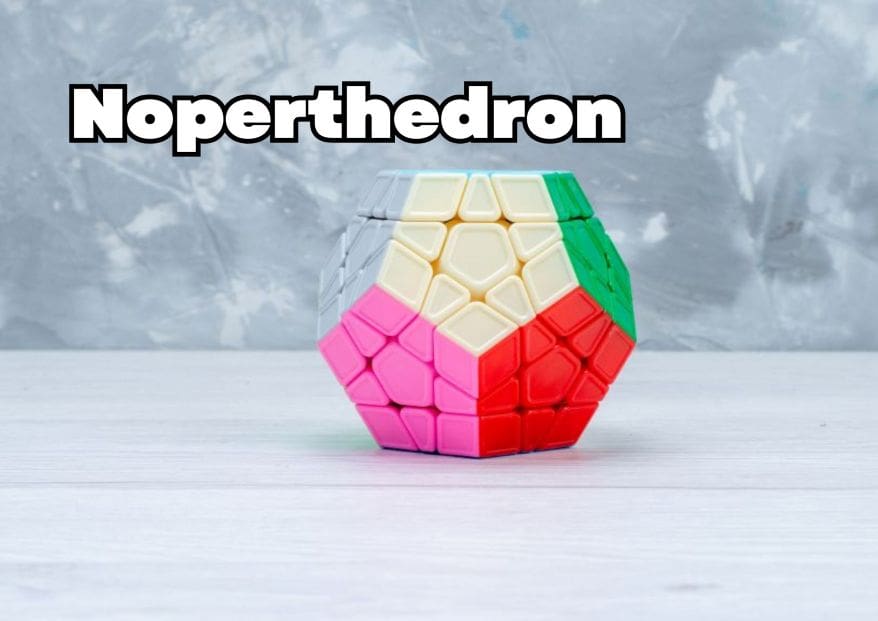
The Noperthedron has 90 vertices, many faces, and unique symmetry. Its design uses advanced geometry and symmetry ideas to make sure the shape resists self-passage.
Noperthedron: The First Convex Shape That Cannot Pass Through Itself
Estimated reading time: 4 minutes
The paper offers an explanation of the Noperthedron, which is a novel sort of geometric solid that, regardless of its orientation, is not allowed to pass through itself with any degree of success. The findings of this study have called into question a number of commonly held ideas, one of which is that all convex shapes might always be able to accommodate this particular “self-passage.”
Jakob Steininger and Sergey Yurkevich conducted this research and published it under the title “A convex polyhedron without Rupert’s property” in August 2025.
ENTECH STEM Magazine has included this research in its list of Top 10 Mathematics Discoveries of 2025.
What Is Rupert’s Property and the Noperthedron?
Rupert’s Property Explained
In geometry, a solid has Rupert’s property if you can cut a straight hole through it and pass another identical copy through that hole. This idea dates back to Prince Rupert of the Rhine in the 1600s. A cube famously has this property because a second cube can be maneuvered through a hole cut inside it.
For a long time, mathematicians assumed that many convex polyhedra (shapes with flat faces and no indentations) would have this property. In fact, most known shapes studied so far do.
The Innovation: The Noperthedron
Meaning, no copy of this shape can pass through another copy of it, even if positioned or rotated in every possible way. This is the first known shape proven to behave this way.
The Noperthedron has 90 vertices, many faces, and unique symmetry. Its design uses advanced geometry and symmetry ideas to make sure the shape resists self-passage.
How This Was Proven
Mathematical Strategy
To show the Noperthedron lacks Rupert’s property, the researchers relied on a mix of mathematics and computation. Specifically, they demonstrated that no matter how you orient the shape, a second copy can never fit through it. Consequently, this proof involves studying all possible orientations and projections of the solid. In doing so, the team bridged the gap between theoretical geometry and high-performance computing.
A computer program checked millions of parameter combinations to determine if one shape could fit inside a projection of another. Strict mathematical rules eliminated each unsuccessful case.
This proof is not just experimental; indeed, the researchers rounded numbers carefully and, furthermore, used rational mathematics to ensure that every case was checked without rounding errors. Additionally, they used the SageMath software to verify all possibilities in the tests.
A Shape That Is Also Rupert in a Different Way
Interestingly, the team also found a related shape that does have Rupert’s property, but only in some orientations and not in others. They call it the Ruperthedron. This shape helped show that geometric properties related to self-passage can vary in subtle ways.
Practical Uses and Real-World Inspiration
While this research is highly theoretical, it matters in several areas:
- Education: Students can explore geometric properties that contradict long-held assumptions.
- Computer Graphics: Understanding shape projections improves 3D modeling and rendering.
- Robotics and Manufacturing: Predicting how objects fit and move through spaces is essential in design and movement planning.
- Mathematical Tools: The proof techniques can help in algorithm design for geometry problems.
This innovation shows how deep geometric rules can influence fields beyond pure mathematics.
What This Means for Students and Future Careers
Students interested in geometry, computer science, and mathematical research can take inspiration from this discovery; accordingly, they might consider exploring the following related areas:
- Computational Geometry: Studying how shapes interact with each other.
- Symmetry and Group Theory: Investigating how symmetry helps in shape design.
- Algorithmic Verification: Using software like SageMath for large-scale verification.
- Mathematics Research: Understanding open problems and exploring new conjectures.
These paths lead to careers in mathematics, computer science, engineering, and scientific research.
When Could This Influence Practical Tools?
Although engineering does not yet directly use the Noperthedron, the methods for proving geometric properties remain relevant today. Tools for geometry processing in robotics and CAD software already use principles related to projections and shape interactions.
Faster and more precise geometry algorithms will improve tools that model physical interactions based on Noperthedron shape properties over the next few years.
Why This Discovery Matters
This research changed a long-standing assumption in geometry of noperthedron. For decades, people believed all convex polyhedra might allow self-passage like the cube does. The Noperthedron proves that assumption wrong, expanding understanding in discrete geometry and shape theory. The combined use of mathematics and computation sets a standard for future proof-based work. Open access to the research paper allows other scientists to build on these ideas and explore new possibilities in shape theory and algorithms. In summary, this discovery shows how even simple questions about shapes can lead to deep insights and open new fields of study.
Additionally, to stay updated with the latest developments in STEM research, visit ENTECH Online. Basically, this is our digital magazine for science, technology, engineering, and mathematics. Further, at ENTECH Online, you’ll find a wealth of information.
Reference:
- Steininger, J., & Yurkevich, S. (2025). A convex polyhedron without Rupert’s property. arXiv (Cornell University). https://doi.org/10.48550/arxiv.2508.18475
- Author
- Latest Posts

I’m a web developer and science writer with a Master’s degree in Computer Applications (MCA) from Pune University.
I work in tech, building websites and staying updated with the latest developments. I also love writing about physics, chemistry, technology, robotics, mathematics, and breakthrough innovations. My passion is breaking down complex scientific topics into simple, easy-to-understand stories.
My goal is to help everyone stay informed about the exciting changes happening in science and technology. I believe understanding science shouldn’t be complicated—it should be accessible to all.