This red giant, known as R Doradus, is just around 180 light-years distant, and a group of researchers from Chalmers University of Technology in Sweden concentrated their attention on seeing it.
New Study Revises How Red Giant Stars Spread Elements for Life
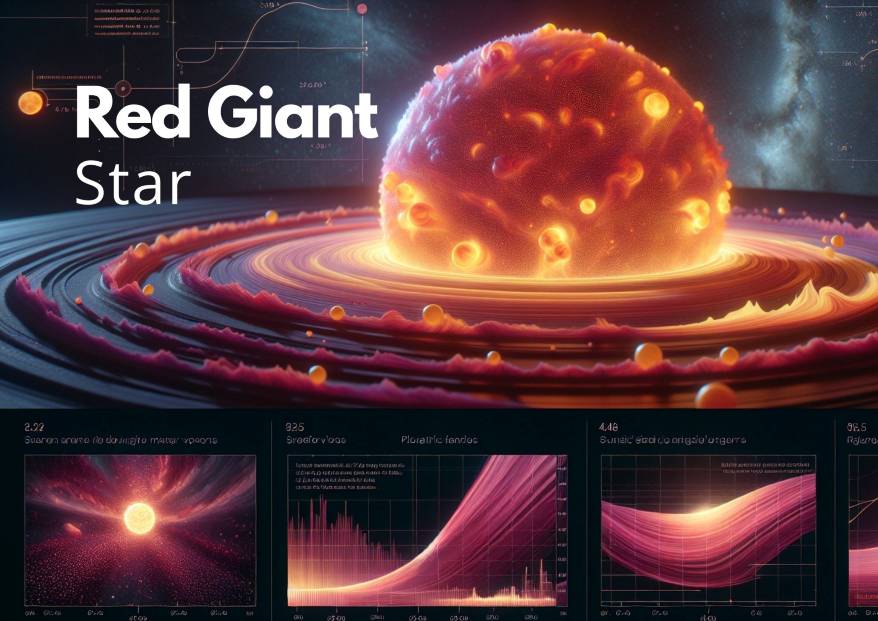
A recent study has shed new light on how red giant stars spread essential elements across the galaxy. For many years, scientists believed that starlight pushing on dust grains launched the strong winds from these stars. However, new observations reveal this explanation might be too simple.
What Are Red Giant Stars?
All of the hydrogen fuel that was contained within the cores of red giant stars has been used up. As a consequence of this, they experience a significant expansion, growing to a size that is several times larger than their initial size. As a component of the life cycle of a star, this phase occurs before the star either disappears or transforms into a white dwarf.
With the help of consistent stellar winds that are packed with gas and dust, red giant stars are able to shed their outermost layers after reaching this stage. The components that are necessary for the formation of planets and, eventually, life itself are carried into space by these winds.
These elements consist of carbon, oxygen, nitrogen, and other essential components that are necessary for the existence of life. To comprehend how the cosmos recycles material, it is essential to have an understanding of how these winds originate.
The Study of R Doradus: A Nearby Red Giant
This red giant, known as R Doradus, is just around 180 light-years distant, and a group of researchers from Chalmers University of Technology in Sweden concentrated their attention on seeing it. R Doradus was an ideal target for extensive observation because of the fact that it is both highly visible and very close.
ESO’s Very Large Telescope, which was equipped with a device known as Sphere, was utilized by the researchers. This allowed them to evaluate the light that was reflected by the dust grains that were located close to the star. In contrast to what was anticipated, these grains were discovered to be far smaller, measuring only around one-tenth of a millimeter in width.
Dust Grain Size Matters
When it comes to the size of these dust grains, it is extremely important since the particles need to be large enough for starlight to exert a substantial amount of force on them to generate stellar winds. It is unfortunate that the small grains that are located around R Doradus appear to be too small for this method to be successful.
A Surprise for Scientists
Strong winds were anticipated by scientists to be caused solely by the pressure of starlight. However, according to these recent discoveries, sunlight does not generate sufficient force to free these extremely small particles from the grasp of gravity.
We thought we had a good idea… It turns out we were wrong,” said lead researcher Theo Khouri (Khouri et al., 2025).
What Could Be Powering These Winds?
The research team put forward several other theories explaining how a red giant star may generate powerful stellar winds. These include the possibility that the wind is being driven outward by dramatic bursts of dust creation or by enormous convective bubbles moving across the surface of the red giant star. Additionally, huge pulsations, which are regular expansions and contractions of the red giant star, were also considered a possible mechanism for accelerating the wind.
Why This Discovery Matters
This discovery not only challenges a long-held belief about how a red giant star loses mass, but it also opens new directions for research in stellar physics. The way a red giant star disperses heavy elements directly affects the formation of planets around younger stars billions of years later.
By gaining a clearer understanding of stellar winds from a red giant star, scientists can better predict how life-supporting elements move through galaxies such as the Milky Way. This knowledge improves models of cosmic evolution and element distribution across the universe.
Additionally, to stay updated with the latest developments in STEM research, visit ENTECH Online. Basically, this is our digital magazine for science, technology, engineering, and mathematics. Further, at ENTECH Online, you’ll find a wealth of information.
Reference:
Schirmer, T., Khouri, T., Vlemmings, W., Nyman, G., Maercker, M., Arbab, B. B., Knudsen, K. K., & Aalto, S. (2025). An empirical view of the extended atmosphere and inner envelope of the asymptotic giant branch star R Doradus. Astronomy and Astrophysics, 704, A4. https://doi.org/10.1051/0004-6361/202556884
- Author
- Latest Posts

I’m a web developer and science writer with a Master’s degree in Computer Applications (MCA) from Pune University.
I work in tech, building websites and staying updated with the latest developments. I also love writing about physics, chemistry, technology, robotics, mathematics, and breakthrough innovations. My passion is breaking down complex scientific topics into simple, easy-to-understand stories.
My goal is to help everyone stay informed about the exciting changes happening in science and technology. I believe understanding science shouldn’t be complicated—it should be accessible to all.