The mystery of Sailing Stones that glide across deserts, leaving trails behind them. Discover how they move naturally.
The Mystery of Moving Sailing Stones
Estimated reading time: 12 minutes
Imagine rocks gliding across a desert floor, leaving trails behind them. This strange phenomenon has puzzled scientists for decades. These “sailing stones” move without human or animal interference, relying on nature’s forces. Thin ice sheets, formed on cold nights, act as slippery sails. Wind pushes these sheets, while water creates a slick surface, allowing stones to glide smoothly. Researchers have even tracked stones traveling over 224 meters in one winter, proving how rare and fascinating this event is.
What are Sailing Stones?

Definition of Sailing Stones
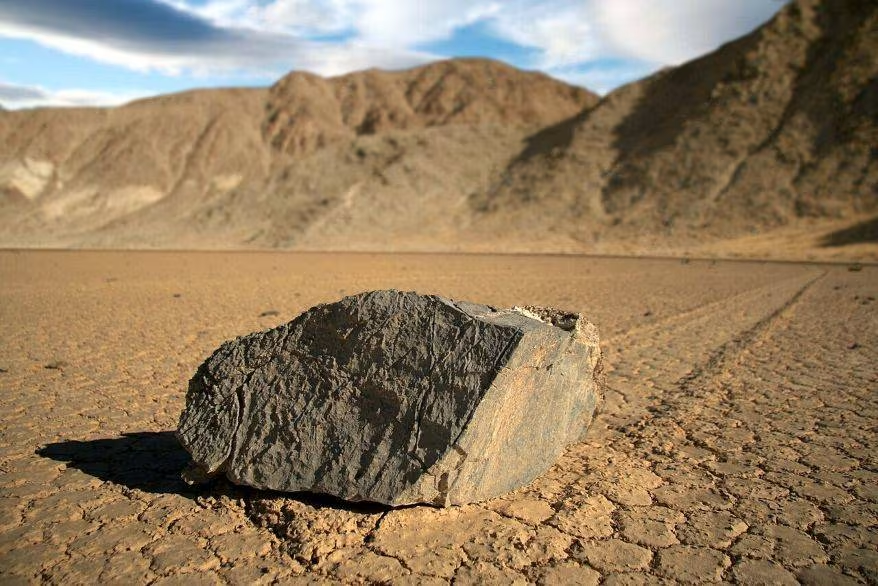
Sailing stones are rocks that mysteriously move across flat desert terrain. You can find them in places like Racetrack Playa in Death Valley, a dry lake bed famous for this phenomenon. Thus, these stones range in size from small pebbles to larger boulders. Yet they all share one fascinating trait—they leave trails behind as they move.
In 2014, researchers Richard D. Norris and James M. Norris conducted groundbreaking studies to explain this movement. Their findings revealed that thin floating ice panels, driven by light winds during winter, are responsible for the stones’ motion. Therefore, this research confirmed the scientific basis of what many call the “Death Valley mystery.”
Unique Movement Patterns
The trails left by sailing stones are one of their most intriguing features. These trails can stretch for several meters, showing the stones’ journey across the playa. What’s even more fascinating is that the movement happens without human or animal interference.
Empirical studies have documented this phenomenon in Racetrack Playa and other locations like Bonnie Claire Playa in Nevada. Researchers found that microbial mats in the soil play a role in facilitating the movement. Thus, these mats destabilize the sediment during storm episodes, allowing the rocks to slide across the surface. Similar processes have been observed in deserts worldwide, including the Tunisian Sahara and South Africa.
In July 1996, scientists used advanced GPS technology to map the trails of 162 moving rocks in Racetrack Playa. They discovered that the trails’ length and shape depend more on the rocks’ starting positions than on their physical characteristics. This mapping also showed how wind direction influences the trails. Moreover, highlighting the importance of environmental factors in this unique phenomenon.
The Science Behind Their Movement
Role of Ice Sheets
Thin ice sheets play a key role in the movement of sailing stones. These sheets form during cold nights when water pools on the desert floor and freezes. The ice acts as a slippery surface, reducing friction and allowing rocks to slide effortlessly.
Scientists have conducted fascinating experiments to understand this process. GPS trackers confirmed that rocks moved slowly, often just a few inches per second. In December 2013, researchers witnessed this phenomenon firsthand. After a storm, water pooled on Racetrack Playa and froze overnight. As the ice cracked into panels, gentle breezes pushed the rocks across the surface. Thus, this rare combination of events proved how ice sheets facilitate the movement of sailing stones.
Wind and Water Dynamics
Wind and water work together to drive the movement of sailing stones. Light winds, blowing at speeds of 3-5 meters per second, push the ice sheets across the playa. Hence, the rocks, embedded in the ice, glide along with it.
Water plays an equally important role. It pools on the desert floor after rainfall, creating the conditions for ice formation. As the ice melts during the day, the water lubricates the surface, making it easier for rocks to slide.
This dynamic interaction between wind and water creates trails that stretch for meters. The trails reveal the direction and force of the wind. Hence, it shows how environmental factors shape the science behind this phenomenon.
Seasonal Nature of Movement
The movement of the sailing stones is a seasonal event. Moreover, it happens primarily in winter, when cold nights and rainfall create the perfect conditions for ice formation. During summer, the stones remain stationary as the playa dries up and temperatures rise.
Researchers have documented multiple movement events during winter months. These events occur when freezing temperatures and light winds align. Therefore, creating the rare conditions needed for rocks to sail.
Thus, this seasonal pattern highlights the delicate balance of nature. The sailing stones remind you of this balance, showing how simple forces can create something extraordinary.
Experimental Evidence
Studies using GPS trackers confirmed stone movement
Scientists didn’t just rely on theories to explain the movement of sailing stones. They used GPS trackers and cameras to gather solid proof. In 2014, researchers at Racetrack Playa attached GPS devices to several stones. Further, they also set up time-lapse cameras to capture their movements over time. This experiment revealed something amazing.
The GPS data showed the stones moved slowly, often just a few inches per second. The cameras recorded their precise paths, speeds, and the environmental conditions during their journey. You could see how wind, ice, and water worked together to push the stones across the playa. These tools provided visual proof that the stones weren’t moving randomly. Instead, their movement followed clear patterns tied to nature’s forces.
Thus, this experiment wasn’t just about tracking rocks. It was about understanding how simple elements like wind and ice create something extraordinary.
Researchers observed stones moving under controlled conditions
Controlled experiments added another layer to the story. Scientists recreated the conditions needed for stone movement in smaller setups. They used thin ice sheets, light winds, and water to mimic the environment at Racetrack Playa.
In one experiment, researchers placed stones on a frozen surface and applied gentle breezes. The stones slid across the ice, leaving trails similar to those found in the desert. Therefore, these tests proved that the combination of ice, wind, and water was enough to move the stones.
What’s fascinating is how predictable the movement became under controlled conditions. The stones didn’t just move. Moreover, they followed specific paths based on wind direction and ice thickness. This showed how nature’s forces work in harmony to create this rare phenomenon.
Thus, these experiments remind you of the beauty of science. They show how curiosity and observation can turn mysteries into knowledge.

Environmental Conditions Required
Temperature
Cold nights are needed for ice formation
Cold nights play a crucial role in the movement of the sailing stones. When temperatures drop, water on the desert floor freezes into thin sheets of ice. These ice sheets act as a slippery platform, reducing friction and setting the stage for the stones to glide. Without these freezing conditions, the stones would remain stationary.
Warm days melt the ice, aiding movement
As the sun rises, the ice begins to melt. Therefore, this midday thaw creates a layer of water between the ice and the ground. The water acts as a lubricant, making it easier for the stones to slide. This combination of cold nights and warm days is essential for the stones’ movement. It’s a delicate balance that nature orchestrates perfectly.
Wind Speed
Moderate winds are strong enough to push stones
Wind is another key player in this phenomenon. Moderate winds, blowing at just the right speed, provide the force needed to move the stones.
A steady, light wind of about 7-10 miles per hour was also needed, but before the ice had completely melted. This wind, timed with the midday melt, pushed massive panes of ice into the stones. When the ice accumulated behind the stones, it generated enough force to set the stones into motion.
Thus, this gentle yet persistent wind ensures the stones glide smoothly across the playa.
Wind direction influences the trails left behind
The direction of the wind determines the path each stone takes. As the wind pushes the ice sheets, the stones follow, leaving trails that mirror the wind’s course. Hence, these trails offer a glimpse into the interplay between natural forces and the environment.
Terrain
Flat, dry lake beds are ideal for movement
Certainly, the terrain is just as important as the weather. Flat, dry lake beds like Racetrack Playa create the perfect conditions for stone movement.
- Geological studies indicate that flat, dry lake beds create low frictional conditions. Thus, these are essential for the movement of stones.
- Microbial mats contribute to sediment destabilization, facilitating the motion of rocks across these surfaces.
- Also, wind-generated water currents play a significant role in transporting rocks on these smooth terrains.
Role of Cyanobacteria
Cyanobacteria in soil may aid in creating slick surfaces
Cyanobacteria, tiny microorganisms found in soil, play a surprising role in the movement of sailing stones. These microscopic organisms thrive in wet environments, forming slimy layers on the ground. This slimy layer reduces friction, making the surface slick enough for rocks to slide. Without this natural “lubricant,” the stones would struggle to move, even with ice and wind.
When water pools on the desert floor, cyanobacteria become more active. Basically, they produce a sticky substance that binds soil particles together. Therefore, this process creates a smoother surface, which helps the stones glide more easily. Think of it as nature’s way of preparing the perfect stage for this rare phenomenon.
A study on cyanobacteria, specifically Planktothrix, revealed how stagnant water conditions boost their activity. Researchers measured chlorophyll-a levels, which indicated higher cyanobacterial growth in still water. The study also found that optimal light conditions in these environments further encouraged their abundance. This highlights how environmental factors, like water and light, influence cyanobacteria’s role in creating slick surfaces.
Their presence contributes to the rare conditions required
The presence of cyanobacteria is essential for the unique conditions that allow sailing stones to move. These microorganisms not only create slick surfaces but also contribute to the delicate balance of the ecosystem. Their activity depends on specific factors like water availability, temperature, and light. Without these conditions, cyanobacteria cannot thrive, and the stones remain stationary.
Interestingly, cyanobacteria face competition from other microorganisms like Chlorophyta in circulating water. However, in stagnant conditions, they dominate and produce the slimy layers needed for stone movement. Thus, this shows how even the smallest organisms can play a big role in shaping natural phenomena.
Cyanobacteria remind us of this truth. They work alongside ice, wind, and water to create the perfect environment for sailing stones. Therefore, their contribution may be small, but it is vital to this extraordinary event.
Famous Locations of Sailing Stones

Racetrack Playa, Death Valley
Most well-known site for sailing stones
Racetrack Playa in Death Valley is the most famous spot for sailing stones. This dry lake bed, surrounded by steep hills, offers a unique environment where rocks glide across the surface. The stones here are made of dolomite and syenite, matching the nearby mountains. Thus, their trails stretch up to 1,500 feet, showing significant movement over time.
The phenomenon has fascinated researchers for over a century. Early observations began in the 1900s, with scientists proposing various theories to explain the stones’ motion. In 2014, time-lapse photography captured the stones moving, confirming the role of ice, wind, and water. This breakthrough study solidified Racetrack Playa’s reputation as the best place to witness this rare event.
Stones here have been studied extensively
The unique conditions at Racetrack Playa make it a natural laboratory for studying sailing stones. Rare rain events fill the playa with water, which freezes during cold nights. Further, when temperatures drop below freezing, large ice floes form around the rocks. These floes, combined with light winds, push the stones across the flat surface.
The playa acts as a catchment area for runoff from the surrounding hills. Snowstorms in winter add to the water levels, creating shallow ponds that persist for days. Moreover, these ponds help maintain the playa’s flatness. Hence, ensuring the stones move smoothly.
Scientists have documented the movement extensively. Time-lapse imagery revealed how melting snow creates the perfect conditions for ice formation. Historical studies mapped trails left by the stones, showing how environmental factors influence their paths. The trails mirror the wind’s direction, offering clues about the forces at play.
Racetrack Playa’s significance goes beyond science. It attracts visitors worldwide, eager to see the trails and learn about the phenomenon.
Why is This Phenomenon Important?
Understanding Natural Processes
Helps scientists study environmental interactions
The sailing stones phenomenon isn’t just fascinating—it’s a window into how nature works. Scientists have discovered that even thin ice sheets can move large stones across the desert floor. This movement happens through sliding, not rolling, thanks to the low friction on wet mud. It’s incredible how such simple elements—ice, wind, and water—combine to create this rare event.
What’s even more exciting is how this phenomenon connects to other environments. Similar rock movements occur in deeper lakes and marine basins when ice breaks apart. By studying these stones, you’re not just learning about deserts. You’re also gaining insights into geological processes that shape our planet. They show how small, natural interactions can lead to big discoveries.
Shows how simple factors create complex results
Nature often surprises you with its simplicity. The sailing stones prove that basic forces can create something extraordinary. Ice forms on cold nights, wind pushes the stones, and water reduces friction. These straightforward factors work together to produce trails that stretch for hundreds of feet.
Therefore, this phenomenon teaches you that complexity doesn’t always require complicated causes. It’s a reminder that the world’s beauty often lies in its simplicity.

Conclusion
Sailing stones move because of ice, wind, and water working together. Their movement happens in winter when rare conditions align perfectly. You can see how nature’s forces combine to create something extraordinary. Scientists have studied this phenomenon for years, proving how simple elements lead to complex results.
Thus, this rare event reminds you of the beauty hidden in natural processes. It’s a testament to how the environment shapes the world around you.
Additionally, to stay updated with the latest developments in STEM research, visit ENTECH Online. Basically, this is our digital magazine for science, technology, engineering, and mathematics. Furthermore, at ENTECH Online, you’ll find a wealth of information.
References
- Norris, R. D., Norris, J. M., Lorenz, R. D., Ray, J., & Jackson, B. (2014). Sliding Rocks on Racetrack Playa, Death Valley National Park: First observation of rocks in motion. PLoS ONE, 9(8), e105948. https://doi.org/10.1371/journal.pone.0105948
- Wagner, R. S., McKindles, K. M., & Bullerjahn, G. S. (2023). Effects of water movement and temperature on Rhizophydium infection of Planktothrix in a shallow hypereutrophic lake. Frontiers in Microbiology, 14. https://doi.org/10.3389/fmicb.2023.1197394
- Lorenz, R. D., Jackson, B. K., Barnes, J. W., Spitale, J. N., Radebaugh, J., & Baines, K. H. (2011). Meteorological conditions at Racetrack Playa, Death Valley National Park: Implications for rock production and transport. Journal of Applied Meteorology and Climatology, 50(12), 2361–2375. https://doi.org/10.1175/jamc-d-11-075.1
- Author
- Latest Posts

Neha Adikane holds a Master’s degree in Environmental Science from Pune University, bringing a unique blend of scientific expertise and creative writing skills to her craft. She specializes in creating engaging, insightful, and impactful content across various niches. With a passion for translating complex ideas into simple, relatable narratives, she excels at crafting blogs, articles, website content, and social media posts that captivate readers and drive engagement. Neha’s background in environmental science adds depth to her writing, allowing her to effectively cover topics related to sustainability, eco-awareness, and scientific innovations.