Vehicle platooning enables self-driving cars to communicate, synchronize speed, and improve road safety through advanced AI and network systems.
Vehicle Platooning: How Self-Driving Cars Talk
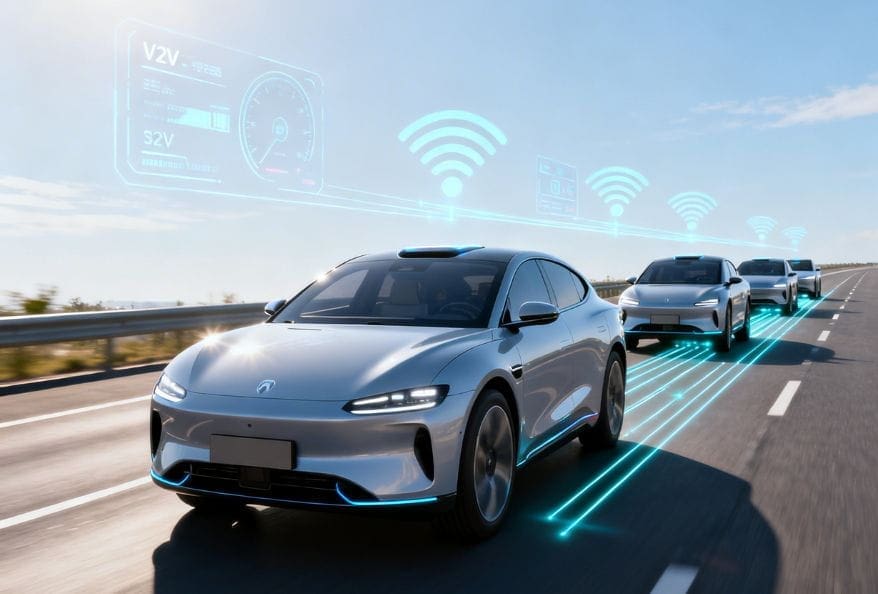
At first, self-driving cars seemed like science fiction. Today, they are becoming a reality on modern highways. One of the most exciting breakthroughs is vehicle platooning, a system where autonomous cars drive closely together while constantly communicating.
Engineers use mathematics, artificial intelligence, and network synchronization to make this possible. As a result, vehicles move efficiently, reduce fuel consumption, and improve road safety. In fact, Synchronized vehicle driving is shaping the future of smart transportation.
What Is Vehicle Platooning?
How Vehicle Platooning Works
Synchronized vehicle driving allows a group of connected cars to travel at the same speed while maintaining a safe, short distance. In other words, the vehicles act like a synchronized team.
For example, when the lead vehicle brakes suddenly, the following cars receive the signal instantly and respond at the same moment. Because of this rapid communication, reaction time improves dramatically. Consequently, the risk of collisions decreases.
Why Vehicle Platooning Matters
Vehicle platooning provides multiple benefits:
- Reduced traffic congestion
- Lower fuel consumption
- Decreased carbon emissions
- Improved highway safety
Therefore, this technology plays a crucial role in sustainable mobility.
Network Synchronization in Vehicle Platooning
How Cars Communicate
Self-driving cars in a vehicle platooning system share real-time data such as speed, braking signals, and road conditions. Similar to computers connected on a wireless network, they exchange information continuously.
However, communication delays or packet loss can create instability. For this reason, engineers design advanced control algorithms to maintain closed-loop stability. As a result, the entire platoon stays coordinated even during disturbances.
Understanding Network Topologies
In Synchronized vehicle driving, network topology defines how cars share information. Some vehicles communicate only with the leader, while others connect with multiple nearby cars.
Although sharing more data improves coordination, too much communication may overload the system. Therefore, engineers carefully optimize data flow to balance performance and efficiency.
The Role of Artificial Intelligence in Networked Vehicle Coordination
Artificial intelligence significantly enhances vehicle platooning systems. For instance, AI predicts traffic congestion before it occurs. In addition, it analyzes road conditions and suggests alternate routes.
If a sudden road closure happens, AI can quickly reroute the entire platoon. Because machine learning adapts over time, the system becomes smarter with experience. Consequently, transportation becomes safer and more efficient.
Cybersecurity in Networked Vehicle Coordination
Since modern vehicles function like computers on wheels, cybersecurity is essential. Hackers could attempt to send fake signals or disrupt wireless communication.
To prevent such threats, engineers implement encryption, secure wireless protocols, and digital firewalls. As a result, malicious data is blocked before affecting the system. In short, security remains a top priority in vehicle platooning development.
STEM Careers Behind Vehicle Platooning
Cooperative driving systems integrates multiple engineering disciplines, including:
- Mechanical Engineering
- Electrical Engineering
- Computer Science
- Artificial Intelligence
- Cybersecurity
Although mathematics can be challenging, it forms the foundation of these technologies. Moreover, collaboration between different engineering teams ensures system reliability.
Students interested in robotics, coding, or physics can explore exciting careers in this field. Eventually, they may design next-generation smart transportation systems.
Environmental Benefits of Cooperative Driving Systems
Vehicle platooning reduces aerodynamic drag when cars travel closely together. Consequently, fuel efficiency improves significantly. In addition, lower fuel consumption means fewer carbon emissions.
Given global climate challenges, sustainable transportation solutions are increasingly important. Therefore, networked vehicle coordination contributes to reducing environmental impact while improving mobility.
Research and Innovation
Recent research highlights advanced control solutions for vehicle platooning using network synchronization methods. Researchers treat vehicles as dynamic systems and test algorithms extensively in simulations before real-world deployment.
Despite challenges such as network delays and signal dropouts, progress continues steadily. As technology advances, large-scale adoption becomes more realistic.
The Future of Vehicle Platooning
Traditional vehicles operate independently. In contrast, vehicle platooning enables connected cars to think and respond collectively. They detect obstacles, adapt to traffic conditions, and communicate instantly.
Although technical challenges remain, the potential benefits are enormous. With continued innovation, networked vehicle coordination will likely become standard on highways worldwide.
Additionally, to stay updated with the latest developments in STEM research, visit ENTECH Online.
Reference
Hanif, O., Gruber, P., Sorniotti, A., & Montanaro, U. (2026). A Review of Control Solutions for Vehicle Platooning via Network Synchronisation Methods. Automation, 7(1), 35. https://doi.org/10.3390/automation7010035
- Author
- Latest Posts

Kottauppari Venkat Raghava
I am a technology-driven IT graduate with a strong passion for science and innovation. I am fascinated by how innovations like artificial intelligence, robotics, and emerging technologies are shaping our world. I specialize in analyzing complex scientific and technological research and presenting it in a clear, accessible way. My goal is to make science and technology understandable and engaging for students, tech enthusiasts, and professionals alike. By breaking down advanced concepts into simple, insightful narratives, I strive to inspire curiosity, learning, and innovation, helping readers stay informed about the breakthroughs that are shaping the future.