A revolutionary tiny AI brain is transforming weld defect detection by spotting hidden cracks and pores with over 99% precision—faster than ever before.
Weld Defect Detection: Tiny AI Brain Spots Hidden Flaws
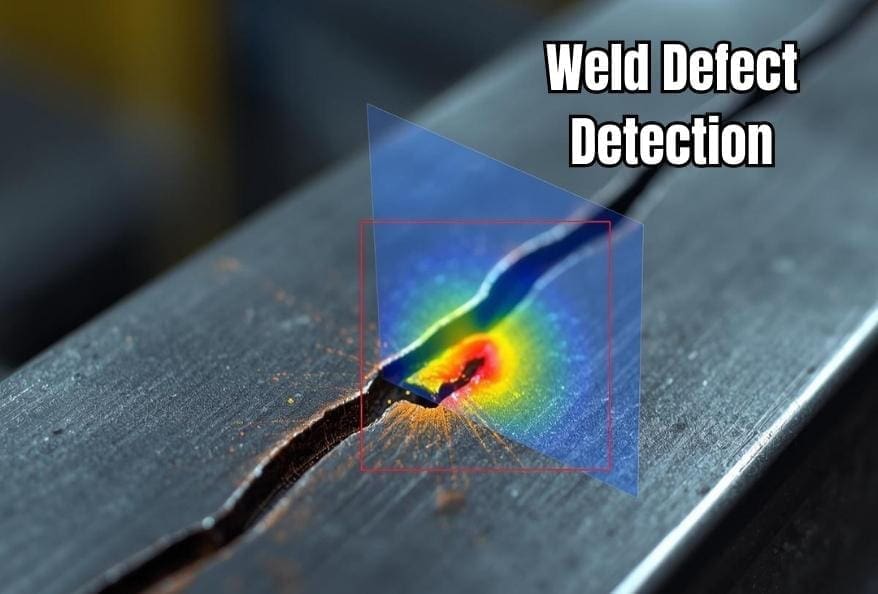
Weld defect detection is becoming one of the most important safety technologies in modern engineering. At the present time, engineers build massive metal structures everywhere, from bridges to factories and pipelines. These structures depend on strong welds. However, even a weld that looks perfect can hide microscopic cracks or tiny pores.
As a result, poor weld defect detection can lead to dangerous structural failures. With this in mind, scientists developed a tiny AI brain that can spot hidden flaws faster and more accurately than humans.
The Growing Need for Weld Defect Detection
To begin with, weld defects vary widely in shape and size. Some appear as tiny round pores. In contrast, others stretch into long, thin cracks across the metal surface.
Traditional computer vision tools struggle with this variety. For instance, small pores may disappear during image processing. Meanwhile, long cracks confuse models that are designed to detect box-shaped objects. Therefore, accurate weld defect detection requires a smarter approach.
Why Older AI Models Struggled
Many engineers rely on the well-known object detection system YOLO (You Only Look Once). In general, YOLO is extremely fast and efficient. However, earlier versions had difficulty identifying very small or extremely thin weld defects.
The core issue was directional sensitivity. Standard AI models treat all directions equally. Yet cracks typically extend in one dominant direction. Consequently, older systems often missed subtle linear flaws.
Because of these limitations, researchers enhanced YOLOv11 specifically for weld inspection.
The Breakthrough: YOLOv11-Weld for Weld Defect Detection
WeldSimAM: Smarter Attention
Researchers introduced WeldSimAM, inspired by SimAM. This lightweight attention module acts like a magnifying lens for AI.
Specifically, it enhances the model’s ability to focus on directional features. As a result, horizontal and vertical crack patterns become easier to detect. Moreover, WeldSimAM adds almost no extra computational burden. Therefore, speed remains exceptionally high.
EnNWD: Solving the Size Problem
Another improvement comes from EnNWD, based on Normalized Wasserstein Distance. This enhanced loss function helps the AI understand scale differences between defects.
For example, tiny pores and large fusion errors differ dramatically in size. Without proper scaling awareness, models may ignore small defects. However, EnNWD teaches the system to treat both large and small flaws accurately. Consequently, overall weld defect detection performance improves significantly.
Real-World Performance That Impresses
In extensive testing, the upgraded model achieved over 99% precision. In addition, it processes images at up to 132 frames per second. That means inspections happen in real time on production lines.
Because the system is lightweight, it runs efficiently on small edge devices. Therefore, factories can deploy it directly on-site without expensive infrastructure upgrades. Not only does this improve safety, but it also reduces operational costs.
Why Weld Defect Detection Matters for the Future
Strong welds protect bridges, vehicles, buildings, and pipelines. When AI enhances weld defect detection, it directly protects human lives. Furthermore, machine learning identifies patterns that humans may overlook.
For students interested in STEM, this technology highlights the power of combining math, computer science, and engineering. In the coming years, intelligent inspection systems will become standard across industries.
Therefore, learning about AI today opens doors to future innovation. You could help design the next generation of safety systems.
Final Thoughts on Weld Defect Detection
In summary, WeldSimAM and EnNWD transformed modern weld defect detection. By upgrading YOLOv11, researchers built a tiny yet powerful AI brain that detects hidden metal flaws with remarkable accuracy and speed.
As AI continues advancing, industrial safety becomes smarter, faster, and more reliable. Ultimately, this breakthrough ensures that the structures we rely on every day remain strong and secure.
Additionally, to stay updated with the latest developments in STEM research, visit ENTECH Online.
Reference
Huang, W., Cheng, Q., & Zhu, J. (2026). WeldSimAM and EnNWD Co-Optimization: Enhancing Lightweight YOLOv11 for Multi-Scale Weld Defect Detection. Technologies, 14(3), 140. https://doi.org/10.3390/technologies14030140
- Author
- Latest Posts

Kottauppari Venkat Raghava
I am a technology-driven IT graduate with a strong passion for science and innovation. I am fascinated by how innovations like artificial intelligence, robotics, and emerging technologies are shaping our world. I specialize in analyzing complex scientific and technological research and presenting it in a clear, accessible way. My goal is to make science and technology understandable and engaging for students, tech enthusiasts, and professionals alike. By breaking down advanced concepts into simple, insightful narratives, I strive to inspire curiosity, learning, and innovation, helping readers stay informed about the breakthroughs that are shaping the future.