Explore the benefits of OCR for students and how it can enhance study efficiency by transforming images into editable text.
What Is OCR Technology and How Can It Help Kids Study?
Estimated reading time: 5 minutes
OCR or optical character recognition is a powerful technology that solves a crucial problem with computers. It allows them to “read” text from images. Now, that may not sound impressive, but you have to understand, an image to a computer is just a graph of colored pixels. It doesn’t matter to the computer that the pixels create a landscape, a portrait, or some text; it is all the same to it.
With OCR, the computer can learn that certain configurations of pixels are actually letters. Then it can extract them into a form where it can manipulate them with word processors.
This technology has a lot of uses today. Quite a few of them are in education and learning. So, let’s see how students can use it for studying.
How OCR Helps Kids Study Better
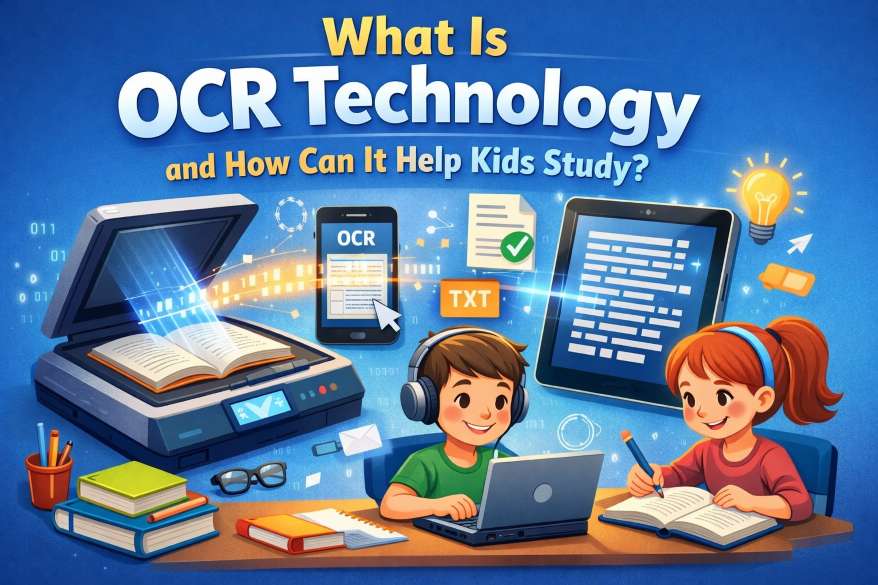
Today, OCR technology is most commonly available in the form of image to text converters. These are tools that use OCR to extract text from images and provide it in TXT or DOCX formats. These formats are easier to edit and manipulate than images. They are also compatible with other software such as screen readers, summarizers, paraphrasers, etc.
This means that students can interact with images of text in a variety of ways. Let’s see how that can help kids with their studies.
1. Makes Studying More Accessible
Reading difficulties are quite common in younger kids. They may suffer from dyslexia, or more commonly, some kind of attention disorder. Both result in kids not being able to read smoothly.
So, how can OCR help with that? Well, teachers and parents can take images of the printed books and written notes that students need to read and run them through an image to text converter. The OCR engine converts the images back into text (but this time in digital form), and then that text can be run through a text-to-speech software that kids can listen to.
Reading can be improved massively if kids can hear the words they are trying to read. It wires their brains to match the sounds to the letters and recognize them more easily.
So, in the long term, their reading capabilities blossom and become more fluid.
2. Saves Time When Taking Notes
In higher grades, taking notes becomes more stressful and time-consuming. Students focus more on noting down whatever is written on the board/lecture slides instead of trying to understand what’s being explained. This hampers their ability to understand the topic and related concepts.
To bypass this problem altogether, students can use OCR technology. All they have to do is obtain the lecture slides or take pictures of the board/slides. Then run them through an OCR tool, and voila, you have ready-made notes that need just minor editing and formatting to work.
This allows students to focus more on understanding concepts rather than copying information.
3. Improves Organization and Revision
Another way OCR technology can help kids learn and study better is by making it easier for them to organize and edit their notes. For older kids who are sufficiently computer-savvy, you can teach them how to create digital notes from their handwritten ones using OCR.
As always, the method is to take pictures of the notes and upload them to an image to text converter, which then uses OCR to create digital copies instead.
The digital copies have a few major advantages over handwritten ones:
- They are easier to edit. Nothing needs to be cut or overwritten with ink. So the final result is clean. You can always add more content later to make the notes more comprehensive.
- They are easier to organize. You can name the notes according to the date you took them, the subject name, and the topic. Later, you can search for them using those names.
This not only makes students better at studying but also prepares them for success in an increasingly technology-driven world by acclimating them to computers.
4. Supports Remote and Digital Learning
One of the greatest advantages of OCR for kids today is supporting remote and digital learning. After the 2019-2020 COVID debacle, many institutes switched to remote learning. Even after things normalized, remote learning didn’t vanish. Many found it to be easier and better than traditional classroom learning.
Nowadays, it is quite a common option in many schools and colleges. Students in such institutions can use OCR quite effectively. They can use it to digitize parts of their textbooks for creating notes and study materials.
Some students aren’t proficient at typing, so they can use OCR to convert their handwritten assignments into digital copies that they can submit to their teachers or learning portals.
All of that is possible due to OCR.
Final Thoughts
OCR is a wondrous technology, and its applications in science and education are numerous. Today, we just covered a few different uses of OCR suitable for students and kids.
Modern tools that employ OCR are typically free and easy enough to use even by non-technical people. That’s why kids and their parents/teachers can easily learn to use such tools and benefit from them.
Additionally, to stay updated with the latest developments in STEM research, visit ENTECH Online. Basically, this is our digital magazine for science, technology, engineering, and mathematics. Further, at ENTECH Online, you’ll find a wealth of information.
- Author
- Latest Posts

Kottauppari Venkat Raghava
I am an Information Technology graduate (B.Tech) and a technology writer specialising in artificial intelligence, robotics, automation, and space technologies. I analyse complex scientific research and convert it into clear, practical insights for students, tech enthusiasts, and professionals. My work bridges the gap between academic research and real-world understanding by simplifying findings from peer-reviewed journals into engaging, easy-to-follow content. Alongside my writing, I have hands-on experience developing real-world projects, showcased on my GitHub, including an Expense Tracker web application for managing and visualising spending, and a Simple Video Summariser that generates concise insights from video content using automation techniques. I also produce research-driven articles on topics such as AI-powered corrosion detection, deep learning in engineering, and advanced automation systems. I follow a research-driven approach, ensuring every article is grounded in verified sources, industry knowledge, and practical applications. My goal is to make advanced technology accessible and meaningful, helping readers stay informed about innovations shaping the future.