February may be short, but it’s packed with historical events in science and technology. Discover milestones from Luna 9’s Moon landing to the invention of nylon and the first general-purpose computer.
Time Capsule: February

February may be the shortest month of the year, but it has witnessed groundbreaking steps in science and technology. From the unveiling of the first general-purpose computer to the discovery of new ways to explore the Moon, the month stands as a reminder of human curiosity and ingenuity. By revisiting historical events in February, we uncover stories of invention, discovery, and innovation that shaped the modern world.
February 2, 1935
Leonarde Keeler tests the first polygraph machine
On February 2, 1935, American scientist Leonarde Keeler demonstrated the first polygraph machine during a criminal investigation. His device, designed to record physiological changes such as heart rate and blood pressure, was used to secure a conviction. The invention brought new attention to the possibilities of scientific tools in law enforcement.
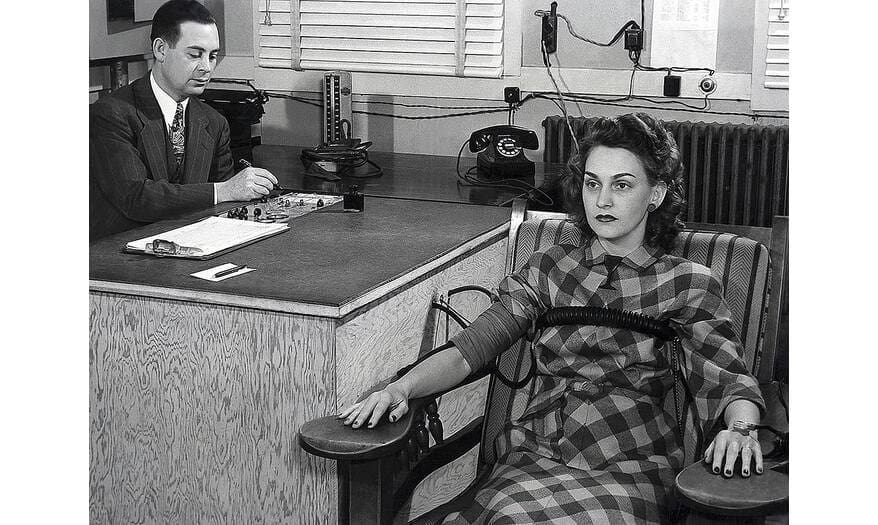
Although the polygraph’s accuracy has been debated, Keeler’s test marked a shift in how technology could intersect with justice. The device inspired further research into lie detection, psychology, and biometric monitoring. Even today, polygraph testing remains controversial, but its legacy underscores how science can raise questions not only of accuracy but of ethics and fairness in society.
February 3, 1966
Soviet Luna 9 makes the first soft landing on the Moon
On February 3, 1966, the Soviet Union’s Luna 9 spacecraft became the first to achieve a controlled landing on the Moon. Unlike earlier missions that crashed into the surface, Luna 9 touched down gently and transmitted panoramic images back to Earth. These images revealed that the Moon’s surface was firm enough to support spacecraft, resolving concerns that landers might sink into deep lunar dust.
This success was a milestone in the space race. It demonstrated advanced engineering, showcased the Soviet Union’s capability, and provided critical knowledge for future missions. Luna 9’s achievement laid the groundwork for later crewed landings, proving that controlled descent and survival on another world were possible.
February 4, 1936
Radium-E becomes the first synthetic radioactive isotope
On February 4, 1936, physicists announced the creation of Radium-E (bismuth-210), the first radioactive isotope to be synthesized artificially. Until then, radioactive elements were known only from natural sources, but laboratory production opened new pathways for research.
The ability to create isotopes expanded the study of nuclear physics and medicine. Artificial radioisotopes became essential in cancer treatment, diagnostic imaging, and scientific experiments. This step also foreshadowed the growing importance of nuclear technology, from energy production to global politics.
February 10, 1996
Deep Blue defeats Garry Kasparov for the first time
On February 10, 1996, IBM’s Deep Blue defeated world chess champion Garry Kasparov in one game of a six-game match. Though Kasparov ultimately won the match, Deep Blue’s single victory marked the first time a computer beat a reigning world champion under standard chess tournament conditions.
The moment was symbolic of the growing power of computing. Deep Blue used brute-force calculations to analyze millions of possible moves per second, showing how machines could challenge human intuition in complex tasks. It became a milestone in artificial intelligence research and fueled debates about the role of machines in human creativity and decision-making.
February 12, 1876
Alexander Graham Bell applies for the telephone patent
On February 12, 1876, Alexander Graham Bell filed his application for a patent on the telephone. Within weeks, his invention would prove capable of transmitting clear speech across wires, transforming communication forever.
The telephone accelerated global connectivity. It eliminated the delays of written correspondence, reshaped business practices, and altered daily life. Bell’s work also demonstrated the value of patents in protecting and commercializing innovation, spurring competition and rapid technological progress.
February 13, 1880
Thomas Edison observes the Edison effect
On February 13, 1880, Thomas Edison observed a curious phenomenon while experimenting with electric lamps. He noticed that current could flow from a heated filament to a metal plate inside a vacuum bulb—a process later called the Edison effect.
Although Edison did not fully understand its significance, the observation became the basis for vacuum tube technology in the early 20th century. Vacuum tubes enabled radio, television, and the first electronic computers. The Edison effect illustrates how accidental discoveries can spark revolutions far beyond their original context.
February 15, 1946
ENIAC was unveiled at the University of Pennsylvania
On February 15, 1946, the Electronic Numerical Integrator and Computer (ENIAC) was unveiled at the University of Pennsylvania. ENIAC was the first general-purpose electronic computer, capable of performing thousands of calculations per second.
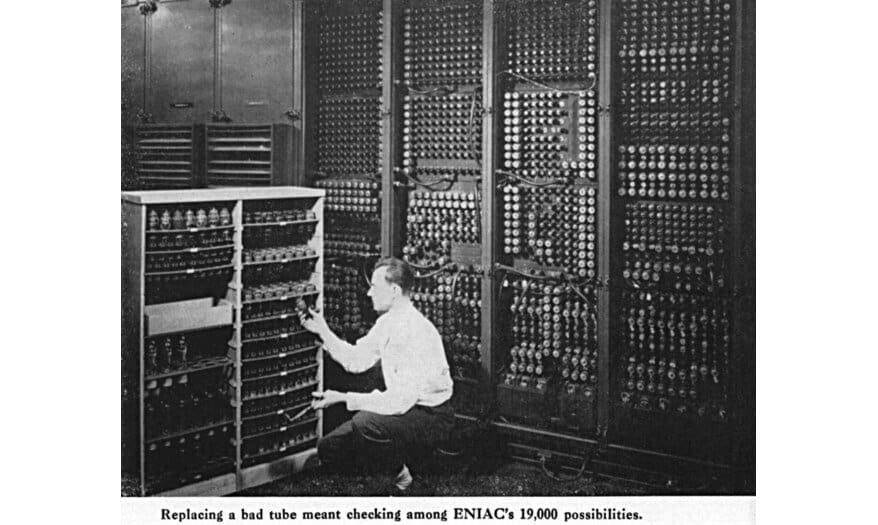
Originally designed for military purposes, ENIAC quickly showed potential beyond ballistics. It pioneered the digital age, inspiring research into programmable computers and shaping the evolution of computing architecture. From business to science, ENIAC’s influence remains visible in every digital device we use today.
February 28, 1935
Wallace Carothers invented nylon
On February 28, 1935, chemist Wallace Carothers and his team at DuPont synthesized nylon, the first fully synthetic fiber. Nylon offered durability, elasticity, and resistance to wear, making it revolutionary for textiles.
Its introduction transformed industries ranging from clothing to military equipment. During World War II, nylon replaced silk in parachutes and ropes, demonstrating its strength under pressure. After the war, nylon stockings became a consumer sensation, cementing the fiber’s place in everyday life.
Nylon also symbolized the power of industrial chemistry, showing how science could create entirely new materials to meet human needs. It remains one of the most important synthetic polymers in use today. And of course, its discovery is one of the major historical events in February.
Conclusion
From the birth of synthetic fibers to the dawn of modern computing, historical events in February highlight human ingenuity at its finest. Each step, from Keeler’s polygraph to Carothers’s nylon, pushed science and technology into new territory. February may be short, but its contributions are long-lasting, shaping the way we live, communicate, and explore.
Additionally, to stay updated with the latest developments in STEM research, visit ENTECH Online. Basically, this is our digital magazine for science, technology, engineering, and mathematics. Furthermore, at ENTECH Online, you’ll find a wealth of information.
References:
- Wolfe, A. J. (2008, October 3). Nylon: A revolution in textiles. Science History Institute. https://www.sciencehistory.org/stories/magazine/nylon-a-revolution-in-textiles/
- Computer History Museum. (n.d.). Birth of the computer. https://www.computerhistory.org/revolution/birth-of-the-computer/4/78/317
- EDN Network. (2019, February 2). Polygraph first used to get a conviction, February 2, 1935. https://www.edn.com/polygraph-first-used-to-get-a-conviction-february-2-1935/
- Author
- Latest Posts

I am currently pursuing Masters degree in Chemistry from the University of Lucknow, and I hold a keen interest in both the subject and its broader applications. With a particular fascination for physical and organic chemistry, my academic path is complemented by a passion for science communication and writing.
I am also actively involved in extracurricular activities, especially public speaking, and debates, where I learned to think clearly and communicate effectively. These experiences have been instrumental in developing my confidence, critical reasoning, and a sense of responsibility toward effective knowledge-sharing.
My skill set includes research writing and editing, and of course, a constant zeal to learn more from everybody. Alongside academics, I enjoy reading poetry and history. My hobbies include singing and gardening.
I have participated in platforms that support women in science, such as IUPAC’s Global Women’s Breakfast. These engagements have helped shape my perspective and strengthened my resolve to contribute positively wherever possible.